Get Full Government Meeting Transcripts, Videos, & Alerts Forever!
Get email alerts on the Energy Infrastructure topic
No spam. Unsubscribe anytime.
McLeod County tables decision on Glencoe Light & Power expansion after neighbors press for screening and noise study
Summary
County commissioners heard about a conditional use permit to add three 3,100 kW diesel generators at a Glencoe substation. Neighbors asked for immediate screening and an EMF/noise study; the board voted 4-1 to table the permit for two weeks to allow a screening plan and applicant waiver.
McLeod County commissioners on April 1 voted 4-1 to table consideration of Conditional Use Permit 25-03, requested by Glencoe Light & Power, after lengthy public comment about screening, noise and potential health concerns.
The permit would allow installation of three new 3,100-kilowatt Caterpillar diesel generators (9.3 megawatts total) inside a new roughly 60-by-101-foot building on a 2.67-acre parcel in the northwest quarter of Section 17 in Helen Township, at 10975 Diamond Avenue, Glencoe.
County environmental services staff (Mister Teleki) told the board that Helen Township and the McLeod County Planning Commission recommended approval with conditions: restore drainage tile and patterns to preconstruction condition and provide a portable restroom during construction. The planning commission had tabled the request earlier to give the applicant additional time to work with surrounding landowners.
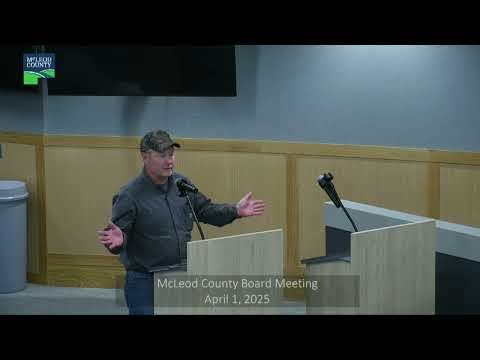
Neighbors who live along Diamond Avenue said the existing substation and the proposed expansion affect their view and prompted concerns about visual screening, noise and electromagnetic fields (EMFs). "I am here, not in opposition to the expansion, but... I respectfully ask that the county require, as a condition of approval, that the applicant install screening between its facility and the neighboring properties," resident Sandy Harmon told the board. Harmon asked for solid, immediate screening such as a cinder block wall rather than plantings that may take decades to provide effective cover.
Neighbor David Paulzine measured the right-of-way and the distances from the road to the facility and argued there is room for a screen on three sides of the fenced substation footprint. He asked the board to require a 15-foot-high barrier to reduce visibility and sound.
Dave Meyer, representing Glencoe Light & Power, said the generators will be housed inside the insulated building and that Light & Power's engineers estimated a worst-case sound level of about 55 decibels at the nearby intersection when all three units were running. Meyer said the generators are expected to run only infrequently — "in the 15 years I've been with Light and Power, we don't have an engine at our plant that's run more than 35 hours in a year" — and that diesel tanks will be double-walled with spill plans and Minnesota Pollution Control Agency permitting in place. He also said installing a permanent 15-foot fence would be expensive and could complicate transmission-line easements and maintenance.
Commissioners discussed alternatives including slats in the existing chain-link fence, live screening on private property, and noise attenuation features. County staff noted the board has authority to require screening but that previous practice and legal advice limited requiring living screening on private land without easements because the utility could not guarantee maintenance.
Commissioner Krueger moved to table the application for two weeks to give the applicant and neighbors time to develop a screening proposal; Commissioner Wright seconded. The roll call vote was Krueger — yes; Wright — yes; Schmalz — yes; Chaska — no; Nagel — yes. The board also discussed that, under state statute, the county must act within 60 days on the permit unless the applicant signs a waiver; staff said the applicant had signed the original 60-day waiver and would need to sign a definite waiver to extend the review period.
The planning commission’s recommended conditions (repair tile, provide onsite portable restroom) and the two conditions recorded in staff materials remain part of the file. The board asked the applicant to return with a written screening proposal and said it would expect the applicant to sign a definite time-extension waiver before the next meeting.
The tabling vote leaves the conditional use permit unresolved; the applicant has been asked to provide a definite waiver and a screening/noise mitigation plan for the board’s next meeting.
Notes: The applicant told the county it has obtained required permitting from the Minnesota Pollution Control Agency for air-related aspects of the diesel engines; the county’s authority for noise is informed by Minnesota rules cited in staff materials (utility noise area classifications), and local staff cited planning commission findings when recommending conditions.