Get Full Government Meeting Transcripts, Videos, & Alerts Forever!
Get email alerts on the Energy Policy topic
No spam. Unsubscribe anytime.
JFAC debates $24.5M home energy rebates and governor’s ‘speed council’; multiple motions fail to secure majority
Summary
The committee debated an OEMR request to accept federal Home Energy Rebate funds and to create a Governor’s Speed Council. Committee members split repeatedly on motions; the package including large federal rebates and council funding failed to secure majority approval in committee votes during the session.
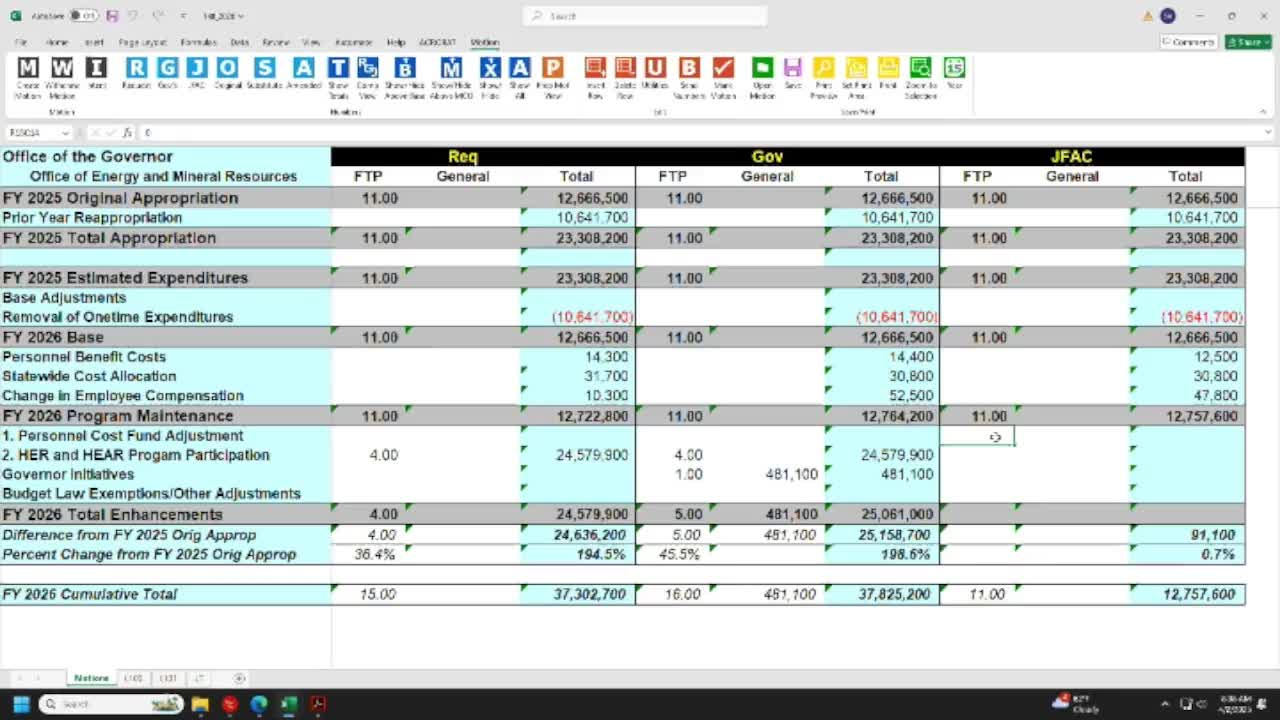
The Joint Finance‑Appropriations Committee considered three related requests from the Office of Energy and Mineral Resources (OEMR): (1) federal funds to administer the Home Energy Rebate program, (2) a fund shift between dedicated accounts, and (3) creation and funding for a governor’s “Speed Council” to streamline permitting and track large infrastructure projects.
Kellen McGurkin, Legislative Services, summarized OEMR’s FY2026 requests. OEMR asked for an ongoing federal appropriation of $24,500,000 to administer the Home Energy Rebate program, including $20,000,000 in trustee/benefits for direct rebates, $4,000,000 for a third‑party implementer and $502,000 for personnel (4 limited‑service FTP). The program was created under the Inflation Reduction Act of 2022; McGurkin said no state match was required and, under current federal rules, funds allocated to a state that declines them are reallocated to participating states.
The governor’s recommended package included a Speed Council and related funding: 1 FTP and $481,100 from the general fund (a mix of ongoing and one‑time amounts in different motions). Callie Younger, OEMR administrator, described the Speed Council as focused on critical minerals and permitting reform and said the council would develop a public dashboard to track project timelines. Committee members questioned whether the council’s purpose (fast permits for critical minerals) meshed with the energy rebates’ conservation focus; discussion included whether the president and federal agencies support the council concept.
Committee members offered multiple motions with different funding levels for the Speed Council and for the Home Energy Rebate implementation. Several iterations failed to achieve the required majority on both sides of the committee. On one roll call the combined motion (rebates plus council funding) failed to gain majority support in both chambers; subsequent amended motions that reduced or altered the funding level for the council also failed to secure a house majority though some scored a senate majority. One final committee motion to fund a smaller, $480,900 one‑time council appropriation recorded a senate majority but the house did not reach the required affirmative majority; the committee left the item open for later consideration.
Why it matters: accepting the federal home energy rebate funds would authorize Idaho to receive and administer tens of millions of dollars for household energy efficiency upgrades. The Speed Council would be a new cross‑agency mechanism to accelerate permitting for critical‑mineral and other large energy projects; creation of the council would add new state administrative responsibilities and cost.
Quotation: Callie Younger, OEMR administrator, said, “Our mission is really to focus on critical minerals. We've seen a 40% increase since 2021 in mining projects in the state.”
Next steps: JFAC did not secure a final affirmative majority for the full package during the hearing; the item may be reintroduced or reconsidered later in the session.