Get Full Government Meeting Transcripts, Videos, & Alerts Forever!
Get email alerts on the Zoning Quarterquarter topic
No spam. Unsubscribe anytime.
Houston County pauses on changing one‑per‑quarter zoning rule after extended public debate
Summary
After more than an hour of public comment and commissioner discussion, the county board took no immediate action on a proposal to allow additional dwellings on quarter‑quarter parcels, instead directing committees to gather further information and public input.
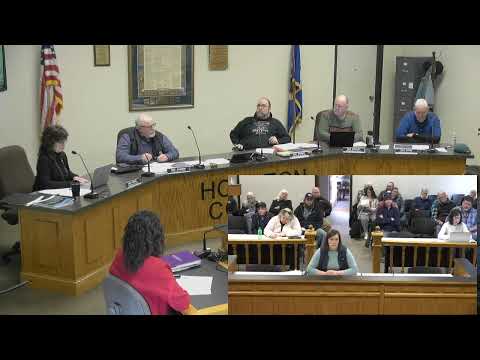
The Houston County Board of Commissioners heard more than an hour of public comment and extended discussion on a possible change to the county’s “one‑per‑quarter” zoning rule but took no formal action, leaving the rule in place for now.
The debate centered on a proposed change—often described at the meeting as allowing “two per quarter” or “2 per 40”—that would let additional dwellings be built on agricultural quarter‑quarter parcels. The matter drew residents, township officials and several commissioners into a broad discussion about farmland protection, property values and the county’s comprehensive land‑use goals.
The issue matters because the county’s comprehensive land‑use plan emphasizes preserving prime agricultural land and limiting rural development. Commissioners and residents repeatedly invoked that plan and survey results when weighing whether to alter the ordinance adopted about a year and a half ago.
Public commenters urged opposite outcomes. George Johnson of La Crescent Township asked directly, "why are we trying to change this from 40 to 20?" and warned that lowering the minimum would encourage outside developers to buy and subdivide farmland. Shane Schumacher of Mount Prairie urged commissioners to consider conflicts of interest and long‑term effects on agriculture, asking: "If that producer was on a governing body, would it be fair to the rest of the county if he was trying to change county policy to further his own business?"
Commissioner Myrie said she supported easing the rule in at least some cases so grown children could return to family farms, telling the board she “can’t see anything wrong with that,” and noting that returning residents could add tax revenue and help care for aging relatives.
County planning staff and board members urged caution. Planning staff reported the county’s 2023 comprehensive plan survey results showed the question of allowing additional dwellings returned mostly neutral results but “kind of on the strongly disagree side,” and noted only about 200 people completed the countywide survey. Staff and several commissioners said the comp plan’s outreach and the plan itself recommend protecting the agricultural district and encouraging growth from within cities.
Commissioners discussed next steps rather than enacting a policy change at the meeting. A motion to proceed immediately with studying a “2‑per‑40” change was made but "died for lack of a second," and the board directed the land‑use committee and the board’s work group to research how many buildable quarter‑quarter parcels exist, review neighboring counties’ approaches, and return with options and additional public engagement. County staff said a survey of buildable quarter‑quarters is underway.
Board members emphasized the formal process for any ordinance change—planning commission review, public notice and hearings—and several commissioners said they favored additional public hearings before any change is adopted. One commissioner asked staff to tell callers the ordinance remains unchanged while the board studies the issue so residents do not assume a near‑term change.
The discussion also touched on related concerns: potential increased demand for township road maintenance, proximity conflicts between new dwellings and feedlots (Wilmington Township currently has a moratorium related to feedlots and new dwellings), property‑value changes, and the possibility that incremental changes could erode farmland protections over decades.
The board concluded by placing further work on committee agendas and scheduling follow‑up research and public outreach rather than taking immediate legislative action.