Get Full Government Meeting Transcripts, Videos, & Alerts Forever!
Get email alerts on the Rural Roads And Trails topic
No spam. Unsubscribe anytime.
Loxahatchee Groves committee approves rural road improvement standards, focuses next on trail connections and equestrian safety
Summary
The Trails & Roads Advisory Committee voted to forward proposed rural road improvement standards to the Town Council after reviewing a draft engineering manual and a town trails map. Discussion centered on equestrian trail connections, locked easement gates, tree preservation and budget timing for paving and culvert work.
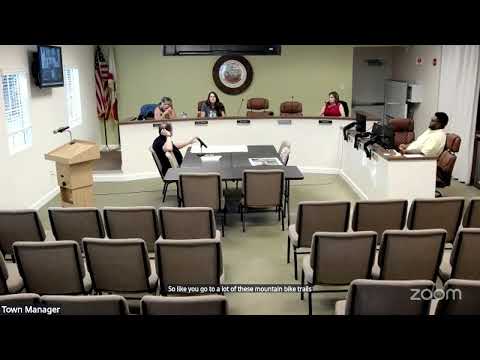
The Trails & Roads Advisory Committee of the Town of Loxahatchee Groves voted unanimously to accept the draft rural road improvement standards for submission to the Town Council, and spent the meeting discussing a townwide trails map, equestrian crossings and related maintenance and funding questions.
Committee members said the road standards are intended as a forward-looking, town-level alternative to Florida Department of Transportation requirements so the town can consistently defend its own rural character when evaluated against a written standard. "The intent is to create 3 separate documents, that will eventually be incorporated into 1," said Richard Gallant, a town staff member who presented the draft. He described separate documents for roads, drainage and multiuse/equestrian trails and said the roads document applies only to future projects and reconstructions, not all existing pavement.
Why it matters: Committee members and residents pressed for details about how the standards would affect trees, equestrian access and townspeople’s property lines. The committee asked staff to follow up on locked gates and disputed easements that currently prevent continuous equestrian routes and to return with specific recommendations at the next meeting. Members also sought clarity on budget timing for planned paving and drainage projects that could create usable equestrian corridors.
Most important actions and schedule items
- The committee approved a motion to submit the draft rural road improvement standards to the Town Council, with committee members to discuss the draft with their council representatives before final council consideration. The motion passed unanimously; the transcript does not record individual roll-call votes.
- Staff reported funding and schedule items that affect trails and roadwork: an estimated $500,000 was budgeted in the capital improvement plan for FY2026 preparation work (easements and site prep) for Upper and Lower North Roads, with actual paving planned for 2027; a proposed pedestrian/equestrian crossing across a local canal was estimated at roughly $130,000–$140,000; and the collecting-canal/F Road culvert/bridge replacement project includes a widened structure with a 12-foot path and was expected to require a temporary intersection closure when built (project timing discussed for May–June construction windows).
Key discussion points and clarifications
- Trail map and signage: Staff brought a map showing existing trails (green on the map), desired additions, and sections where no trail exists. Committee members asked that the map be posted online and distributed to the committee. Town staff said equestrian crossing signs have been ordered and will be installed; staff estimated the signs would arrive in roughly a month and that a few would be installed before the end of the fiscal year.
- Gates and easements blocking continuity: Residents described locked gates at easements that currently interrupt continuous north–south routes, notably a gate adjacent to Madison Green and one near the school that limits canal-bank access. The committee asked staff to research who controls those gates, who has authority to lock them, and whether recorded easements or historical agreements permit the gates to be locked; staff said that could require title or attorney review and agreed to report back.
- Tree preservation: Committee members urged stronger language to preserve mature trees in the standards. Staff said trees would be preserved when feasible and would be removed only where necessary for drainage or public safety; the committee requested that tree preservation be explicitly prioritized in the document.
- Maintenance and grading schedules: Presentations noted grading frequency for unpaved roads: Level 1 roads are currently graded twice weekly; Level 2–4 roads are targeted for grading roughly twice monthly. Staff also described an ongoing, townwide master assessment of drainage, road condition and canal maintenance to reduce repeated site visits over time.
- Equestrian safety and enforcement: Riders asked for outreach beyond signs — mailings, variable-message boards or enforcement — to make visitors and nonresident drivers aware of horse-right-of-way rules. Staff said they are evaluating programmable message boards and can coordinate enforcement requests with the sheriff’s office.
Background and next steps
The draft standards have been presented to the committee previously (January and February meetings were cited). Staff said they plan to keep the three standard documents separated during drafting (roads, drainage, multiuse trails) and then combine them into an engineering manual for town use. The committee asked staff to: post the trails map publicly, provide a short written summary of the proposed standards and proposed sign locations, investigate the locked-gate/easement questions with legal staff, and return with formal recommendations at the next committee meeting (scheduled April 24). The committee also asked that tree preservation language be elevated as a priority in the standards.
The meeting produced no adopted ordinance, code change or binding land‑use decision; the committee forwarded the draft standards to the Town Council for its consideration and additional action.