Get Full Government Meeting Transcripts, Videos, & Alerts Forever!
Get email alerts on the Sentencing Interpretation topic
No spam. Unsubscribe anytime.
Appeals court hears dueling readings of sentence ranges under section 10M after Rodriguez
Summary
In Kamalov v. Da Silva the Commonwealth urged the court to read chapter 10M to require a "minimum-maximum" sentence (e.g., a lower-end range floor such as 1 to 2.5 years) to preserve statutory words; defense urged applying lenity and upholding judge's discretion. Judges probed statutory structure and Rodriguez precedents.
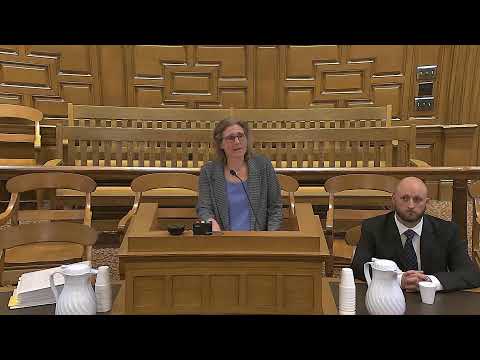
The Appeals Court on April 3 heard argument over how to read overlapping sentencing phrases in G.L. c. 275, (10M) and related statutory provisions in Kamalov v. Da Silva.
Assistant District Attorney arguing for the Commonwealth urged the court to harmonize statutory language so that courts supply a "minimum-maximum" sentence that preserves the statutes components. Counsel said Rodriguez requires the court to treat the lower-end language as the permissible floor and to avoid rendering the separate statutory minimum meaningless.
Counsel for the appellant, Christopher DeMeo, urged that in ambiguous statutory constructions the rule of lenity favors the lower minimum and that judges retain sentencing discretion; he warned that the Commonwealths proposed rule would impose a new canon of statutory construction across multiple provisions.
The justices spent much of their time testing practical consequences: whether a sentencing judge's choice of a 1-to-2.5-year lower-end term produces the same parole-eligibility and statutory effect as a straight 2.5-year sentence; how Rodriguez and subsequent cases such as Rossetti frame the "lower end of the sentencing range," and whether harmonizing the statutory provisions will create unintended limits on judicial sentencing discretion.
Why it matters: The courts ruling would guide lower courts on how to impose indeterminate state prison sentences when the statute contains both a lower-range figure and a mandatory minimum sentence phrase. Counsel said the issue could apply to several penal statutes and affect the structure of many state-prison terms.
The case was submitted after argument.