Get Full Government Meeting Transcripts, Videos, & Alerts Forever!
Get email alerts on the Gun Violence Prevention topic
No spam. Unsubscribe anytime.
Project Longevity outlines housing, jobs and outreach; city violence-prevention office warns of federal funding risk
Summary
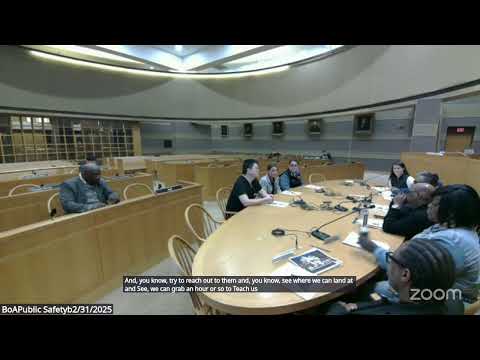
Project Longevity, a city-serving gang-violence reduction program, described steady outreach, intensive case management, emergency housing assistance and pre-apprenticeship training to the New Haven Board of Alders Public Safety Committee on March 31, 2025, while the Office of Violence Prevention warned that federal funding that supports much of the local violence-prevention ecosystem could be at risk.
Project Longevity, a city-serving gang-violence reduction program, described steady outreach, intensive case management, emergency housing assistance and pre-apprenticeship training to the New Haven Board of Alders Public Safety Committee on March 31, 2025, while the Office of Violence Prevention warned that federal funding that supports much of the local violence-prevention ecosystem could be at risk.
Project Longevity's statewide coordinator, Kate (statewide coordinator, Project Longevity), told the committee Project Longevity has worked with the New Haven Police Department since 2012 and now operates with expanded services after the Justice Education Center assumed oversight in 2022. "We want you to live safe and free," Kate said, describing an approach that pairs police intelligence with outreach workers and case managers to identify people at high risk of involvement in gun violence and to offer housing, job training and other supports.
The program relies on several partners, including retired New Haven police officers assigned to outreach roles, Clifford Beers (care coordination and intensive case managers), NewReach (short-term rental assistance and security-deposit support) and contracted outreach providers. Project Longevity staff described paying for security deposits and the first two months' rent and providing up to a year of housing assistance in many cases; they also support drivers-license restoration, CDL training, GED and pre-apprenticeship construction, masonry and trades training.
Kate and Project Longevity staff described a mix of immediate emergency responses and longer-term work: rapid relocation and hotel placement after shootings, a master contract with a landlord to provide short-term shared living when someone is homeless and coordinated "meet-and-greets" for people returning from incarceration. Kate said the program differentiates case intensity and refers the most complex family cases to Clifford Beers for long-term care coordination.
Chief (New Haven Police Department) framed Project Longevity as a shift in policing strategy. "Now we're sharing information and getting them services, offering jobs," the chief said, describing a move away from an arrest-only model toward shared service referrals and outreach.
Committee members asked about program scale, juvenile outreach and program constraints. An Alderman identified juvenile involvement in stolen-vehicle incidents as a continuing concern; Project Longevity staff said the program historically focused on adults 18 and older but has expanded to include after-school and other youth-oriented activities to reach younger people. Staff described pilot ideas such as car-repair training targeted at younger teens as a way to engage them safely.
On funding, McKenna Booker, coordinator for the Office of Violence Prevention, told the committee the city received a $2,000,000 grant through the Bureau of Justice Assistance (BJA) that supports the PRESS initiative (Pathways for Reintegration, Engagement, Strategy and Support) and broader ecosystem coordination. Booker said the City and its partners are preparing contingencies in case federal funding is reduced or rescinded. "We have not been told that our funding is being cut. We are just trying to prepare in the case that we get that news from the federal government," Booker said.
The Office of Violence Prevention provided committee members with a budget breakdown of potential impacts if federal support were curtailed: Project Longevity might lose roughly $290,000; CTVIP life-coaching supports about $400,000; the basic-needs and housing-support pool the city helps coordinate about $485,000; and data and capacity supports were estimated near $280,000. Project Longevity staff separately said program-level operating support for their New Haven site has been cited informally at about $200,000 to $250,000 of the statewide allocation.
Program staff described recent field results and methods. After two homicides in November, Project Longevity said it moved three families, supported transitions and maintained follow-up for those who stayed in touch with providers. Staff recounted at least one case where a hotel placement was re-targeted when renewed threats surfaced; in another case, staff described connecting a family to long-term providers after relocation and receiving photos of the children's first day at new schools.
Project Longevity also highlighted workforce outcomes: trainers reported that about half of a recent cohort entered union apprenticeships or work placements, and staff said several program participants obtained licenses and steady employment. The program also runs community events and youth programming, including spring-break activities that drew hundreds of youth on some nights.
Committee members pressed staff on two recurring limits: landlord willingness to rent to program participants and the difficulty of persuading high-risk people to accept services. Project Longevity staff said both barriers persist; they use rapid financial supports and close coordination with parole/probation and outreach partners to reduce barriers and to encourage engagement.
The Office of Violence Prevention and Project Longevity asked for continued alder support while they develop philanthropic contingencies and replication strategies for the city's violence-problem analysis and data tools. Booker said staff are pursuing philanthropic partners and contingency planning so core coordination and data systems can be sustained if federal funds are reduced.
The committee heard requests to expand listening sessions and community advisory input. Booker said the office will host neighborhood listening sessions and focus groups, including planned sessions for aldermen and community management teams, and that staff will circulate invitations for those meetings.
Why this matters: Project Longevity and the Office of Violence Prevention together form the operational core of New Haven's local approach to reduce firearm-related harm. The program couples police intelligence with case management, housing and workforce services; the BJA grant and state funding underpin many of those services. A reduction in federal funds, staff told the committee, would reduce capacity across multiple providers and risk disrupting services to people at immediate risk of retaliation or reoffending.
"We want you to live safe and free," Kate said in closing, and city staff and alder members discussed options to protect services and sustain coordination if federal support changes.