Get Full Government Meeting Transcripts, Videos, & Alerts Forever!
Get email alerts on the Elderly Housing topic
No spam. Unsubscribe anytime.
Applicant withdraws 69-unit elderly-housing variance at 19 Tinker Road after heavy public opposition
Summary
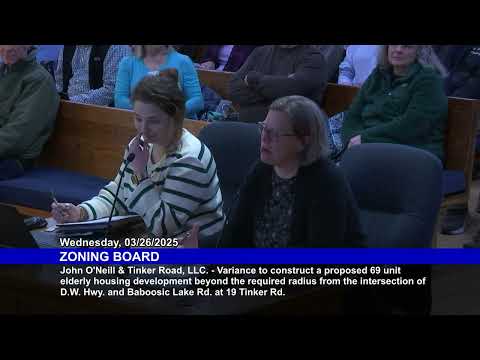
A proposed 69-unit, age-restricted development at 19 Tinker Road — the subject of hours of testimony and dozens of written objections — was withdrawn by the applicant during the March 26, 2025 Merrimack Zoning Board of Adjustment meeting.
The applicant for a proposed 69-unit elderly-housing development at 19 Tinker Road withdrew the zoning variance request during the March 26 Merrimack Zoning Board of Adjustment meeting after extensive public comment and questioning by board members.
Monica Kiezer, attorney with Hopeful Phoenix Gormley & Roberts speaking for petitioner John O'Neil, presented a plan for a roughly 22-acre parcel she described as having municipal water and sewer and access from Tinker Road. She said the proposal would be “about 69 units” of age-restricted housing served by private roads and a condominium association. Kiezer and project engineer Paige Libby (Jones and Beach Engineering) told the board they had modified the concept after neighborhood meetings, removing units adjacent to nearby homes and replacing planned pickleball courts with lower‑noise features.
Opposition from dozens of residents and several written letters consumed most of the public hearing. Dennis Flynn (20 Dunbarton Drive) said his calculations showed the development would add “as many as 400 vehicles per workday,” and a coalition of abutters read letters raising safety at the Tinker Road–Continental Boulevard intersection, wetlands and aquifer concerns, and potential declines in neighboring property values. Realtor Linda Moreau of eXp Realty and several abutters said removal of tree buffers and ledge blasting would alter neighborhood character.
Board members questioned traffic, access and enforcement of the age restriction. Kiezer said the applicant used standard trip‑generation tables (not a field traffic study) and stressed a later, planning‑board traffic study would provide detailed counts: “That is the first place that you're gonna go to try to get your arms around the potential issue,” she said. She also said condominium declarations would be used to enforce age limits.
After public testimony and follow-up questions, the applicant’s counsel said the petitioner would withdraw the variance. The chair announced, for the record, that “the applicant has withdrawn these variants.” No formal vote on the project was taken because the withdrawal removed the petition from the board’s consideration.
Why it matters: residents and the developer framed the same concerns differently — the developer emphasized housing need and engineering controls; residents pointed to traffic, water quality, wetlands and the project’s distance from the town’s elderly‑housing overlay. The withdrawal leaves the project’s next steps unclear; the developer may refile after redesign or further outreach.
What the board heard and decided: the application was presented and thoroughly questioned on the five variance criteria. Dozens of residents and several professionals filed written objections and spoke at the hearing. The petitioner withdrew the request before the board made a decision. The town record shows the petition (listed on the agenda as case number ZBA2020Five-three) was removed at the applicant’s request and will not proceed unless refiled.
Ending note: Because the applicant withdrew the petition, the ZBA did not vote to grant or deny the variance. Residents and the applicant emphasized the same key issues — traffic, wetlands/aquifer protection, buffering and enforcement of age restrictions — which would need resolution if the proposal returns to a public hearing.