Get Full Government Meeting Transcripts, Videos, & Alerts Forever!
Get email alerts on the Cfo Inspections topic
No spam. Unsubscribe anytime.
Committee moves to codify inspections and biosecurity requirements for confined feeding operations
Summary
Senate Bill 193, as amended, would put inspection timelines and biosecurity protocols for confined feeding operations into statute, extend scheduling windows to help agencies meet inspection demands, and preserve complaint-based, no-notice inspections; the committee passed the bill 13-0.
The Indiana House Environmental Affairs Committee advanced Senate Bill 193 as amended, a measure that places inspection timelines and biosecurity requirements for confined feeding operations (CFOs) into statute and clarifies when IDEM may conduct complaint-driven inspections.
Senate Bill 193, amended by language described in committee as Amendment 9, requires a compliance inspection tied to the submission of a construction-completion affidavit, establishes a scheduled inspection window around five-year renewals, elevates biosecurity protocols to statutory status and preserves IDEM's discretion to perform complaint-driven inspections without notice.
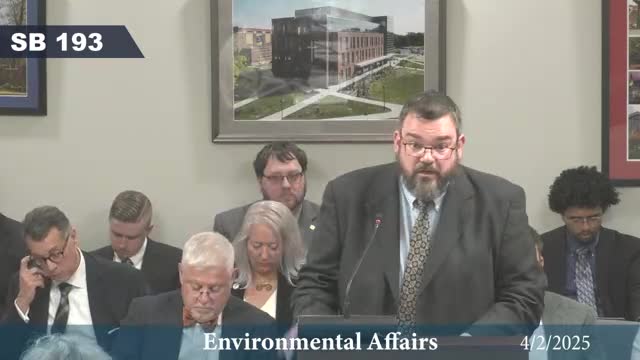
Josh Trenary, executive director of the Indiana Pork Producers Association, testified in support and described the practical need for longer scheduling windows. "There's four environmental consultants in the state that do this type of work. There's 1,635 permits," Trenary said, arguing that extending windows ensures inspectors can schedule on farms while accommodating biosecurity downtime.
Trenary said the amendment also moves the timing trigger for an initial compliance inspection to the submission of the construction completion affidavit so an inspector visits when there is something built to inspect. "Between the affidavit submission and final approval, IDEM engineers do construction inspections," he added, but said the compliance inspection should occur after construction completion.
Environmental groups supported the bill's inspection requirement. Toby Days, sustainable agriculture director for the Hoosier Environmental Council, told the committee that inspections help prevent spills and enforce consistent management of manure. Citing IDEM reports, Days said that in February 2024 IDEM conducted 525 inspections that resulted in 95 violations and 11 spills. "Inspections assure that all operators are held to the same standards," Days said.
The bill, as amended, was described by proponents as clarifying existing practices that IDEM already conducts in regulation and placing key elements into statute. Jake Tory, IDEM legislative director, told the committee the agency was agreeable to the amended language and believed current staff could carry out the inspections under the new schedule.
Becky Yonishkan, president of the Indiana State Poultry Association, said the poultry industry supported codifying inspection expectations and appreciated the bill's recognition of biosecurity and the need for quarantine/downtime between farm visits.
The amended language permits IDEM to focus discretionary inspections on higher-risk facilities, and it keeps complaint-driven inspections available "with no notice," proponents said. That change was presented as an important enforcement tool for both new and existing facilities.
The committee adopted the amendment and approved the bill as amended by voice and roll-call vote; the clerk recorded a 13-0 vote in favor. The amendment's sponsors and industry witnesses said the statutory changes reflect long-standing agency practice while ensuring scheduling windows account for limited consultant capacity and biosecurity constraints.
The bill will proceed for further legislative consideration.