Get Full Government Meeting Transcripts, Videos, & Alerts Forever!
Get email alerts on the Earned Wage Access topic
No spam. Unsubscribe anytime.
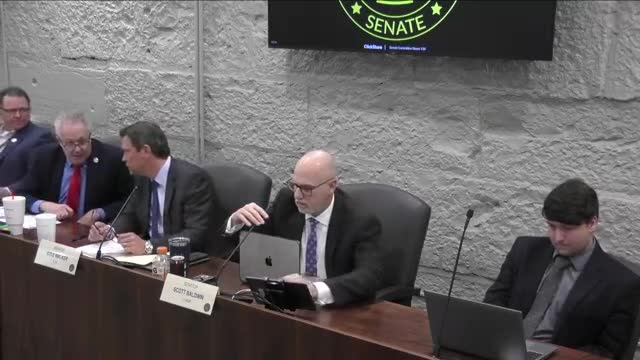
Senate committee hears testimony on House Bill 11 25 to regulate earned wage access; vote delayed
Summary
Senator Kyle Walker, presenting House Bill 11 25, told the Indiana Senate Committee on Insurance and Financial Institutions that the measure "establishes the Indiana Earned Wage Access Act, which creates regulatory framework for earned wage access services," and that the bill would put a regulatory structure around a product already in use in the state.
Senator Kyle Walker, presenting House Bill 11 25, told the Indiana Senate Committee on Insurance and Financial Institutions that the measure "establishes the Indiana Earned Wage Access Act, which creates regulatory framework for earned wage access services," and that the bill would put a regulatory structure around a product already in use in the state.
The bill would require providers to offer a no‑fee option and ban interest, late fees and credit reporting, Senator Walker said. It would license EWA providers through the Indiana Department of Financial Institutions (DFI), require background checks and surety bonds, and give DFI exam and enforcement powers. "This is not payday lending. This is not a loan," Walker said.
Why it matters: Earned wage access lets employees access wages they have already earned before payday. Proponents argued EWA can reduce late fees, overdrafts and turnover; opponents said without fee limits and stronger transparency it can function like a high‑cost, repeat product that disproportionately affects workers living paycheck to paycheck.
Supporters at the hearing included employer‑integrated and direct‑to‑consumer providers. Andrew Welch, Government Relations Manager at DailyPay, said his firm integrates with payroll systems and that about 36% of eligible employees download the app; "of those, about half of them just track their wages," Welch said. He testified the bill "ensures critical consumer protections are guaranteed for EWA consumers, including a mandatory free option and requirements that there's no interest, debt collection or credit involvement." Welch also read a user quote: "DailyPay helped me tremendously by staying out of debt and staying on top of things needed at the moment," attributing the remark to a DailyPay user.
Industry witnesses described optional expedited transfers and voluntary tips as common revenue models. Senator Walker and witnesses said providers typically offer an ACH transfer that takes 1–3 business days at no cost and an optional instant transfer for a flat fee (witnesses cited ranges of roughly $2 to $5 or $2.99 to $5.99).
Consumer groups and community organizations urged stricter guardrails. Erin Macy of the Indiana Community Action Poverty Institute, speaking also for the coalition Hoosiers for Responsible Lending, said, "Our coalition currently opposes House Bill 11 25 in its current form." Macy warned that some app‑based products operate like loans in practice and noted an example where an app charged $12 for a $50 advance for seven days, calling that "almost double what a payday lender would charge for a $50 advance." Macy also raised concerns that tipping, though labeled voluntary, could be de facto pressured and that the bill places EWA outside existing Indiana lending rules and criminal loan‑sharking statutes.
Andrew Bradley of Prosperity Indiana said EWA could be harmful without stronger limits and data reporting. "Without transparency and appropriate guardrails, these Hoosiers could mistakenly see earned wage access products as a way to make paychecks stretch just a little further," Bradley said, citing data showing a widening gap between wages and the state housing wage.
Points of contention and committee discussion included whether to: cap or otherwise limit fees; prohibit or restrict ownership overlap or referrals between EWA providers and payday lenders; require public reporting of aggregated transaction data; define what constitutes a reasonable free option; and limit push notifications or other behavioral engagement in apps. Senator Baldwin (chair) and others noted some reporting language already requires quarterly composite reports to the DFI, while opponents asked that more of that data be publicly available to policymakers.
Regulatory details in the bill described in testimony included licensing and surety bond requirements (witnesses said bonds would range from about $100,000 to $250,000 based on average daily transaction volume), mandatory recordkeeping for at least two years and quarterly reports to DFI, and DFI authority to examine, impose civil penalties, and suspend or revoke licenses. Senator Walker said the language remains a work in progress and welcomed edits to strengthen consumer protections, such as opt‑ins for app tracking, bold disclaimers, limiting push notifications, and defaulting apps to the 0‑cost option.
Committee action: The hearing was testimony‑only; Senator Walker and Chairman Baldwin said the committee will not vote on the bill at this meeting and will take a vote next week. Committee members asked staff and sponsors to continue drafting options on fee limits, referral or ownership restrictions, and reporting and privacy provisions.
The hearing included representatives from EarnIn, DailyPay, the American Fintech Council, Prosperity Indiana, and consumer advocacy groups. No formal amendment or vote was recorded at the session.
Looking ahead: Committee members signaled they will continue negotiations on language addressing fees, affiliate/referral rules, data transparency and consumer‑facing protections before the next meeting when a vote is expected.