Get Full Government Meeting Transcripts, Videos, & Alerts Forever!
Get email alerts on the Education Title 20 topic
No spam. Unsubscribe anytime.
Senate panel advances wide-ranging Title 20 education rewrite after debate on assessments and official residency
Summary
The Senate committee approved a lengthy Title 20 education code rewrite (House Bill 1002) after amendments and debate over school-based assessments, property-sale exceptions and a failed amendment requiring the education secretary to live in Indiana.
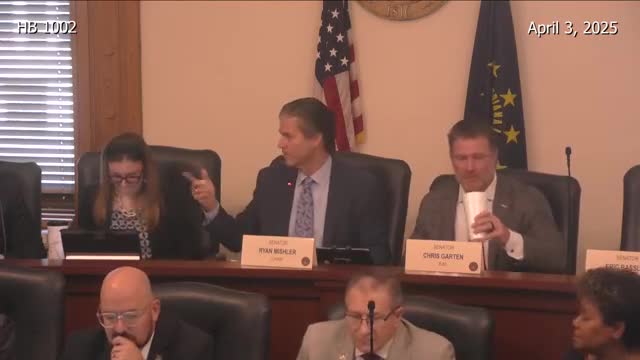
The Senate Appropriations Committee on Tuesday approved a broad revision to Title 20 of Indiana law, advancing House Bill 1002 after debate over changes that members said could affect special-education assessments and local school transactions.
The bill, which members described as the product of an extended summer review of Title 20, passed committee 10-3. Committee discussion centered on amendments that removed, restored or narrowed language affecting school psychologists’ assessment authority, plus local exceptions allowing two school districts to sell buildings to municipalities.
Supporters said the 140-page bill compiles many technical updates and clarifications following a committee review begun last year. “This bill is a result of that. It’s about 140 pages and a lot of hours of work sifting through it,” a sponsor told the committee. Several amendments were handled by consent; others drew extended debate.
A contested change originated with an education committee amendment that removed social-and-emotional-learning language and related assessment text. Opponents warned that excising the assessment language could unintentionally conflict with Article 7 requirements for school-based assessments used in special-education evaluations, particularly for students with ADHD or on the autism spectrum. One senator argued that removing the assessment wording could force parents to obtain independent private evaluations costing more than $3,000 and would omit the classroom learning-environment context from evaluations.
After back-and-forth between committee members and the bill sponsor’s staff, the senator who raised the concern withdrew a substitute amendment and said she would work with the bill’s authors on a second-reading fix. Members repeatedly emphasized the distinction between removing statutory language and prohibiting an assessment in practice, but several voiced concern about a statutory contradiction between sections if the assessment wording remained deleted.
Other amendments handled by consent included one (amendment 35) that creates an exception allowing two specific school-district buildings to be sold to municipalities, and a separate amendment restoring a 1% cap referenced in the bill. A separate amendment (number 39) that would have required the governor’s appointee as Secretary of Education to be an Indiana resident was moved, seconded and then rejected by the committee 9-4 after debate about whether such a residency requirement should apply only to one cabinet post.
The committee held several members’ questions about remaining items and signaled willingness to resolve technical conflicts on second reading. After the roll call the chairman announced the bill passed by a 10-3 margin.
The committee recorded no floor-level appropriations tied specifically to the Title 20 reorganization; members repeatedly described the package as policy and code cleanup arising from the summer review.
Looking ahead, sponsors said they will work with school officials and counsel to clean up any statutory contradictions before second reading, and senators asked for clear drafting to ensure assessments required elsewhere in code are not unintentionally curtailed.