Get Full Government Meeting Transcripts, Videos, & Alerts Forever!
Get email alerts on the Transportation Infrastructure topic
No spam. Unsubscribe anytime.
Enterprise Council focuses on long-range road projects as ALDOT readies signal work
Summary
City leaders reviewed a connectivity study that showed roughly $42 million in corridor needs, authorized design work for widening Bolivar (Bow Weevil) Circle and discussed ALDOT signal and safety plans for the 167/Salem Road area.
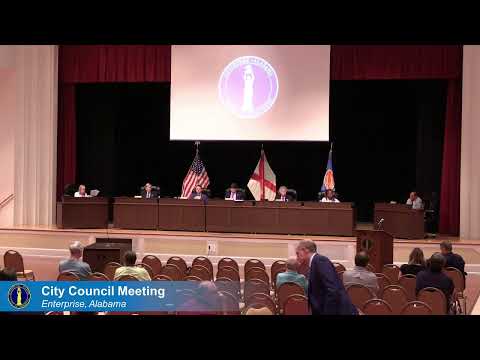
Enterprise City Council members spent part of a work session reviewing long-range road and safety projects, including a costly connectivity study, a design contract to widen part of the city bypass and coordination with the Alabama Department of Transportation on signalization and safety funding.
City Administrator Jonathan Mayer told the council the comprehensive-plan connectivity work looked at “different routes that would further connect our arteries” but that building the full corridor was financially out of reach now. “We don't have the resources to do a $42,000,000 road project,” Mayer said, and recommended the council decide whether to pursue smaller segments, engineering and right-of-way work over time.
The council authorized an agreement with engineering firm Volkert, Inc., to design widening of Bolivar (Bow Weevil) Circle between Highway 27 South and Highway 84 to make remaining sections four lanes and reach shovel‑ready status. Staff said the Volkert work would carry the project through design and bid phases if the council elects to build later.
Mayer also summarized a recent meeting with ALDOT about signalization at the 167 and Salem Road intersection. He said ALDOT found the warrants for signalization “justified” but that funding and cost-sharing remain to be determined. Mayer gave the council a funding example: Highway Safety Improvement Program (HSIP) grants commonly cover up to roughly $2 million; a city-preferred $5 million fix would require a local contribution to make up the difference.
City staff reported that the contractor-selected ALDOT signal project (originating from a previous roundabout proposal) is in procurement and that poles and equipment are on order; staff expect construction to begin in June. Staff asked whether the council wants to press for public engagement beyond the mandatory ALDOT process; council members noted both community concern about design choices (roundabout vs. signal) and support for improved safety.
Mayer said the connectivity study and Bolivar widening are different scales of work: the study identified multi-segment corridor options that in sum were roughly $42 million; the Volkert agreement is targeted design for completing the bypass four‑laning in phases. He recommended the council decide which segments, if any, to pursue incrementally.
Staff recommended next steps that include a council workshop with Sane & Associates (the study consultant) to identify priority segments, potential right-of-way needs and preliminary budgets.
If the council chooses to pursue design and early property acquisition, further budget actions and grant-seeking would follow.