Get email alerts on the Land Use Planning topic
No spam. Unsubscribe anytime.
House passes bill changing planning commission membership rules
Summary
The House passed House Bill 3136 A to remove a categorical restriction on the occupational composition of larger local planning commissions and preserve local appointment authority.
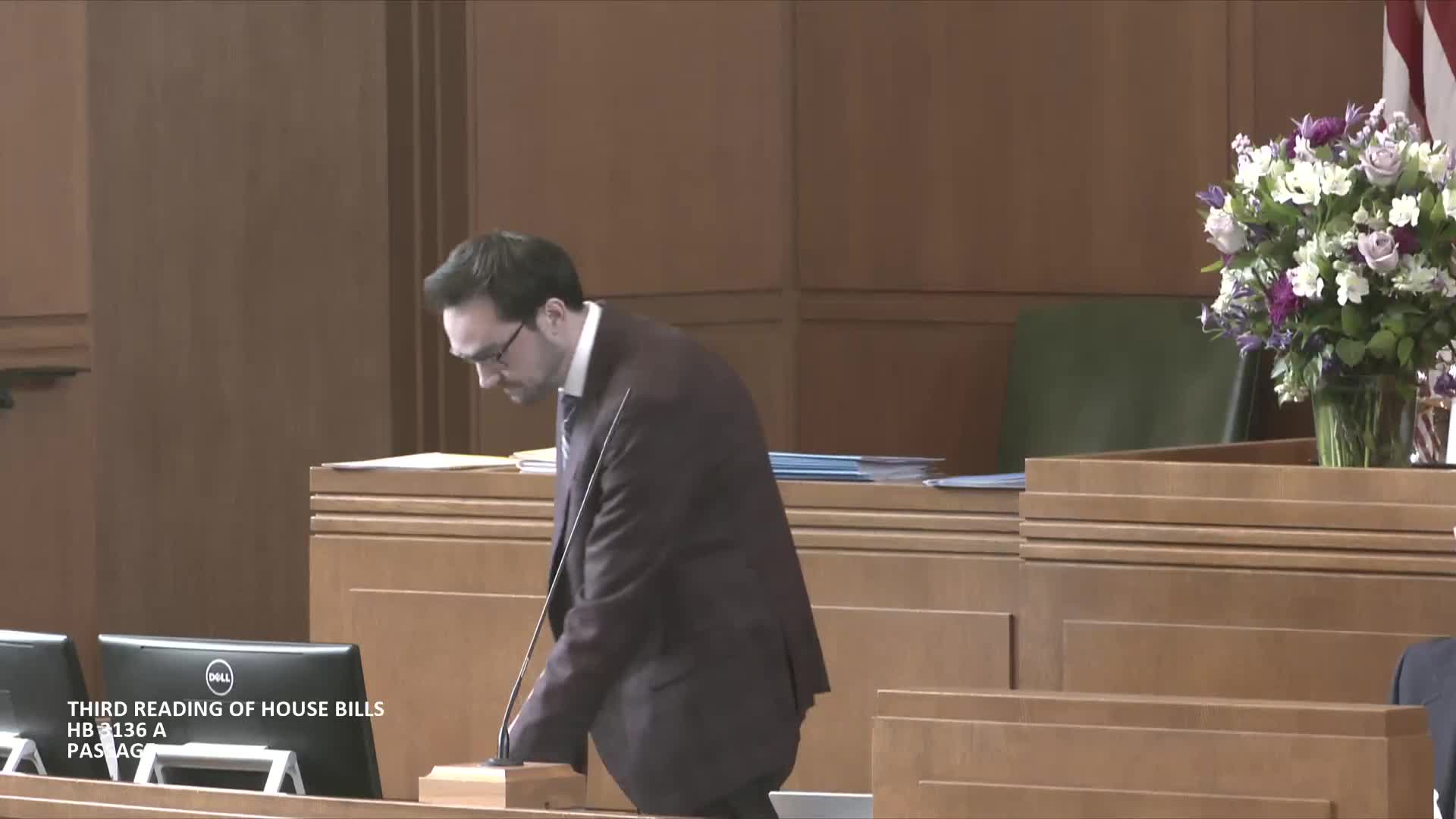
The House on April 4 passed House Bill 3136 A, a bipartisan measure that removes a specified occupational restriction for larger local planning commissions while preserving local appointment authority, Representative Breeze Iverson said on third reading.
Supporters told colleagues the existing statute limited participation by singling out professions involved in real estate development; the bill would keep the current rule for five-member commissions but eliminate the discriminatory provision for commissions of seven or nine members. Representative Breeze Iverson, the floor sponsor, said the change is intended to make local planning bodies more equitable and clearer for appointing authorities.
Breeze Iverson cited the relevant statutory language found in the Oregon Revised Statutes for counties and cities (ORS 215 and ORS 227) and said the bill preserves local governments’ discretion to define "occupation" when making appointments. The sponsor noted the bill passed out of the House Committee on Housing and Homelessness unanimously.
On third reading the House voted and the clerk announced that House Bill 3136 A had received the constitutional majority and was declared passed. The measure clarifies state law on planning commission composition; it does not itself change local appointment procedures but removes a state-level categorical bar for certain occupations on larger commissions.
AI generated
The text on this page is AI generated. Summaries, highlights, analysis, and video transcripts are all produced from the original source material.
AI can make mistakes, so if you spot one, and we will fix it for everyone.
Note: the source content is unaltered by us. Any content source we link to, be it a video, an audio recording, or a document, is presented exactly as its publisher released it. That publisher is usually a government body, sometimes an individual official or another organisation.