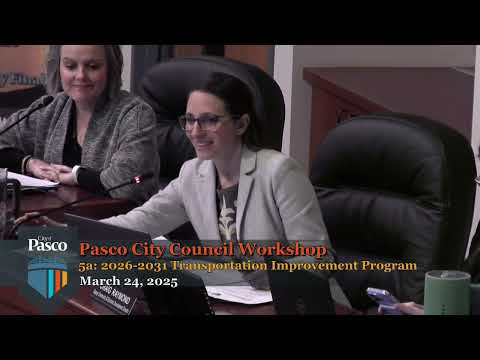
Pasco introduces 2026–2031 Transportation Improvement Program, schedules outreach
Summary
City staff introduced the draft 2026–2031 Transportation Improvement Program, said it must be adopted by July 1, 2025, and outlined a public outreach schedule with a draft due in April and a public hearing in May.
Director Sarah introduced the City of Pasco’s Transportation Improvement Program (TIP) for 2026–2031 on March 24, saying the program is a required multi-year plan that identifies projects, schedules and funding sources. “This program is required to be adopted before July 1 of each year,” Director Sarah said.
The TIP is intended as a planning guide that lists projects with brief scopes, estimated costs by phase (planning, design, right-of-way, construction) and proposed funding, including secured grants and planned grant applications. Director Sarah told the council staff is updating last year’s list by removing completed projects, adjusting schedules and costs, and adding newly identified projects drawn from master plans, regional plans, safety studies and staff- and public-generated requests.
Director Sarah laid out a schedule: staff will return with a draft TIP in April, begin combined online and in-person outreach, then present what they hear back in mid-May. A formal public hearing — required by state law — is planned during a council meeting, and the TIP adoption is tentatively scheduled for mid-June 2025, with a two-week contingency if more time is needed.
Council members thanked staff for bringing the item earlier than in some prior years. Council member Harpster asked what kinds of public comments would change staff priorities; Director Sarah said safety concerns top the criteria for reprioritizing projects and that council direction will ultimately guide inclusions. Council member Grama and others noted the importance of securing outside funding rather than relying solely on fees.
The presentation noted the previous TIP contained 51 items, a mix of projects, studies and programs, and emphasized projects funded by state and federal grants that must be transmitted to the regional Council of Governments and the state to access awarded dollars.
Staff asked council to expect outreach in a hybrid format (in-person events, online forms and bilingual communications) and said TIP items will be incorporated into the broader Capital Improvement Plan once approved.
No formal TIP adoption vote occurred at the March 24 workshop; staff characterized the item as an introduction to the process and timeline and invited council questions.
AI generated
The text on this page is AI generated. Summaries, highlights, analysis, and video transcripts are all produced from the original source material.
AI can make mistakes, so if you spot one, and we will fix it for everyone.
Note: the source content is unaltered by us. Any content source we link to, be it a video, an audio recording, or a document, is presented exactly as its publisher released it. That publisher is usually a government body, sometimes an individual official or another organisation.