Get Full Government Meeting Transcripts, Videos, & Alerts Forever!
Get email alerts on the Wildfire And Forest Management topic
No spam. Unsubscribe anytime.
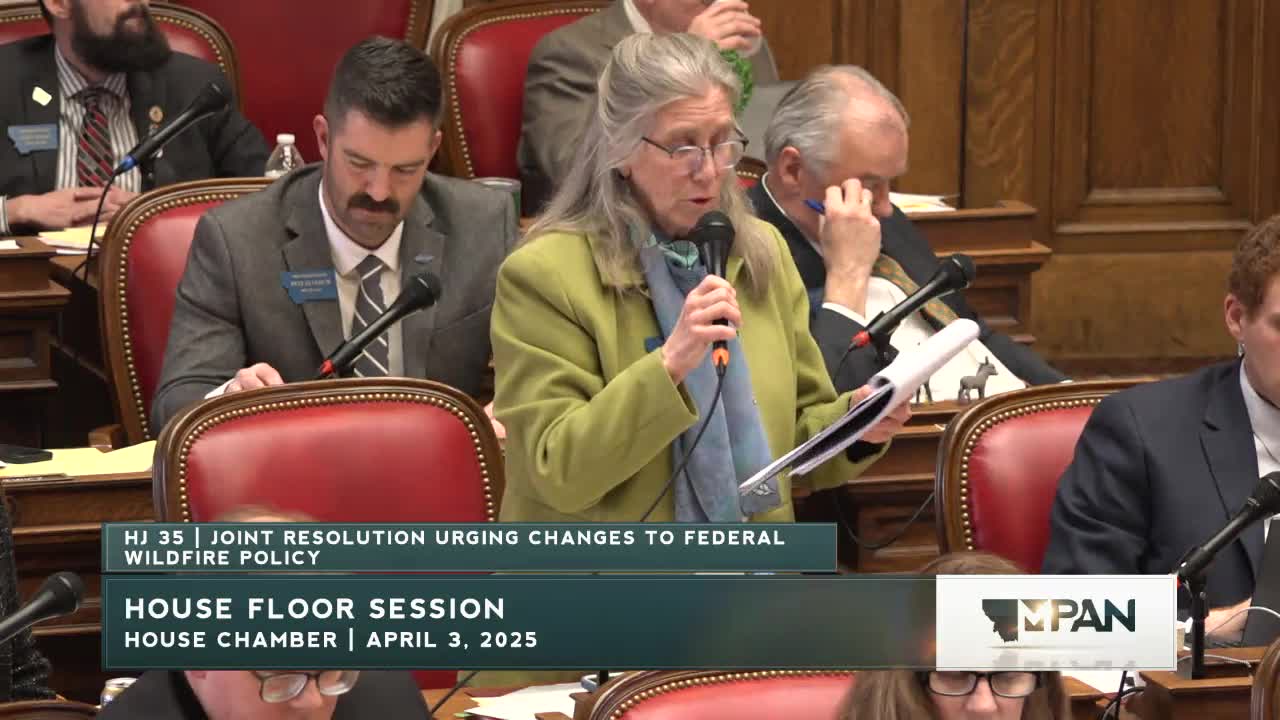
Montana House narrowly approves resolution urging changes to federal wildfire policy
Summary
House Joint Resolution 35, urging federal changes to wildfire and forest management, passed 58–42 after extensive debate about suppression strategy, fuels reduction, and tribal and ecological fire management.
The Montana House of Representatives voted 58–42 to approve House Joint Resolution 35, a nonbinding resolution urging modification of federal wildland fire and forest management policies to better protect Montana communities.
Sponsor Representative Jay Hinkle, a former U.S. Forest Service employee, said the resolution was intended to draw attention to long‑standing concerns about how federal agencies manage fuels and suppression. "I come from a family of forest service employees including myself. Personally, I spent 18 seasons working for the forest service," Hinkle said, urging the new administration and Forest Service leadership to consider changes.
Floor debate highlighted differing views on causes and remedies. Representative Marler urged a broader historical perspective, noting Indigenous use of fire and arguing that the resolution’s framing underplays that context. "We need both. We need people to cut more logs. We need people to embrace fire, and we need to do more of everything," Marler said.
Representative Weber challenged language in the resolution that described a “let it burn” policy, saying there is no current official policy to ignore fires and emphasizing that suppression strategies aim to protect life first. "There is no let burn policy," Weber said, and he noted technical details of federal fire policy and recent staffing changes that affect suppression capacity.
Supporters described longstanding changes in forest structure and the need for active management, more timber harvest and fuels reduction to reduce the most intense, large fires. Opponents and some scientists said the issue requires a balanced approach that acknowledges ecological roles for fire and the complexities of climate, drought and seasonal change.
The motion recommending the resolution do pass carried 58–42 at second reading. The resolution is a statement from the House urging federal attention; it does not impose state law or mandate federal action.