Get Full Government Meeting Transcripts, Videos, & Alerts Forever!
Get email alerts on the School Safety topic
No spam. Unsubscribe anytime.
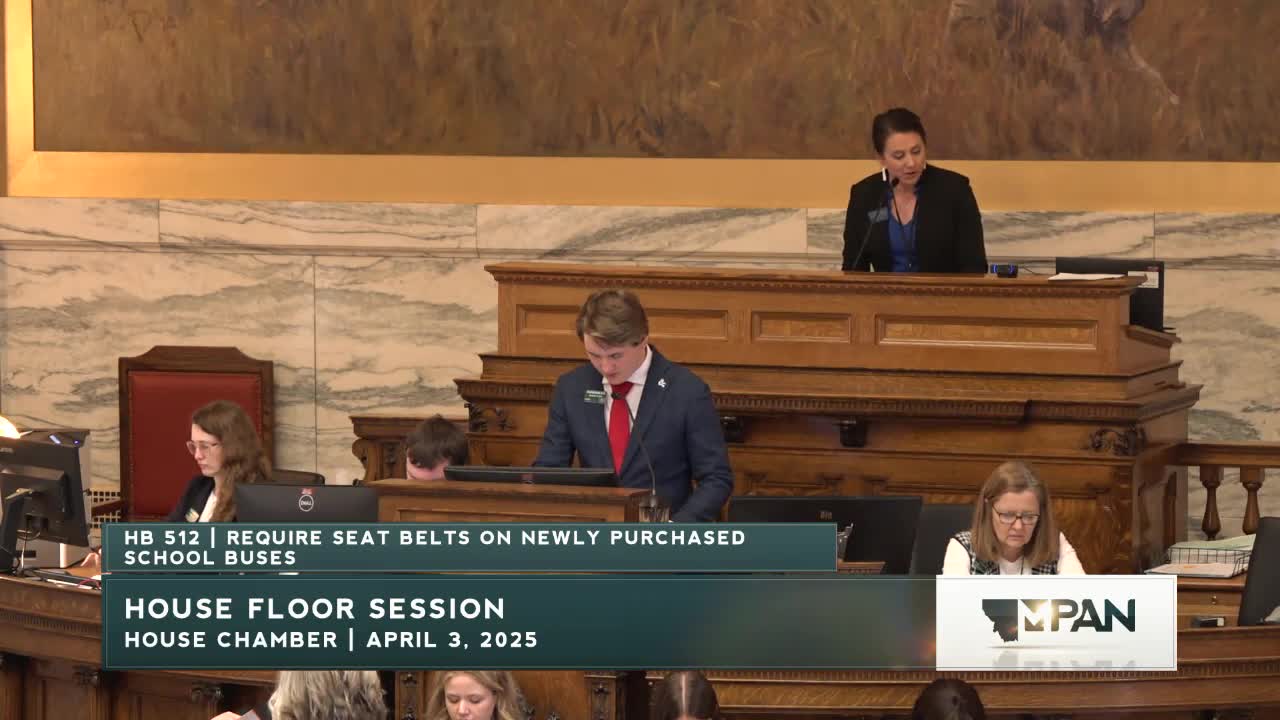
House advances bill requiring lap‑shoulder belts on school buses; districts must adopt usage policies
Summary
House Bill 512 passed second reading after debate on safety, behavior and costs; sponsors say lap‑shoulder belts reduce injuries in rollovers and side‑impact crashes and ask the Board of Public Education to set standards.
The Montana House of Representatives voted to advance House Bill 512, which requires new school buses to comply with lap‑shoulder belt standards established by the Board of Public Education and requires school districts that use belted buses to adopt enforceable, publicly available usage policies.
Sponsor Representative Sam Kohlenhauer told the chamber the measure does not force districts to immediately buy new buses, but it ties standards for new buses and creates incentives and policy requirements for districts that operate belted buses. “The 1 fatality we've had in the state of Montana on a school bus did come from a side impact…a child actually went out the window and died in Billings,” Kohlenhauer said when describing safety risks in some crash scenarios.
The bill includes policy language requiring districts that operate buses with lap‑shoulder belts to require all passengers use them and to maintain belts in working order. It also adjusts procurement and reimbursement rules to allow differential contract pricing for buses with belts — “that differential cost does not go towards your 12% increase,” the sponsor said — and reduces a fee in lieu of taxes for contract buses equipped with lap‑shoulder belts as a financial incentive.
Opponents raised questions about practical implementation: how districts will ensure very young children buckle correctly, whether districts must retrofit older buses (the sponsor said older buses are not required to be retrofitted), and whether districts will need additional aides on buses to assist students. Representative Barker asked whether drivers will have assistance to help younger children secure belts and how children would be helped in a post‑crash fire; sponsor Kohlenhauer said the Board of Public Education’s model policy and local district policies will address training and procedures and that many districts already use bus aides for students who need help.
Supporters pointed to pilot results and experience in districts that have adopted belts and cited behavioral improvements and reduced injury risk in side‑impact crashes. Representative Dain said footage from modern bus accidents shows passengers being ejected or thrown during crashes and argued lap‑shoulder belts reduce that risk.
The House recorded 69 representatives voting aye and 31 voting no on the motion to recommend due pass at second reading; House Bill 512 passed second reading and will continue through the legislative process.