Get Full Government Meeting Transcripts, Videos, & Alerts Forever!
Get email alerts on the Social Media Regulation topic
No spam. Unsubscribe anytime.
House committee advances Social Media Youth Protection Act after daylong hearing
Summary
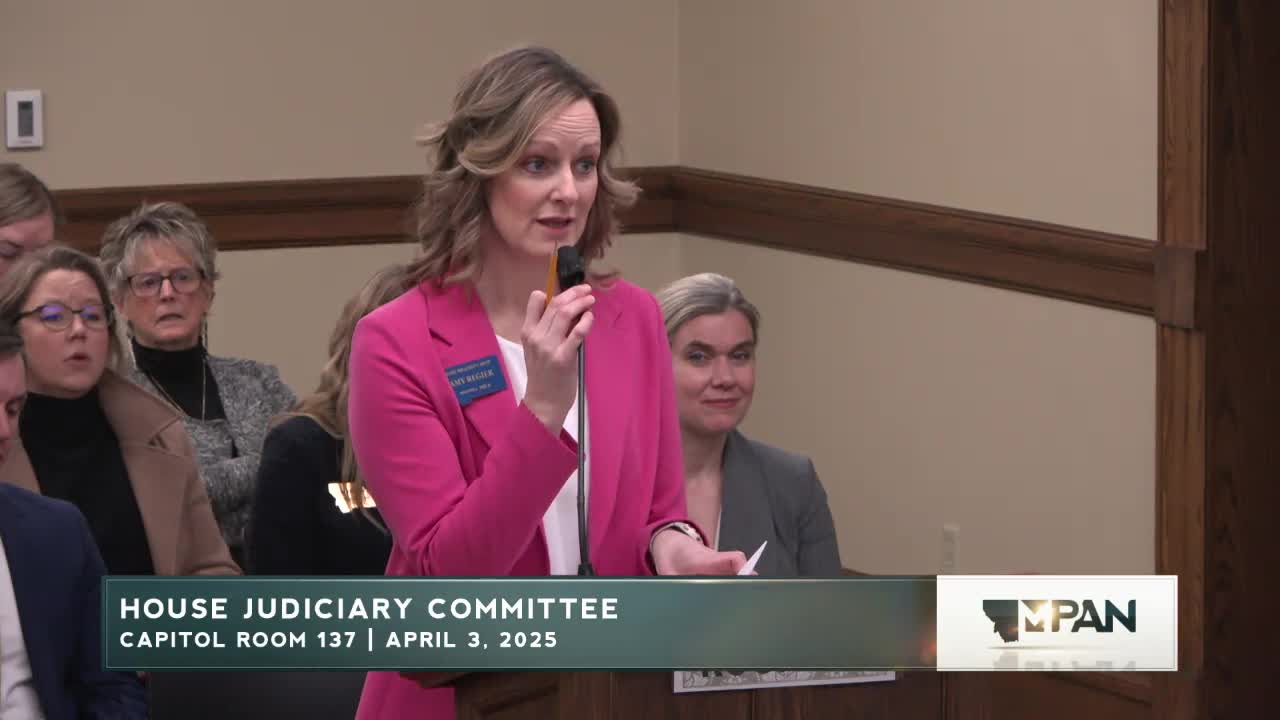
Representative Amy Regier, sponsor of House Bill 9 25, opened the Judiciary Committee hearing by saying she represents House District 6 in Kalispell and that she brought "House Bill 9 25, the Social Media Youth Protection Act" to the committee to require platforms to install safeguards and give parents supervisory tools.
Representative Amy Regier, sponsor of House Bill 9 25, opened the Judiciary Committee hearing by saying she represents House District 6 in Kalispell and that she brought "House Bill 9 25, the Social Media Youth Protection Act" to the committee to require platforms to install safeguards and give parents supervisory tools.
The bill would require social media companies to implement an age-assurance system, set strong default privacy settings for minor account holders, disable engagement-driving features such as autoplay and push notifications for minors, and offer parental supervisory tools including time limits and mandatory breaks. The bill also ties enforcement to the Montana Consumer Protection Act and creates a private right of action, and it includes a 95% accuracy standard for age-assurance measures in the text discussed in the hearing.
Why it mattered: proponents said the law addresses a widespread public-health problem for Montana youth. Rachel Green, the governor's policy director, cited surveys and prevalence figures in support of the legislation and said social media use among teens is near-universal. Several health and child-welfare witnesses, including Renee Novak of the Children's Mental Health Bureau and Matt Kuntz of NAMI Montana, described published research and public-health advisories linking excessive social media use to mental-health harms: Novak cited Surgeon General guidance and testimony noting that children and teens who spend more than three hours daily on social platforms have higher rates of depression and anxiety.
What proponents pressed for: witnesses urged requirements the bill contains—age assurance, strong privacy defaults for minors, parental supervisory controls and limits or removal of autoplay/infinite-scroll features for minor users. Adam Carpenter, Montana's chief data officer, told the committee technical solutions exist for age assurance and likened the obligation to other regulated retail-age checks: "If you're gonna serve AI driven content, make sure you know the age of the person you're serving it and serve appropriate content." Protect Young Eyes founder Chris McKenna and others described anecdotal and programmatic contacts with families who say default platform settings and engagement design make supervision difficult.
Opponents' concerns: trade groups and platform representatives testified in opposition, focusing on constitutional and practical issues. Jesse Luther, representing Meta, and trade groups including NetChoice and TechNet warned the bill mirrors provisions already enjoined in other states, particularly Utah's SB194, and that courts have raised First Amendment and other challenges to similar measures. Industry witnesses said the bill's 95% accuracy requirement could push firms toward more intrusive identity checks and create privacy risks. Several witnesses urged an interim study or an app-store–level alternative that would not require collecting new identity data at the app level.
Committee exchange and technical questions: members pressed technical and fiscal questions. Representative Kelly asked about location verification; Adam Carpenter said location is sometimes inferred imperfectly and that the bill's 95% standard contemplates a best-effort approach rather than perfection. Representative Sharp asked proponents to point to evidence about addictive effects; several proponents referenced dopamine/engagement research and offered to supply studies. The sponsor and witnesses discussed a $25,000 enforcement appropriation mentioned in the bill; Renee Novak described it as a "starting point" and deferred detailed fiscal questions to the Office of Consumer Protection.
Vote and outcome: in executive session Vice Chair Deming moved that the committee report HB 9 25 do pass. On a roll call the committee recorded 12 yes votes and 8 no votes; the committee clerk announced, "House Bill 9 25 has passed, House Judiciary." The bill will proceed to the full House.
Context and next steps: witnesses and stakeholders signaled the debate is likely to continue on legal grounds. Industry representatives pointed to ongoing litigation in other states; informational testimony included an Age Verification Providers Association representative who described noninvasive estimation and age-estimation options. Supporters urged timely action to protect children; opponents urged a measured approach and further coordination with technology and privacy experts.
Ending note: the committee vote advances HB 9 25 to the House; legal challenges and implementation details — especially the age-assurance standard and how platforms would handle identity data — were the key outstanding issues noted in testimony.