Get Full Government Meeting Transcripts, Videos, & Alerts Forever!
Get email alerts on the Firearms Liability topic
No spam. Unsubscribe anytime.
Senate Judiciary advances bill narrowing liability for gun and ammunition makers
Summary
Representative Shannon Maness introduced House Bill 801, the Montana Firearms Liability Clarification Act, telling the Senate Judiciary Committee the measure would narrow state-level exceptions to the federal Protection of Lawful Commerce in Arms Act and limit negligence-based marketing claims against gun and ammunition manufacturers.
Representative Shannon Maness, sponsor of House Bill 801, told the Senate Judiciary Committee that the bill — titled the Montana Firearms Liability Clarification Act — is intended to tighten protections for firearms- and ammunition-related businesses by narrowing the state-level exceptions to the federal Protection of Lawful Commerce in Arms Act (PLCAA).
“PLCAA … was set up to protect gun and ammo manufacturers from these frivolous lawsuits,” Maness said. She told the committee HB 801 would limit negligent-marketing claims to narrow circumstances — for example, where a manufacturer “directly targets individuals legally prohibited from owning firearms” or “knowingly and willfully violates a state or federal statute regulating the marketing of firearms and ammunition.” She asked the committee for a do-pass recommendation.
Montana Attorney General Austin Knudsen and the Montana Chamber of Commerce urged the committee to support the bill. “We are seeing abuse of the PLCAA,” Knudsen said, telling members that courts and the trial bar have attempted to widen a federal predicate exception in ways he described as beyond Congress’s intent. He said the measure would help Montana recruit firearms-related businesses and protect jobs.
Opponents, including attorney Alice Smith of the Montana Bridal Lawyers Association and gun owner Shani Henry, said the federal PLCAA already provides strong protections and that the bill would grant unprecedented immunity to an industry that — they argued — should be subject to ordinary checks and consumer protections. “This provides unprecedented immunity already provided by our federal law,” Henry said, adding that she is a proud gun owner and hunter who nevertheless opposed further state-level protections.
Committee debate included questions about constitutional conflicts and attorney-fee provisions; opponents cautioned that limiting causes of action could raise equal-protection or other constitutional arguments in state court. Senator Olson asked whether the bill could affect plaintiffs’ ability to recover attorney’s fees if they were to prevail; counsel responding in the hearing described Montana’s general “American rule” approach to attorney fees but acknowledged the provision could prompt equal-protection arguments if a plaintiff successfully overcame the bill’s heightened pleading requirements.
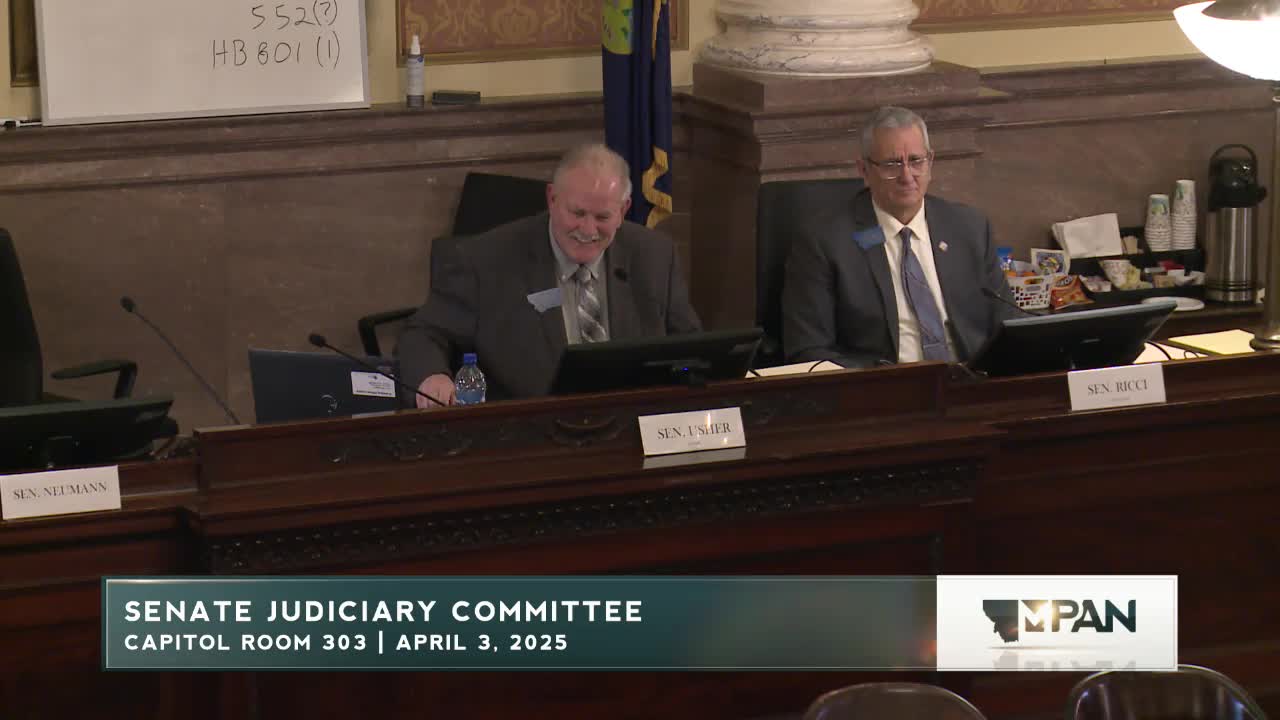
The committee proceeded to executive action on HB 801. Senator Manzella moved that HB 801 be concurred in. The roll call recorded: Vice Chair Ricky — yes (by proxy), Vice Chair Olsen — no, Senator Emmerich — yes, Senator Manzella — yes, Senator Newman — no, Senator Smith — no, Senator Vinton — yes, Chair Usher — yes. The motion passed, 5–3; the committee reported the bill out of Senate Judiciary with a do-pass recommendation.
Why it matters: Supporters say the bill prevents litigation tactics they view as attempts to hold manufacturers responsible for criminal misuse of firearms; opponents say it undermines Montanans’ access to legal remedies and creates a special exemption for one industry. The statute, if enacted, would change how Montana courts treat PLCAA predicate-exception claims and negligent-marketing theories involving firearms or ammunition.
Sources and status: HB 801 was opened for hearing in Senate Judiciary, heard with proponents and opponents in the room, moved in executive action, and concurred in by the committee (vote recorded in the committee transcript).