Get Full Government Meeting Transcripts, Videos, & Alerts Forever!
Get email alerts on the Early Childhood Education topic
No spam. Unsubscribe anytime.
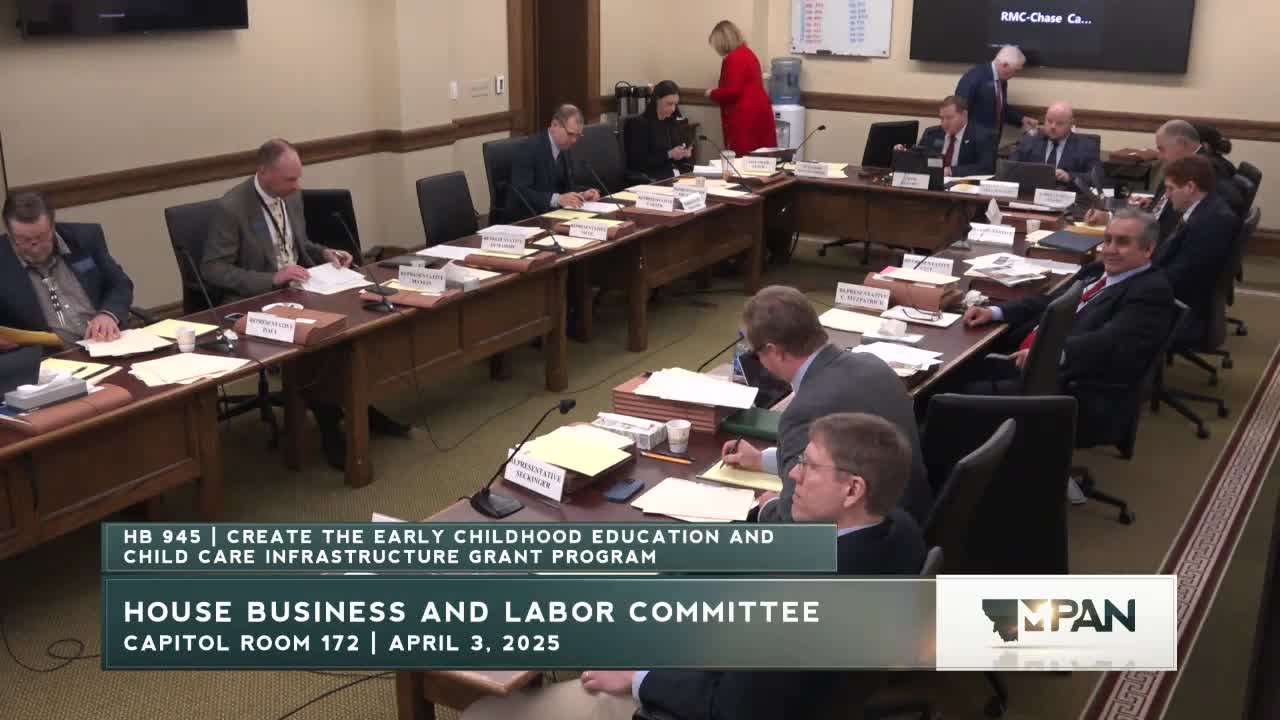
Bill to create childcare infrastructure grant program draws strong support from providers and economic-development groups
Summary
HB 945 would create a state grant program to help child‑care businesses with start‑up, renovation and expansion costs; supporters said one‑time capital grants can create new licensed slots and increase workforce participation, while advocates asked the committee to broaden eligibility and ease match rules for small providers.
House Bill 945 would create a state grant program — the Early Childhood Education and Child Care Infrastructure Grant Program — administered by the Montana Department of Commerce to provide one‑time capital and startup grants for child‑care facilities (startups, expansions and renovations). Representative Katie Sullivan (R‑House District 93) sponsored the bill and framed it as a small‑business infrastructure program to increase licensed child‑care capacity, reduce waitlists and support workforce participation.
Why it matters: Montana faces a shortage of licensed childcare, particularly for infant/toddler care; providers and economic‑development witnesses said limited capital and renovation costs are major barriers to opening or expanding licensed programs, especially in rural communities.
Support and technical testimony: 0 to 5 Montana (state early‑childhood nonprofit) and a roster of childcare providers and local economic‑development organizations urged passage. Caitlin Jensen (0 to 5 Montana) and Jason Nitschke (0 to 5’s senior childcare‑business advisor) testified that capital needs and inability to access equity capital were primary reasons potential providers did not open or expand. Todd O’Hair (Montana Chamber of Commerce) and Alison Corbin (Montana Economic Developers Association) said childcare capacity is a workforce‑development issue that affects employers statewide.
Concerns and suggested fixes: Montana Advocates for Children urged three changes to ensure the program reaches small providers: (1) expand eligible applicant types to include sole proprietorships and partnerships (most Montana childcare programs are small, single‑owner businesses); (2) remove, or exempt very small applicants from, the bill’s proposed 1:1 non‑public match requirement for grants over $50,000; and (3) revisit the geographic prioritization language (the bill limits awards to two grants per county) because larger urban areas have much larger gaps in capacity and may need more than two grants per county.
Agency roles: If enacted, Commerce would administer the program and the Department of Public Health and Human Services (Early Childhood and Family Support Division) would provide training and technical assistance to licensed providers; Commerce staff present said their Business & Trade division would house program administration.
Outcome: HB 945 received broad support in the public hearing and was closed by the committee; committee members were receptive to technical changes and the sponsor said she would work with stakeholders and is open to amendments if the committee moves the bill forward. (The transcript records the hearing and indicates the bill was closed in committee; executive action on this bill was not recorded in the session excerpt.)
Next steps: If the Legislature funds HB 945, the state will need to set grant size, match rules and eligibility criteria (with attention to sole proprietors and rural providers) and decide reporting requirements and distribution priorities to achieve statewide capacity gains.