Get Full Government Meeting Transcripts, Videos, & Alerts Forever!
Get email alerts on the Data Centers Tax Incentives topic
No spam. Unsubscribe anytime.
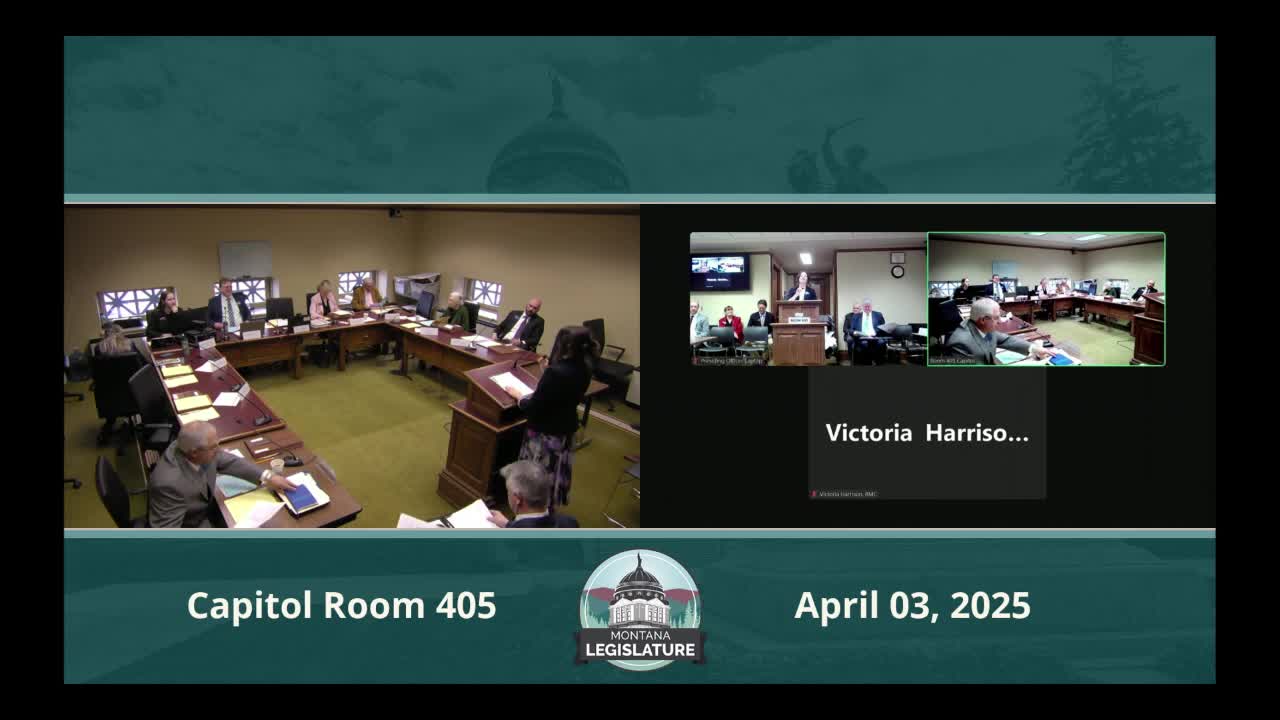
Tax committee hears bill to extend Class 17 to data centers that generate on-site power
Summary
A Montana House bill would expand the state's Class 17 property classification to new data centers that provide behind-the-meter electricity generation and allow excess power to flow to the grid during governor-declared emergencies; committee held a hearing but took no vote.
Rep. Katie Zolnicov introduced House Bill 4 24 to the Montana Tax Committee on Thursday, proposing to expand the state's existing Class 17 property classification to include new data centers that generate the majority of their power on-site.
The bill would allow data centers that supply up to 80% of their own electrical load with behind-the-meter generation to qualify for the Class 17 tax treatment; Rep. Katie Zolnicov, the sponsor, told the committee, "we are trying to incentivize any data centers that come to the state to provide their own electrical generation behind the meter." She said the 80% threshold is waived if the governor declares an electrical generation emergency, allowing a qualifying data center to route its on-site generation to the local grid during an emergency.
Why it matters: supporters said the bill would help Montana compete for data center investment and bolster local grid resilience. "Sabey Data Centers is an industry leader," attorney Mark Taylor testified on behalf of Sabey, which has evaluated Montana locations for more than a decade. Taylor said data centers with on-site generation can provide power to communities in emergencies and pointed to Quincy, Washington, as a local-tax example, noting that the county's tax base grew from about $4,000,000,000 to $14,000,000,000 over a decade after data center investment.
Committee testimony and technical details
Proponents included Todd O'Hare, president and CEO of the Montana Chamber of Commerce, and George Harris of the Montana Coal Council, both of whom stressed economic and energy-supply benefits. O'Hare called Montana "in a catbird position" for attraction of large facilities and emphasized rural job potential; Harris highlighted coal as a reliable generation resource during periods when wind and solar are not producing.
Anne Hedges of the Montana Environmental Information Center appeared as an informational witness. She told the committee that data centers are "very, very interested" in renewables but often remain connected to the grid for backup, and she said the bill is notable for "incentiviz[ing] them to bring new energy." Jared Isom, an economist with the Department of Revenue, and Bryce Kautz, bureau chief with the Property Assessment Division, logged on as informational witnesses to answer fiscal and assessment questions.
Sponsors and supporters described a series of House amendments that changed taxable treatment and timing: the sponsor said the preferred Class 17 rate would apply to new qualifying facilities for the first 10 years, then fall to half of the Class 13 rate (3%) for the subsequent 10 years, and then settle at 6% thereafter. The bill also, according to testimony, applies only to new construction after enactment and includes language stating that a data center located in a tax increment financing (TIF) district must still pay the 95 mills imposed statewide.
Issues raised in questioning
Committee members pressed witnesses on water use, transmission capacity and the mix of generation technologies that could be used behind the meter. Mark Taylor said data centers could pair with solar, wind, geothermal, nuclear or natural gas and noted many facilities use redundant, rapid-start backup generation. On transmission, Anne Hedges said on-site generation reduces need for very large regional lines but some local connecting lines would still be required for exporting excess power in emergencies. Taylor and others acknowledged that site selection and economic decisions remain subject to private due diligence; Sabey had not committed to build in Montana at the time of testimony.
Outcome and next steps
The committee held the hearing and asked questions but took no committee vote on the bill at this session. Representative Zolnicov closed by urging the committee to pass the bill; the chair closed the hearing and adjourned the committee for the day.
Ending note: witnesses recommended further technical study of transmission, water impacts and local permitting as the bill moves through the legislative process.