Get Full Government Meeting Transcripts, Videos, & Alerts Forever!
Get email alerts on the Trade And Economic Development topic
No spam. Unsubscribe anytime.
Montana bill to open trade office in Israel draws hours of public opposition
Summary
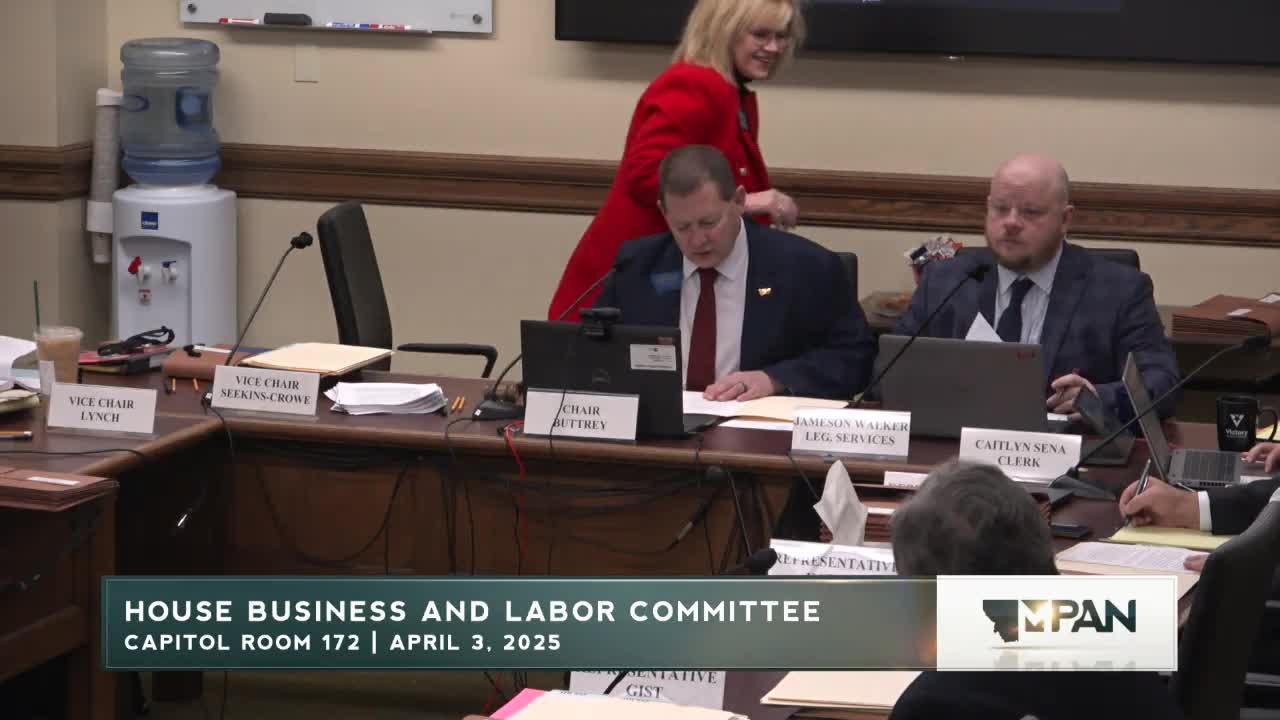
House Business and Labor heard hours of testimony on HB 950, which would create a Montana trade office in Israel and carry a $500,000 biennial appropriation; proponents tied the office to Montana strengths in photonics and ag tech, while opponents urged keeping the money in-state and criticized ties to companies they said support Israeli military operations.
House Business and Labor opened and closed a public hearing on House Bill 950, a proposal to create a Montana trade office in Israel with a biennial appropriation of $500,000 ($250,000 per year). The bill’s sponsor, Representative Brad Barker (R‑House District 55), said the office would promote Montana research-and-development and exports — particularly in photonics, agriculture technology, water technology, biotech and cyber — and cited Bozeman’s large photonics cluster as a natural fit.
Why it matters: The measure would create a state presence in a politically sensitive foreign market while directing taxpayer money to support Montana businesses’ market-development efforts overseas. Proponents framed HB 950 as a targeted economic tool tied to existing Montana industry strengths; opponents framed it as a moral and fiscal error and urged prioritizing Montana spending at home.
Supporters’ case: Barker and Montana Department of Commerce witnesses described how Montana’s existing trade offices (in Taiwan and Japan) are staffed by in-country contractors and managed by Commerce personnel in Helena. Deputy Director Mandy Rambo said those offices cost roughly $130,000–$170,000 per year each for contracted staff and that the requested appropriation covers both in‑country costs and the incremental Montana staff cost needed to manage another office. Rambo said trade with Israel totaled about $9 million in goods in 2024 and is concentrated in optics/photonics and pulse crops; she and Barker said a dedicated trade office can help Montana businesses increase market share through trade missions and R&D partnerships.
Opponents’ concerns: More than a dozen opponents, many testifying remotely, urged the committee to reject HB 950. Testimony focused on three recurring themes: (1) the $500,000 appropriation should be spent on Montana priorities such as school lunches, teacher pay, housing or childcare; (2) Israel’s private-sector technologies cited by the sponsor (particularly photonics and surveillance technology) are linked, in their view, to military applications and alleged human-rights abuses; and (3) taking a formal state role in Israel could be interpreted as a political endorsement of Israeli government policies. Speakers included Jane Clarke, Donald Jacques, Gwen Nicholson, Brandon Wirk, Kate Keller and others; several described personal ties to or experiences in Gaza and argued Montana should not facilitate trade that they said would support Israeli military capabilities.
Committee questioning and context: Committee members asked Commerce witnesses about how Montana’s two existing trade offices work (staffing, mission, and measurable returns) and whether trade offices are necessary to grow exports. Rambo pointed to a 23% increase in Montana exports to Taiwan from 2023 to 2024 as an example of measurable growth tied to an office. Members also raised concerns about political volatility in the region; Barker repeatedly characterized HB 950 as an economic — not foreign policy — measure focused on Montana businesses.
Outcome: The committee took executive action on multiple bills later in the day. After debate and a failed substitute motion to table, members voted to advance HB 950 to the House floor. The committee recorded the motion as passing; the official tally reported on the record was “motion passes 12 4 8 against” (as read on the floor transcript). The committee chair stated HB 950 will move to the House floor for further action.
What to watch next: If HB 950 reaches the House floor and later the Senate, amendments could change the funding level, reporting requirements, or restrictions on how the office operates. Watch for any floor amendments that narrow the office’s focus to non‑defense sectors or that add additional transparency and reporting requirements to the Department of Commerce.