Get Full Government Meeting Transcripts, Videos, & Alerts Forever!
Get email alerts on the Public Safety topic
No spam. Unsubscribe anytime.
Public hearing on HB 5,005 spotlights funding needs for Criminal Justice Commission programs
Summary
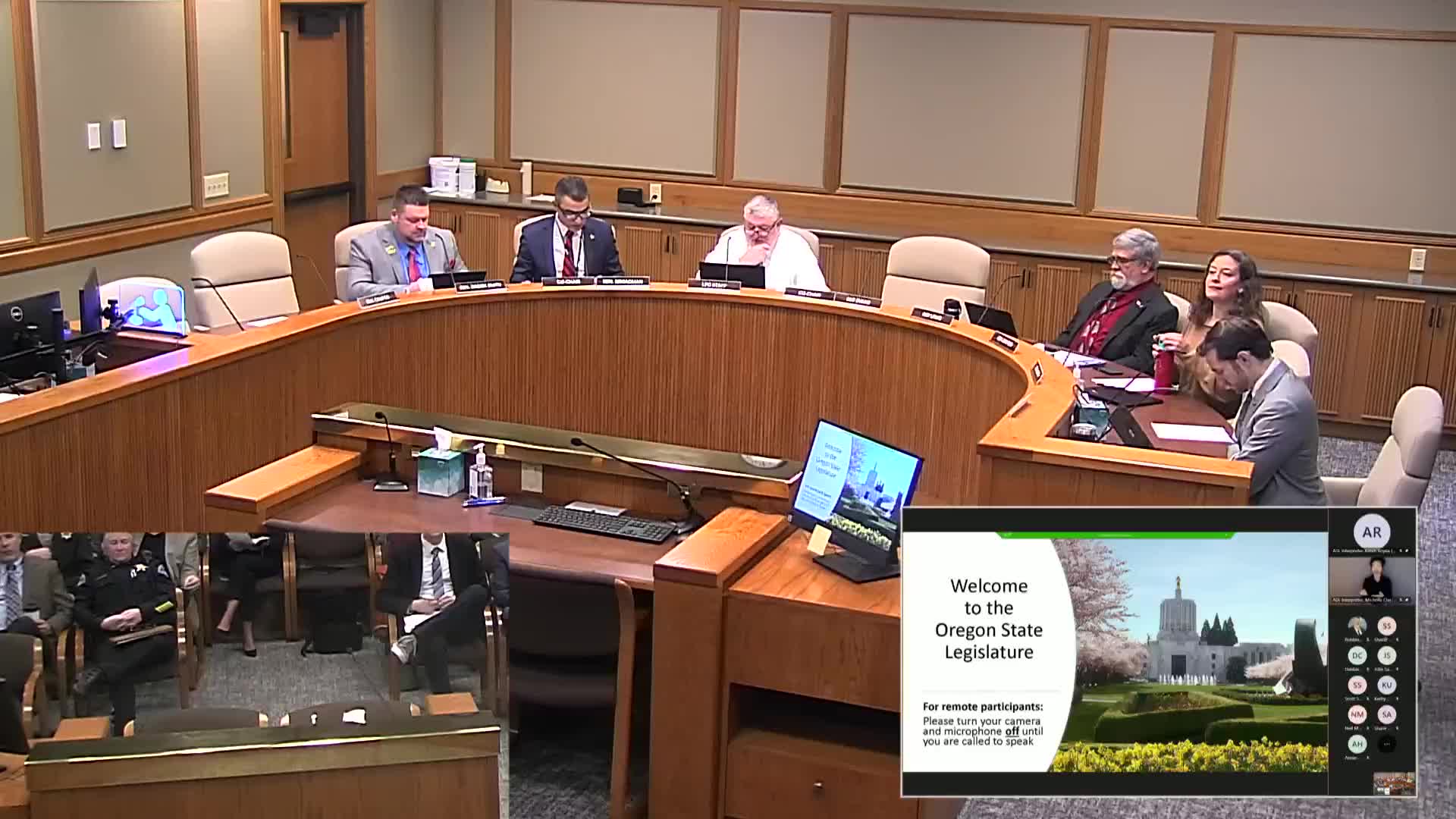
The Joint Committee on Ways and Means Subcommittee on Public Safety held a public hearing April 3, 2025, on House Bill 5,005, the Criminal Justice Commission's primary budget bill.
The Joint Committee on Ways and Means Subcommittee on Public Safety held a public hearing April 3, 2025, on House Bill 5,005, the Criminal Justice Commission's primary budget bill. Law enforcement leaders, county officials, community-based organizations and service providers testified in support of full funding and several policy amendments for programs that cover behavioral health deflection, restorative justice grants, jail-based medication for opioid use disorder and illegal marijuana market enforcement.
The hearing matter matters because HB 5,005 directs appropriation levels that counties and service providers say sustain newly created deflection programs and other grants that divert people from incarceration into treatment, support crisis services and fund enforcement and victim services related to illegal cannabis operations. Witnesses said program operations are at risk without continued or increased funding and urged inclusion of several “dash-1” amendments and additions to the governor's recommended budget.
Amanda Dalton, president of the Northwest Grocery Retail Association, asked the committee to prioritize a supportive grant the association received in 2023, noting the 2023 appropriation of $5,000,000 funded cross-county enforcement “blitzes” and shared resources to counter organized retail theft. Dalton said, “I uploaded [the report] twice, it's that important,” and urged the committee to include related language from Senate Bill 96C in the budget.
Holly Harris, behavioral health director for Deschutes County representing the Community Mental Health Program, described the county's Stabilization Center—supported previously by CJC’s impacts grant—and warned that “Without continued funding, operations at that level will not be possible.” Harris said the center has served more than 4,400 unique individuals and recorded more than 15,000 visits, has diverted about 30% of people from emergency departments and jails, and that 67 people told staff they would have ended their lives had the center not been available.
Sheriff Matt English of Hood River County, speaking for the Oregon State Sheriffs Association, and Sheriff Sam Elliott of Yamhill County each told the committee the CJC-funded enforcement and deflection programs have produced measurable public-safety benefits. English said expanded policy option packages would “allow counties to further develop community based behavioral health deflection programs” and improve long-term outcomes. Elliott described recent enforcement seizures in Yamhill County, saying one operation had “over 100 greenhouses, 22,000 marijuana plants, and over 10,000 pounds of marijuana,” and another yielded “over 76,000 pounds of marijuana,” and he urged continuation of the illegal marijuana market enforcement grant to avoid a resurgence of illicit grows.
Rob Bovette, adjunct professor and former vice chair of the Criminal Justice Commission, urged the committee to adopt the dash-1 amendments that would make temporary marijuana-enforcement funding more durable. Bovette said the basic math for the enforcement grant is a $6,000,000 baseline (marijuana-tax funding) and a roughly $5,000,000 expected carryover, and that an additional $11,000,000 is needed to maintain current service levels.
Multiple speakers pressed for higher allocations for two central items in the governor's recommended budget. County and local officials and deflection coordinators asked that the Behavioral Health Deflection Program be funded at $46,900,000 rather than the $40,000,000 in the governor's recommendation. Deputy Neil Marchington, deflection coordinator for the Deschutes County Sheriff’s Office, said their program—operational since Sept. 1, 2024—has led to rapid access to treatment and reported that many participants have had no arrests after deflection.
Restorative justice providers and prosecutors asked that the Restorative Justice Grant Program be set at $8,000,000 for the next biennium. Testimony from public defenders, prosecutors and local program directors described lower recidivism in pilot projects and cost savings tied to avoided incarceration; for example, the Emerging Adults Program in Deschutes County reported a 9 percent rearrest rate for participants tracked since 2021 compared with a 66.7 percent rearrest rate for the county’s 18–30 population in 2021, according to testimony citing CJC dashboard figures.
Community-based organizations and legal aid representatives also asked the committee to continue funding the CJC’s illegal marijuana market enforcement grant, which supports both law enforcement operations and wraparound services for exploited workers. Witnesses described outreach and service partnerships organized under the Cannabis Workers Resilience Partnership and urged that dash-1 amendments preserve funding for community-based legal and mental-health services that assist farmworkers and others exploited in illegal grow operations.
Several speakers emphasized the CJC’s data and technical-assistance role. Paul Solomon, chair of the Criminal Justice Commission, described the agency as Oregon’s central repository for criminal justice data and analysis and urged full funding to sustain grant administration, program evaluation and evidence-based policy decisions.
The subcommittee opened the public hearing at the start of the session, took in-person and remote testimony from more than three dozen witnesses representing sheriffs, county officials, nonprofit service providers and victims’ advocates, and closed the public hearing later the same day. Cochair Broadman noted that the committee will accept written testimony for 48 hours from the start of the hearing and that the Legislative Fiscal Office will review next week’s agenda items, including a Department of Emergency Management budget bill and April population forecasts.
The hearing record includes multiple written submissions posted to OLIS and further follow-up from parties that want the committee to incorporate the dash-1 amendments, increase appropriations for deflection and restorative justice, and preserve and continue support for the illegal marijuana market enforcement grant and associated community-based services.