Get Full Government Meeting Transcripts, Videos, & Alerts Forever!
Get email alerts on the Public Pensions Investments topic
No spam. Unsubscribe anytime.
Treasury investment office defends long-term strategy, requests more staff for fixed-income work
Summary
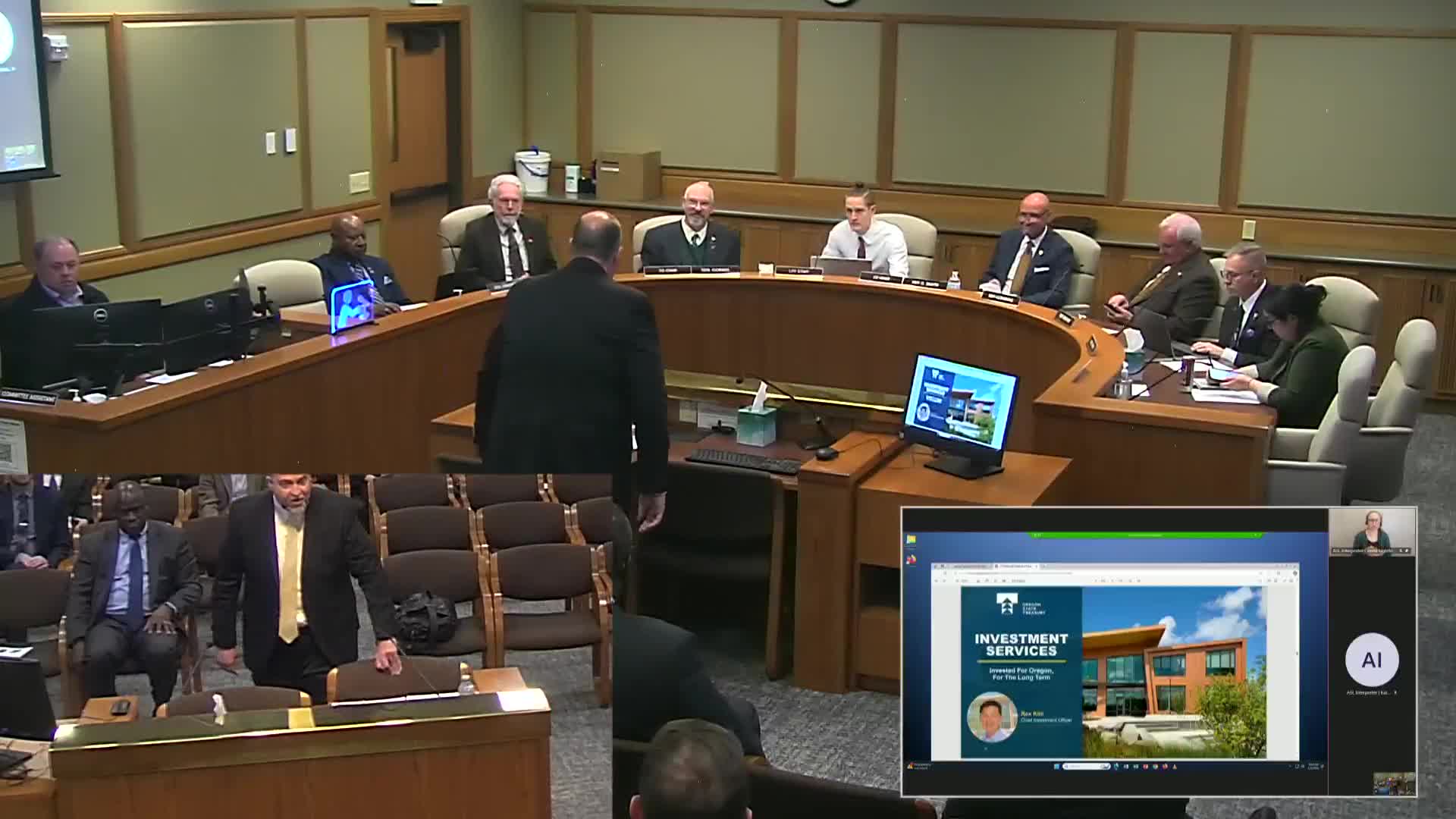
Deputy Treasurer George Naughton and Rex Kim, chief investment officer for the Oregon State Treasury, told the Ways and Means Subcommittee on General Government on April 3 that the agency's investment team manages hundreds of billions of dollars and needs added staff to handle growing fixed‑income and complexity demands.
Deputy Treasurer George Naughton and Rex Kim, chief investment officer for the Oregon State Treasury, told the Ways and Means Subcommittee on General Government on April 3 that the agency's investment team manages hundreds of billions of dollars and needs added staff to handle growing fixed‑income and complexity demands.
The presentation said the Oregon Public Employee Retirement Fund (OPRF) and related portfolios total about $141 billion, with roughly $95 billion in the defined‑benefit program, $36 billion in the Oregon Short Term Fund and other large internal mandates. Kim said the fund's five‑ and ten‑year returns have outperformed a 70/30 stock‑bond reference portfolio, with a rolling five‑year average excess return of about 1.4 percent.
Those returns, Kim said, reduce employer contribution needs: "Using the $95,000,000,000 for the defined benefit program today, that is more than $1,000,000,000 that employers do not need to contribute because of our value add above the 70/30 portfolio." He also warned that the most recent one‑year results were weaker.
The presentation emphasized governance: the Public Employee Retirement Board (PERS board) sets the assumed return rate (6.9 percent, Kim noted), and the Oregon Investment Council (OIC) sets reference portfolios and policy. Kim described the reference portfolio as a benchmark to measure how much risk the OPRF needs to take to reach the assumed rate.
Committee members pressed the office on risk and local investment. Senator Anderson asked whether "most productive" investments meant more than return; Kim and Naughton replied that investment choices are driven by fiduciary duty to beneficiaries and risk/return tradeoffs, while other Treasury divisions (debt management, for example) pursue different public‑policy objectives.
On staffing, the agency asked for Policy Option Package (POP) 106 (investment services capacity). Kim and Naughton said staffing levels remain low relative to peer institutional investors and cited CEM benchmarking; they said the fixed‑income team currently manages large pools (including about $36 billion in the Oregon Short Term Fund) with a small team and requested additional positions to increase coverage and reduce operational risk.
Committee members raised internal‑control questions. Representative Smith asked about mandatory time off for key personnel; the investment team said it maintains backup, redundancy, internal audit and external reviews but will take the committee's mandatory time‑off question back for further consideration. Naughton noted audits by the Secretary of State, PERS board‑commissioned audits and an internal audit function.
No formal action was taken on POP 106 at the hearing; the presentation was informational and part of the record for Senate Bill 5542.
Ending: The investment presentation concluded before the hearing moved to other Treasury divisions. The staffing request and risk disclosures will be part of the subcommittee's budget deliberations on SB 5542.