
Council approves RHID for Union at Tower District with 20-year cap and sale clawback
Get AI-powered insights, summaries, and transcripts
Sign Up Free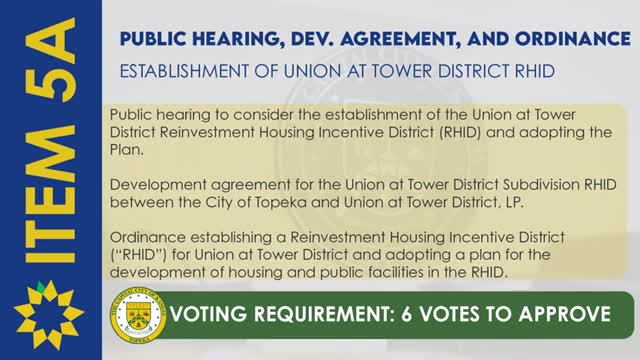
Summary
After a public hearing and weeks of financial review, the Topeka City Council approved a reinvestment housing incentive district (RHID) and development agreement for the Union at Tower District project, requiring a 20-year, capped tax-abatement package and a clawback if the property is sold before the term ends.
The Topeka City Council voted to establish a reinvestment housing incentive district (RHID) for the Union at Tower District and to approve a development agreement with the project's developer, the Annex Group, after adding a 20-year limit, a $12,000,000 gross RHID cap and a clawback condition that would end RHID benefits if the property is sold before the term expires.
The vote followed a public hearing and extended presentations from city staff and the developer. The project would build 250 apartment units downtown between 11th and 12th Streets and Quincy and Monroe, with a mix of one-, two- and three-bedroom units that the developer said will be income-qualified and capped at 30%, 50% and 60% of area median income in some units.
City staff and the RHID review committee had analyzed the developer's original request and financial pro forma. The applicant sought a net present value (NPV) RHID reimbursement the city characterized as $7,600,000 (about $15,800,000 gross over 25 years), while the city's initial financial review recommended a much smaller NPV (about $900,000). The RHID review committee had earlier proposed a compromise at about $4,800,000 (gross), but council members eventually approved the developer's project with the conditions that limit the RHID to 20 years and cap the gross RHID at $12,000,000 (the city estimated that cap equates to a roughly $6,600,000 NPV).
Why the decision mattered
Council members and staff said Topeka needs high-quality, affordable units close to downtown to support the area's revitalization. Developer representatives said the financing package is necessary to make the $58 million project feasible. Kurt Peterson of Polsinelli, representing the developer, told the council the project is "shovel ready" and that closing was scheduled in about 10 days if the council approved the RHID.
Financial context and incentives
Deputy City Manager Braxton Copley summarized the competing financial analyses and emphasized the distinction between net present value and gross tax-abatement totals: "The 7.6 request is the net present value. So really, the gross amount is closer to $15,000,000," he said, adding that the $4,800,000 figure recommended by the RHID committee was a gross amount. The developer has additional subsidies: the project was awarded federal 4% low-income housing tax credits and an industrial revenue bond (IRB) from Shawnee County for sales-tax exemption on construction materials.
Kurt Peterson and Joyce Skidmore (Annex Group's director of development) explained the developer's operating and community plan, including a nonprofit partner, Impact Housing Corp, that would provide resident services. Peterson described the project as "250 quality homes in this location at affordable prices, bringing the impact nonprofit services, commitment to being in this community for at least the next 30 years."
Council debate and amendment
Several council members pressed staff and the developer on the magnitude of the requested incentives and whether the city would be over-incentivizing a privately held project. Councilmember Neil Dobler moved to approve the RHID and development agreement as presented but with two amendments: (1) a clawback provision that ends the RHID if the property is sold before the RHID terminates, and (2) reduce the RHID term to 20 years with a gross cap of $12,000,000. Braxton Copley confirmed for the council that the developer and the city's counsel could document that cap in the developer agreement. The motion passed on roll call (10-0).
What the approvals require next
Council directed staff and the city attorney to incorporate the 20-year term, the $12,000,000 gross cap and the sale-clawback language into the final ordinance and development agreement. Staff indicated the developer planned to close financing quickly if the approvals were finalized.
Community and funding details
- Projected total development cost: about $58,000,000. - Units: 250 apartments; a mix of one-, two- and three-bedroom units. - Affordability: project will include units capped at 30%, 50% and 60% AMI; staff said the project will also include a 10% discount to fair-market rents in some form in the plan documents. - Known incentives cited in the presentation: federal LIHTC (4%) allocation, state LIHTC, county IRB sales-tax exemption; city RHID tax-abatement capped at $12,000,000 (gross) over 20 years per the council approval.
Ending
Council members described the vote as a compromise between the developer's financing needs and the city's obligation to avoid over-incentivizing a project that already used significant state and federal subsidies. With the conditions added, the developer said it would move forward with closing and construction on an accelerated schedule.