Get Full Government Meeting Transcripts, Videos, & Alerts Forever!
Get email alerts on the Youth Mental Health Suicide Prevention topic
No spam. Unsubscribe anytime.
Sources of Strength peer program credited with no student suicides in Lower Kuskokwim schools since 2022, presenter says
Summary
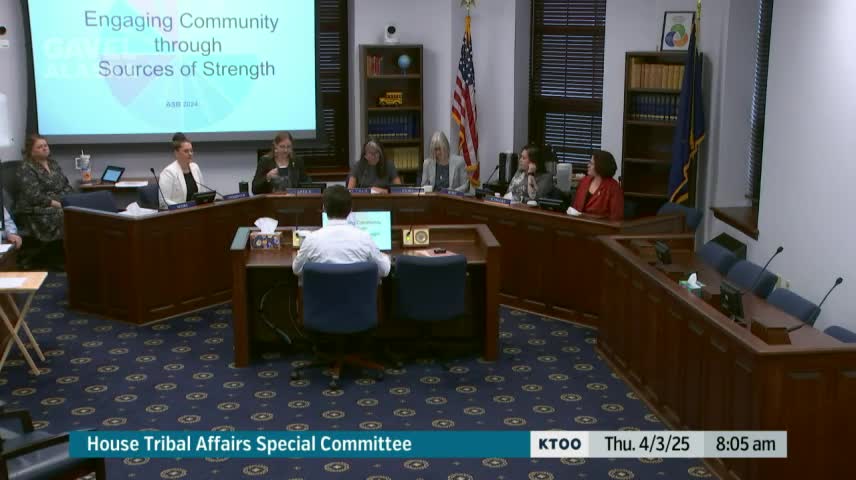
James Vila, advocacy ambassador and healing coordinator for the American Foundation for Suicide Prevention (AFSP) Alaska chapter, told the Alaska House Tribal Affairs Committee on April 3 that a locally adapted Sources of Strength peer-mentoring program is now active in most schools in the Lower Kuskokwim School District and that the district has not recorded a student suicide since 2022.
James Vila, advocacy ambassador and healing coordinator for the American Foundation for Suicide Prevention (AFSP) Alaska chapter, told the Alaska House Tribal Affairs Committee on April 3 that a locally adapted Sources of Strength peer-mentoring program is now active in most schools in the Lower Kuskokwim School District and that the district has not recorded a student suicide since 2022.
The program, Vila said, is peer led and built around eight “cycles” — mental health, family support, positive friends, mentors, healthy activities, generosity, spirituality and physical health — with monthly family nights and periodic campaigns in schools. Vila described a multi-day “Hope and Healing” event in the village of Tuksuk Bay that evolved into regular cultural programming and community-wide activities tied to the Sources of Strength curriculum.
Why it matters: suicide and suicidal ideation have been persistent problems across rural Alaska communities, particularly for young people. Committee members repeatedly praised the program’s cultural adaptation and community involvement; several asked whether the model can be scaled beyond LKSD. Joanne Profrock, area director for AFSP Alaska, said the national organization is paying attention and wants to support expansion.
How the program works and local adaptations Vila told the committee that Sources of Strength began in the Northern Plains in the late 1980s and that LKSD adapted it to local Yup’ik traditions after testing a Westernized curriculum that did not resonate with students. Vila said peer leaders meet twice weekly with an adult advisor; the program runs campaigns in two half-year cycles (Aug–Dec and Jan–May). Family nights are typically monthly, two-hour events held in school buildings that focus on a single cycle each session.
Vila described tangible local adaptations: classroom posters with student messages, QR-code audio segments recorded by students, Yup’ik translations in progress and cultural activities such as a drum painted with Sources of Strength imagery. He said the program has mobilized large community events — one Hope and Healing event drew about 700 people and included a memorial feast and celebration dance.
Funding, staffing and training Committee members asked about funding and staffing. Vila said the district has received multiple grants and that district-level funding this year was “something like $30,000” to cover supplies and the program stipends. He said adult advisors who take on extra work are paid a stipend of $1,000 per school year; an external trainer costs roughly $6,000 for a one-day training. Vila also said the district’s Sources of Strength rollout is largely supported by a Title IV federal grant that will continue for five years.
Vila and committee members also described human-services limits that affect implementation. The Lower Kuskokwim School District has nine social workers assigned across 26 villages; four social workers are based in Bethel, and five travel among villages. Vila said village social workers typically spend about five to six days at a site before rotating. For referrals beyond school-based support, staff refer to Yukon Kuskokwim regional behavioral health services; Vila said those services generally have a four- to six-week wait for evaluation. For imminent risk, the village public officer (VPO) can be notified for Title 47 involuntary-commitment procedures and to arrange emergency transport.
Reported outcomes and cautions Vila reported outcomes the district has tracked: he said student test scores in one village (Nightmute) improved significantly after the program and that LKSD has not had a youth suicide since schools reopened in 2022. He cautioned that the tracking is ongoing and that reporting of suicidal ideation continues even where attempts have not occurred; he offered to provide committee members with more detailed data on referrals, ideation reports and grant amounts.
Committee response and next steps Committee members from across the political spectrum praised the peer-led, place-based approach and asked about expansion, translation work and partnerships with the University of Alaska Fairbanks Center for Alaska Native Health Research. Joanna Profrock of AFSP Alaska, who joined Vila at the hearing, said, “He’s a force of one,” and added that AFSP’s national office is taking an interest in the Alaska adaptations. Rep. Schwanke noted the role of “social connection and nature” in rural healing and encouraged wider use of the model.
Vila said he would follow up with detailed funding and program information by email to committee staff and welcomed additional school districts and community partners to adapt the model’s cultural elements. He also plans to present a workshop on Sources of Strength at an elders-and-youth conference in October. No formal committee action or vote was taken during the presentation.
Quotes "Talking saves lives," Vila said during his presentation. "He's a force of one," Joanne Profrock said of Vila's work for AFSP Alaska. "We need social connection and we need nature," Rep. Schwanke said in praise of the program's cultural grounding.
Ending Vila and AFSP Alaska asked committee members to help spread awareness; Vila said he would supply grant and funding details to the committee by email. The committee did not take formal action on the presentation; its next scheduled items include a follow-up on House Bill 59 and a separate presentation on missing and murdered Indigenous women, girls and two-spirit Alaskans.