Arctic Slope Regional Corporation tells House Resources committee it supports Alaska jobs, pays major dividends
Loading...
Summary
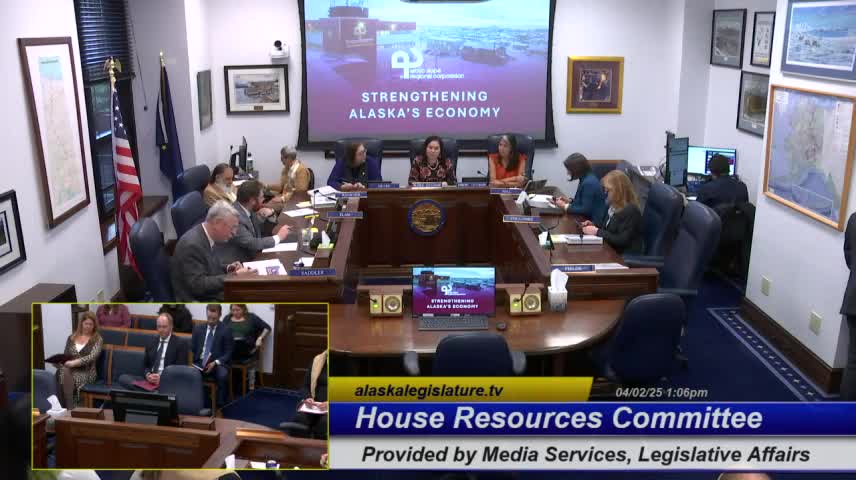
Juneau — Arctic Slope Regional Corporation officials told the Alaska House Resources Committee on April 2 that ASRC’s Alaska operations employed about 3,700 people in 2024 and paid roughly $500 million in wages in the state, and that ASRC distributed $188,300,000 in shareholder dividends in the most recent year.
Juneau — Arctic Slope Regional Corporation officials told the Alaska House Resources Committee on April 2 that ASRC’s Alaska operations employed about 3,700 people in 2024 and paid roughly $500 million in wages in the state, and that ASRC distributed $188,300,000 in shareholder dividends in the most recent year.
The presentation, led by Bridget Anderson, senior vice president of external affairs for ASRC, outlined the corporation’s history under the Alaska Native Claims Settlement Act, its business divisions and the company’s role in statewide revenue sharing under ANCSA sections 7(i) and 7(j). Anderson told the committee ASRC has contributed “over $1.8 billion” in 7(i)/7(j) payments tied to development of ANCSA lands and stressed that ASRC intends to remain based in the North Slope.
Why it matters: ASRC is a major private landowner and employer with operations across Alaska and in the Lower 48. Committee members pressed subsidiaries on workforce training, local hiring and how corporate activities translate into income for shareholders and other Alaska Native corporations.
Key facts and operations
- ASRC scale and history: Anderson summarized ANCSA’s effect on the North Slope and said ASRC received roughly 5 million acres of the region’s lands after ANCSA’s enactment. She said ASRC enrolled about 3,800 original shareholders at incorporation and, after opening descendant enrollment in 1989, now has more than 14,000 shareholders from eight communities in the region.
- Employment and payouts: Anderson said ASRC had about 3,700 Alaska employees in 2024 and paid about $500 million in wages in Alaska that year. She said ASRC distributed $188,300,000 in shareholder dividends last year and that the corporation has distributed about $1.8 billion in dividends since 1974. Anderson attributed the capacity to pay dividends to ASRC’s diversified, for‑profit business model.
- 7(i)/7(j) revenue sharing: Anderson told the committee that since development of ANCSA lands beginning with Alpine production, ASRC has contributed more than $1.8 billion through ANCSA revenue‑sharing provisions commonly cited as sections 7(i) and 7(j). She said some regions, including NANA, also have been significant contributors to the statewide pool.
ASRC Energy
Christine Ressler, president and CEO of ASRC Energy, described the subsidiary as the largest provider of oilfield services on the North Slope and said the company is the largest employer on the North Slope. Ressler outlined services including downhole and remediation work, pipeline construction and operations and maintenance, and said ASRC Energy is involved in carbon capture and sequestration projects funded in part by federal Infrastructure Investment and Jobs Act grants.
Ressler said ASRC Energy is advising and managing drilling work to expand energy storage capacity in a North Slope area and noted the company’s training initiatives for shareholders and new employees. She described a program that provides industry‑entry training and said ASRC partners with a vocational training provider for initial instruction before on‑the‑job programs that place trainees into operational roles.
PetroStar
Ryan Muspratt, senior vice president of PetroStar, said PetroStar owns two of Alaska’s three commercial refineries (North Pole and Valdez) and has capacity to run about 85,000 barrels per day. He told the committee PetroStar refines nearly 100% Alaska North Slope crude feedstock in typical years and that the company sells jet fuel, ultra‑low‑sulfur diesel, heating oil and other fuels; he added, “I do want to clarify that we do not produce gasoline.”
Muspratt explained that PetroStar participates in the state’s Royalty‑in‑Kind program, under which the state delivers some royalty oil to in‑state refiners, and that PetroStar moves refined fuel around the state by double‑hulled barges and rail cars for interior distribution.
ASRC Construction
Paul Carey, president and CEO of ASRC Construction, told the committee the construction arm operates across Alaska and pursues federal, state and local public works — including military, tribal and rural projects — and that roughly 98% of its work is public (federal, borough/municipal) contracting. Carey said ASRC Construction focuses on local hire and apprenticeship programs and that Alaska hires generally exceed 95% on many projects; he also described strong involvement in federally funded health‑care and rural infrastructure projects and climate‑resilience work in communities such as Kivalina and Newtok.
Federal contracting and small business programs
Committee members asked about the federal 8(a) small‑business program and ASRC’s participation. Carey and other ASRC speakers said ASRC’s federal contracting portfolio includes 8(a) awards but is a mix of 8(a) and full‑and‑open contracts; ASRC representatives estimated a meaningful share of ASRC’s federal work comes through government initiatives that seek experienced contractors and acknowledged they will provide more precise percentages to the committee on request.
Workforce and training
Committee members repeatedly pressed subsidiaries on workforce shortages. Carey described hiring challenges across the state and said many ASRC units use apprenticeship and local‑hire approaches; Ressler outlined an industry entry training pipeline for shareholders and new employees. Anderson pointed the committee to the Arctic Education Foundation and other regional education efforts that ASRC supports to build a local labor pool.
Questions and committee follow up
Representative Colom asked about ASRC’s role in a North Slope drilling and storage project; Christine Ressler said ASRC Energy is managing drilling operations for two newly drilled wells and advising the project team on day‑to‑day drilling operations. Representative Rauscher and others asked for clarification on figures; ASRC officials said they would provide detailed breakdowns on request.
No formal committee action
The hearing was a presentation and Q&A; committee members did not take votes or make formal policy decisions during the session. The committee adjourned at 1:58 p.m. and scheduled its next House Resources meeting for April 4 at 1 p.m.
Ending: The presentation positioned ASRC as a diversified, for‑profit Alaska Native corporation that frames its business activity as both a source of shareholder dividends and a contributor to statewide revenue sharing, while committee members requested additional data on contracting mixes, training pipelines and program percentages.