Lifetime Citizen Portal Access — AI Briefings, Alerts & Unlimited Follows
DOT outlines fleet replacement, capital projects and long‑range plan for Alaska Marine Highway
Loading...
Summary
DOT presented a long‑range plan and capital priorities, including a Tustumena replacement, two ocean‑class mainliners, a low/zero‑emissions commuter ferry, and terminal upgrades; officials described procurement and Buy America considerations.
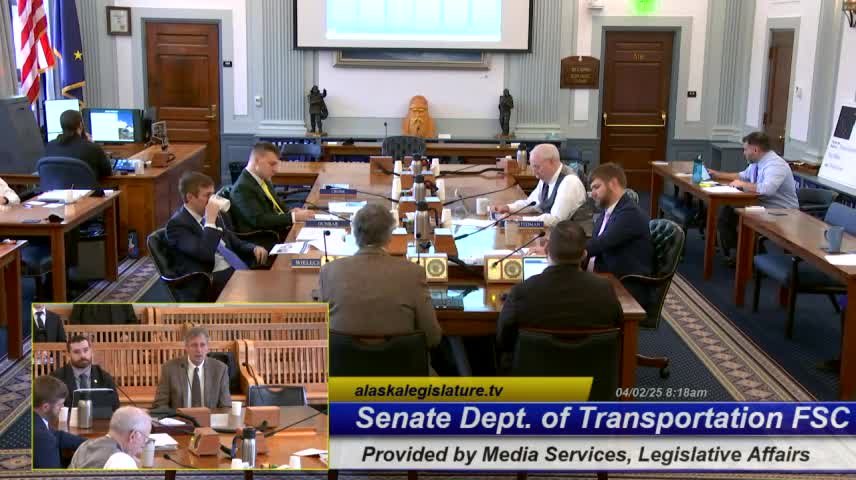
For the record, Craig Tornga, Marine Director for the Alaska Marine Highway System, described the department’s capital pipeline and long‑range fleet plan at the DOT Finance Subcommittee meeting on March 12, 2025.
Tornga said the department’s capital program totals roughly $170,000,000 in planned projects. He identified near‑term projects including crew quarters improvements at Taslina, upgrades to terminals in Prince William Sound and Southeast, generator replacement and boiler work for the MV Kennicott while in dry dock, and continuing maintenance on vessels such as MV LeConte and MV Columbia.
On vessel replacement and new builds, DOT provided the following specifics: - Tustumena replacement (the department used the spelling "Tustamina" in presentation): DOT intends to move forward with the replacement and expects to issue a request package (RP) in September after Siemens finalizes Buy America documentation for the propulsion system components. DOT said Siemens is working to certify the domestic content percentage before a Federal Transit Administration audit. - Mainliner replacements: DOT said funds exist for design work on ocean‑class mainliners and that the plan includes two sister ocean‑class vessels so they can interchange on Gulf crossings and back each other up. - Low/zero‑emissions commuter ferry: DOT reported it has issued an RP for design money, received four bids, and is evaluating responses this week.
The department said standardization is an explicit goal to reduce spare‑parts holdings, lower capital and maintenance costs, and simplify crew transitions between vessels; federal procurement rules, DOT said, constrain the degree to which specific equipment can be mandated in RFPs because of equal‑access procurement rules.
Why it matters: DOT framed the long‑range plan as a path to improved reliability and lower lifecycle costs. In DOT’s model, the planned fleet configuration would reduce average fleet age from the current high thirties down to the low teens by 2045 and increase annual port calls from roughly 5,200 to about 6,700 under the target configuration.
DOT also described equipment and maintenance trends: newer vessels will be more sensor‑driven and computerized, creating both predictive‑maintenance opportunities and cybersecurity/access questions. Senator Dunbar pressed DOT on ensuring the state retains adequate access to software and diagnostic systems so the fleet can be repaired and serviced without undue third‑party restrictions; he warned that proprietary software can potentially “brick” equipment if access is restricted.
DOT said it will present findings to the Alaska Marine Highway Operators (AMHOP) meeting later in March and that the long‑range plan will remain a living document the department reviews annually. No formal procurement award decisions were made at the hearing.