Get Full Government Meeting Transcripts, Videos, & Alerts Forever!
Get email alerts on the Mandatory Reporting topic
No spam. Unsubscribe anytime.
House committee backs study and urges legislature to consider making public officials mandatory reporters after high‑profile abuse case
Summary
House Concurrent Resolution 3,037, which asks the Legislature to consider mandatory reporting requirements and other responses to allegations that public officials exploit or conceal crimes against children, won a unanimous committee recommendation after amendments narrowed its language.
House Concurrent Resolution 3,037, which asks the Legislature to consider mandatory reporting requirements and other responses to allegations that public officials exploit or conceal crimes against children, won a unanimous committee recommendation after amendments narrowed its language.
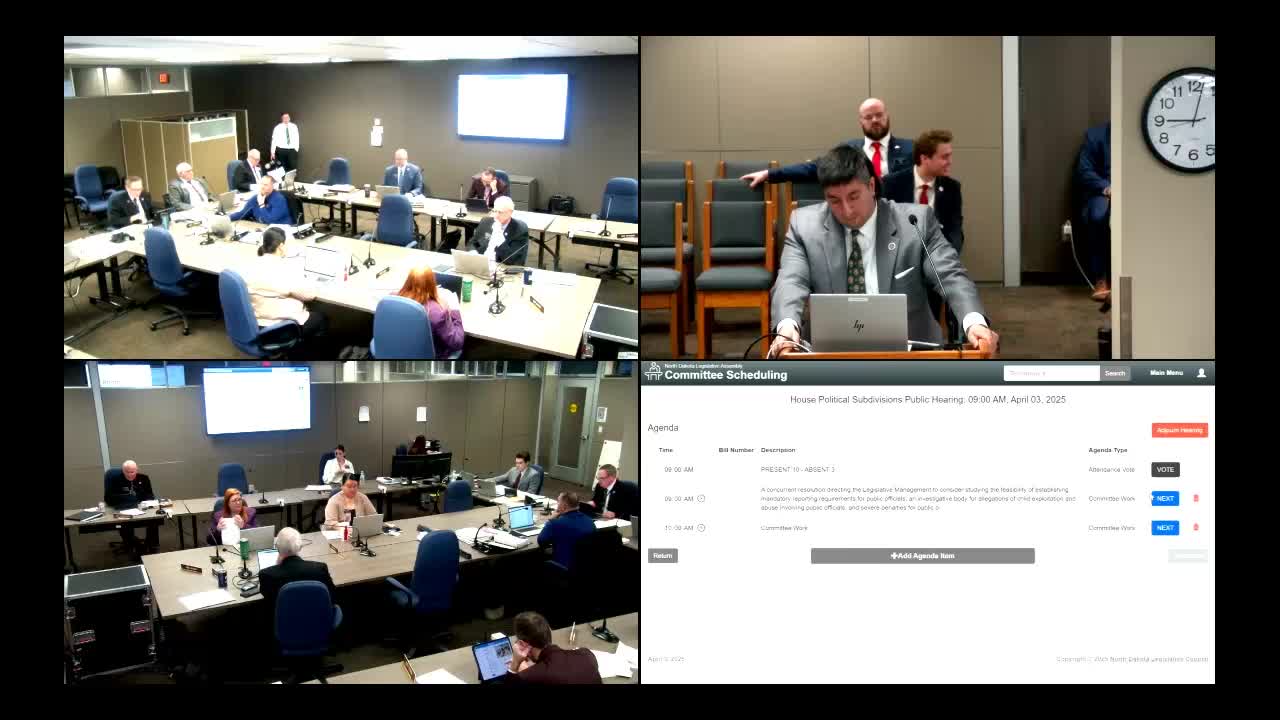
Representative Rios (District 23 of Williston), who sponsored the resolution, told the House Political Subdivisions Committee the measure "is just asking for a study to see the feasibility of mandatory reporting for government officials." Rios said the resolution grew from public reaction to recent revelations about a long‑serving former state senator and a sentencing memo that prompted calls for stronger accountability.
The resolution asks legislative management to consider a study on three pillars: mandatory reporting duties for public officials, a focused investigative mechanism for allegations involving public officials, and imposing severe penalties for officials who commit, enable, or conceal child exploitation. Rios said the study approach was chosen because of the late stage of the legislative session: "I felt like it being so late in session ... I explained to [late bills committee] that I'm bringing a resolution asking for a study because I know if I bring a bill to do just this it's gonna be much harder to pass." (Representative Rios)
Derek Turbine, national committeeman for the North Dakota Young Republicans and a member of the policy team that drafted the resolution, urged the committee to recommend passage. "The North Dakota Young Republicans respectfully urge a unanimous due pass recommendation," he said, describing the resolution as a "sincere effort to protect children." Turbine recommended a special investigative task force under the attorney general's office and urged lawmakers to treat the proposal seriously while acknowledging the drafters did not have time to develop detailed statutory language.
Committee members pressed several substantive points during discussion. Representative Haggard proposed removing lines that quoted Christian scripture; Haggard said he feared the quotation could alienate citizens of other faiths and distract from the resolution's purpose. Representative Hager offered the motion to remove the scripture lines; Representative Jonas seconded the motion. The amendment to delete the quoted scripture passed on a roll call, 7 yay, 5 nay, 1 absent.
Other lawmakers asked whether the measure should address misconduct beyond crimes against children or whether the state Ethics Commission should be involved. Representative Bosley summarized the proposal as primarily seeking to "want public officials to be a mandatory reporting occupation similar to dentists, school teachers, etcetera." Representative Moshenbacher and others asked whether a special task force in the attorney general's office was necessary and whether existing investigative or prosecutorial tools already covered the issues raised. Rios and testimony from the ND Young Republicans repeatedly emphasized that the resolution was a study of feasibility rather than an immediate statutory change.
After additional amendments that removed the study language from the body and replaced it with language urging the Seventieth Legislative Assembly to consider enacting legislation to make public officials mandatory reporters, the committee adopted the revised language by voice/roll call. Representative Heilman moved the change; Representative Balinski seconded. The committee then approved a "do pass" recommendation for House Concurrent Resolution 3,037 as amended by a roll call vote of 13 yay, 0 nay. Representative Heilman will carry the resolution.
Votes at a glance - Amendment to remove quoted scripture (lines removed as read on the floor): moved by Representative Hager, seconded by Representative Jonas. Passed 7 yay, 5 nay, 1 absent (amendment approved). - Amendment to replace the study text with language urging the Seventieth Legislative Assembly to consider legislation making public officials mandatory reporters: moved by Representative Heilman (seconded by Representative Balinski). Passed 13 yay, 0 nay. - Final committee recommendation on HCR 3,037 (as amended): motion for "do pass" moved by Representative Heilman, seconded by Representative Polinski. Passed 13 yay, 0 nay. Representative Heilman will carry the resolution to the next step.
Context and next steps The resolution repeatedly referenced a recent sentencing and reporting around a former state senator (identified in committee discussion as the impetus for the measure). Committee discussion made clear that members differed over whether the Ethics Commission, the attorney general's office, or a legislative interim committee would best handle any formal investigative role and whether any mandatory reporting requirement should be narrowly tailored (child exploitation only) or broader. Several members said the study/legislative referral should clarify whether concealment by officials should be treated as an aggravating factor or be prosecuted as a separate corruption offense.
The committee hearing drew testimony from the North Dakota Young Republicans and multiple lawmakers. No members of the public opposing the resolution spoke at the committee hearing. The committee processed the resolution to the next stage with instructions to the sponsor to carry the measure.
Ending The committee's action sends HCR 3,037 to the next legislative step with direction to lawmakers and legislative management to consider how mandatory reporting for "public officials" might be structured in statute, whether a dedicated investigative mechanism is needed, and how penal consequences for concealment should be defined. Further drafting and stakeholder work were repeatedly recommended by speakers.