Get Full Government Meeting Transcripts, Videos, & Alerts Forever!
Get email alerts on the Critical Minerals topic
No spam. Unsubscribe anytime.
Landowners, industry and researchers debate rare‑earth minerals bill; legal questions about leases and private contracts dominate testimony
Summary
House Bill 1459 drew extended testimony from landowner representatives, legal counsel and university researchers over how to develop rare‑earth minerals in lignite without violating existing coal leases or constitutional limits on government action.
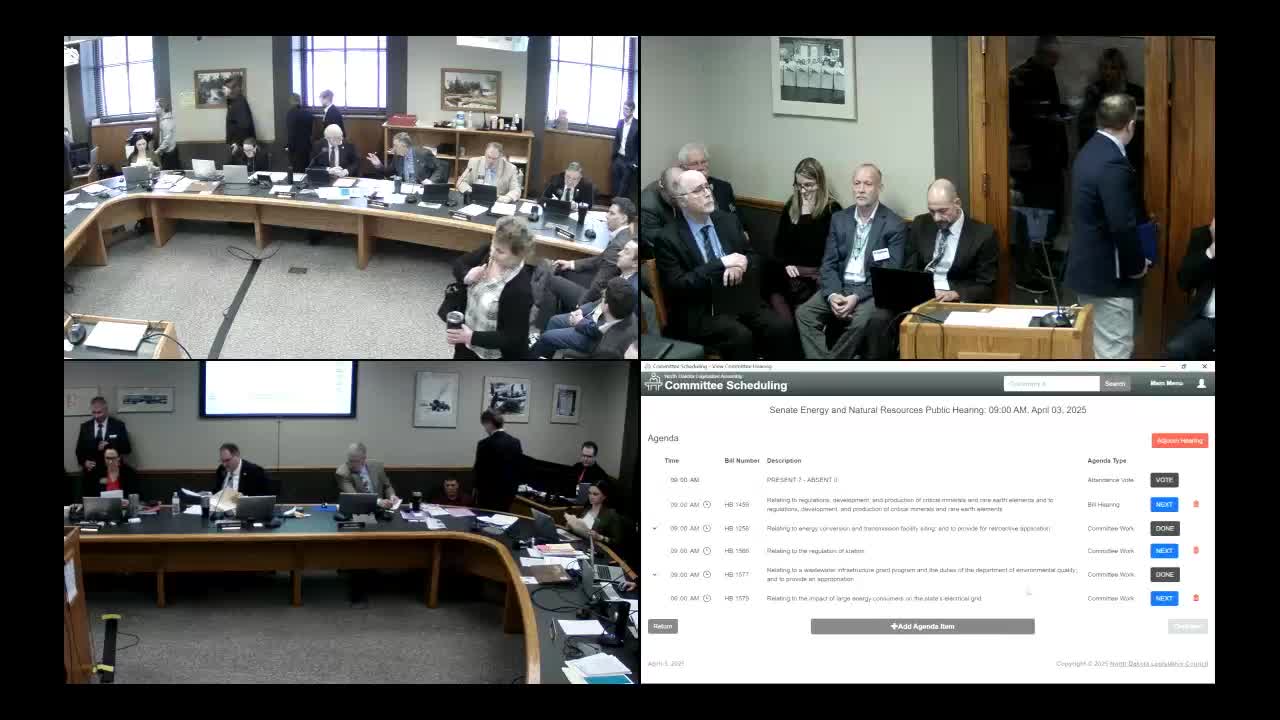
The Senate Energy and Natural Resources Committee opened extended discussion on House Bill 1459, a bill proposing statutory guidance for recovery and development of rare‑earth elements and other critical minerals associated with lignite coal. Testimony revealed disagreement over whether state law should alter contractual rights in existing coal leases or instead leave mineral owners and lessees to resolve disputes through private negotiation or litigation.
Troy Koons of the Northwest Landowners Association urged a do‑not‑pass recommendation, saying the bill "will just pit the state of North Dakota against landowners once again" and that attempts to rewrite existing contracts would raise constitutional takings concerns. Koons said landowners are willing to work cooperatively to find a path forward but that a legislative approach that changes private contract rights risks litigation and renewal of past disputes.
Derek Broughton, general counsel for Northwest Landowners, told the committee that these matters are private contract disputes and that quiet title and other civil actions have historically resolved similar questions in the oil patch. He described alternatives used in other mineral industries — voluntary pooling, forced pooling with risk penalties and arbitration mechanisms — and said private solutions or carefully constructed statutory mechanisms (not ones that rewrite historic coal leases) would be the constitutional path.
University researchers described technical progress and economic uncertainty. Dan Lodall, University of North Dakota College of Engineering and Mines, said UND's pilot‑scale processing system is operating and that front‑end engineering and design work is underway to define a first‑of‑a‑kind commercial facility. Lodall said pre‑combustion recovery is generally more promising for lignite because a fraction of the rare‑earths is bound in organic coal matter and that his group is ready to advance to a commercial project if policy and economics align.
Committee members raised several policy options discussed during the hearing: private treaties or pooling among mineral owners, arbitration or a streamlined legal process for disputed royalties, and an industry focus on post‑combustion recovery where title questions may be narrower. Legal counsel for landowners said the key question — when title has been lost or when a landowner can no longer recover — depends on lease language and facts of each site and may best be resolved through quiet title actions unless parties negotiate alternatives.
Why it matters: rare‑earth and critical mineral recovery from lignite has commercial potential and national strategic importance, but the committee heard that the path forward must reconcile property rights, federal funding opportunities and industrial risk. Witnesses urged either private agreements or carefully drafted statutory language that respects private contracts and constitutional limits.
What’s next: the chair asked interested parties to provide proposed language by Monday. No final committee vote was taken during this session.