Get Full Government Meeting Transcripts, Videos, & Alerts Forever!
Get email alerts on the Wastewater Infrastructure topic
No spam. Unsubscribe anytime.
Committee approves do‑pass on wastewater infrastructure grant bill, sends it to appropriations
Summary
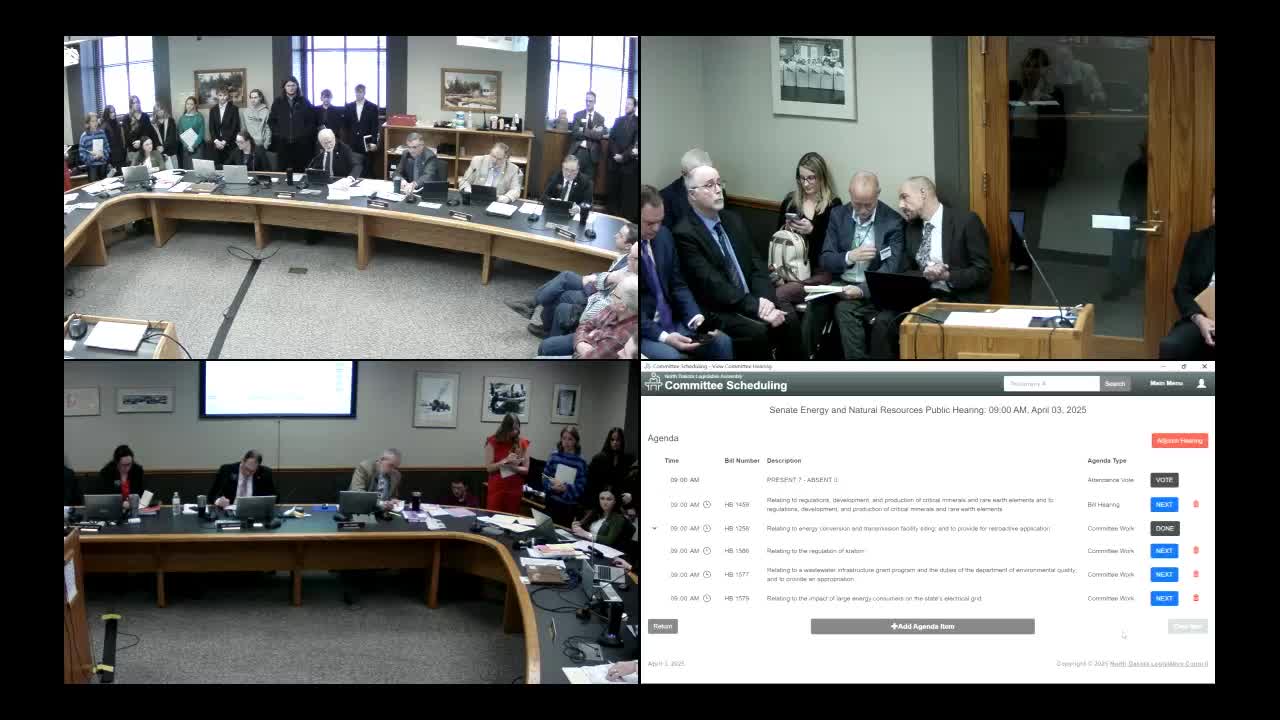
The Senate Energy and Natural Resources Committee voted to recommend House Bill 1577, a state wastewater infrastructure grant program, and referred the bill to the Appropriations Committee after testimony from Department of Water Resources and the Department of Environmental Quality.
The Senate Energy and Natural Resources Committee voted to give a do‑pass recommendation and refer House Bill 1577 to the Appropriations Committee. The bill would create a wastewater infrastructure grant program aimed at small communities and would set aside a portion of funds for communities under a population threshold.
Reesas (transcript), director of the Department of Water Resources, provided neutral information and described the department's cost‑share program as traditionally focused on water quantity projects funded from the Resources Trust Fund (which receives oil extraction tax revenue). Reesas told the committee the Department of Water Resources does not typically fund wastewater projects and prefers wastewater remain under the technical expertise of the Department of Environmental Quality (DEQ), which jointly administers the Clean Water State Revolving Loan Fund with the Public Finance Agency.
David Brushwine, Director for the Division of Municipal Facilities at DEQ, described DEQ's Clean Water State Revolving Fund (SRF) loan program and said the agency routinely coordinates with other state funding partners. He described a PAR planning grant used to fund engineering planning and noted that DEQ has historically been able to provide loans for projects that can demonstrate ability to repay.
Committee members discussed program design details, including a $25,000,000 total that was adopted in appropriations (down from an earlier $50,000,000 proposal), a population cutoff of 12,500 for a smaller‑community allocation and a grant cap of no more than 60% of total project costs (per language discussed). Witnesses and municipal representatives said many small projects still struggle to proceed even with high loan forgiveness rates and that the state frequently coordinates multiple funding sources (USDA Rural Development, U.S. Army Corps, CDBG, Bank of North Dakota) through a FIND portal to assemble packages.
Matt Gardner of the North Dakota League of Cities told the committee that most cities in the state are small (he said 307 of 355 cities are under 1,000 population) and that the design of the program should reflect that project scale. Committee members debated allocation percentages and whether the grant cap should be lowered to extend reach; DEQ staff said higher grant percentages generally help projects proceed but do not guarantee funding success.
The committee voted to recommend the bill for passage and referred it to Appropriations; the clerk recorded six ayes and one nay and the motion passed. Committee members designated a carrier to carry the bill to the next stage.
Why it matters: the bill would make state grant money available to small communities for wastewater projects. Committee discussion focused on coordination with existing SRF and federal programs, program match percentages and the long statewide needs list managed by the State Water Commission.