Get Full Government Meeting Transcripts, Videos, & Alerts Forever!
Get email alerts on the Transmission Siting topic
No spam. Unsubscribe anytime.
Committee votes to recommend 'do not pass' on transmission‑line siting bill after lengthy debate over local setbacks
Summary
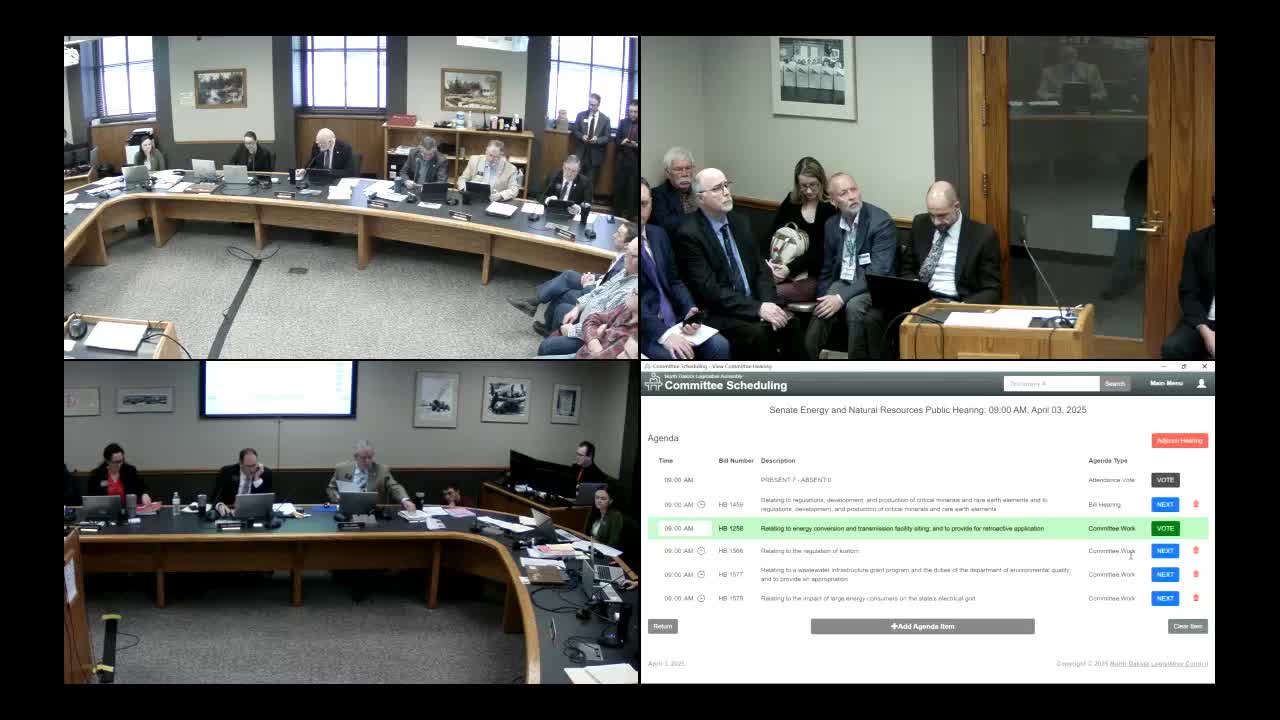
After hours of testimony, the Senate Energy and Natural Resources Committee voted to recommend "do not pass" on House Bill 1258, which would have allowed the Public Service Commission to preempt local zoning when a transmission applicant shows local rules are "unreasonably restrictive."
The Senate Energy and Natural Resources Committee debated House Bill 1258, a proposal to allow the Public Service Commission (PSC) to preempt local zoning ordinances for electric transmission facility siting when the applicant demonstrates the local rules are "unreasonably restrictive" in view of existing technology, costs or consumer needs.
The bill text before the committee would require the PSC to notify affected townships, cities and counties when a certificate application is filed and would give political subdivisions 45 days' notice; local jurisdictions would be required to file a listing of local requirements at least 10 days before a PSC hearing or risk having those requirements superseded. The draft directs the PSC to weigh local requirements and to preempt those it determines are unreasonable.
Committee members expressed divided views. Supporters argued the state must provide uniformity for linear infrastructure and that varying local setbacks and ordinance requirements can make multi‑jurisdiction projects infeasible. One committee member summarized the argument that linear projects across multiple political subdivisions need a single permitting approach to avoid varied setbacks and routing burdens.
Opponents and concerned members emphasized local property‑owner impacts and setback levels raised by townships. Several senators described strong constituent contact and said township officials were not trying to block projects but wanted projects done "right," with adequate consideration of setbacks, electromagnetic field (EMF) concerns and comprehensive local planning. Senators noted prior state experience with setback rules (for oil wells, saltwater disposal wells and pipelines) and debated whether the PSC is the appropriate decisionmaker or whether local planning should carry more weight.
After discussion, Senator Beard moved a "do not pass" motion on House Bill 12 58, seconded by Senator Van Hoosny. The committee conducted a roll‑call vote: Senator Beard (Aye), Senator Babbie (Aye), Senator Ingett (Aye), Senator Gearhart (Nay), Senator Kessel (Nay), Senator Van Oosten (Aye) and Chairman Patton (Nay). The clerk recorded 4 ayes and 3 nays; the motion for "do not pass" carried. Senator Van Oosting was asked to carry the bill.
Why it matters: the bill would shift authority for siting linear electric transmission facilities toward a state‑level determination when local ordinances are judged unreasonable, with direct consequences for township setback rules, routing and project economics. The committee's do not pass recommendation preserves the existing balance of local input in the near term while signaling concern about preemption language and local impacts.
What’s next: the committee approved the do not pass motion and selected a carrier to carry the bill forward consistent with committee rules. The committee record shows substantive testimony from townships, industry representatives and state officials.