Get Full Government Meeting Transcripts, Videos, & Alerts Forever!
Get email alerts on the State Library Access topic
No spam. Unsubscribe anytime.
Committee clears bill allowing any North Dakota resident to obtain state library card
Summary
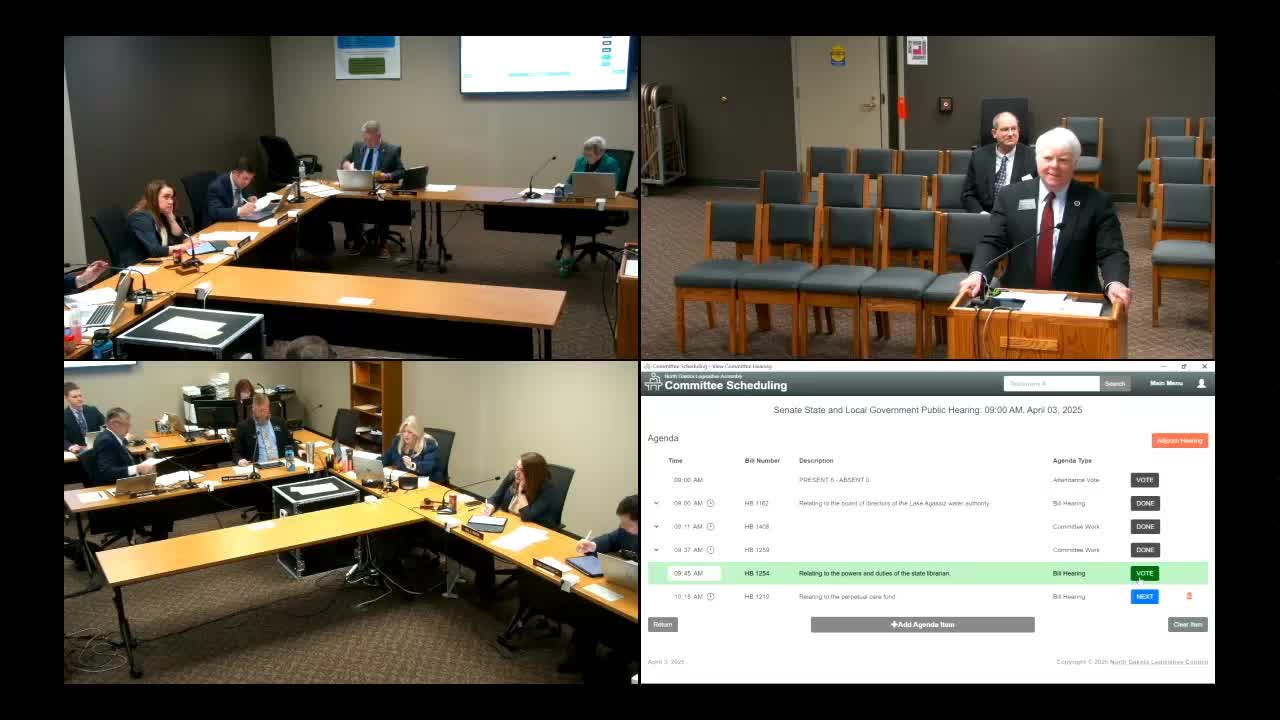
House Bill 1254 would remove a residency restriction and let any North Dakota resident apply for a North Dakota State Library card; the committee voted 6-0 to recommend the bill after testimony from the state library.
House Bill 1254 would remove a statutory limitation that had limited North Dakota State Library cards to residents in “library deserts,” allowing any North Dakota resident to apply for a state library card.
Representative Eric Murphy (District 43, Grand Forks) said the bill was introduced at the request of the state librarian and that the change simply aligns statute with current practice. “This new language merely removes that restriction,” Murphy said.
Steve Hamill, patron services director at the North Dakota State Library, told the committee the library already mails materials to patrons statewide and provides digital resources such as downloadable e-books, audiobooks and online learning tools. “A state library card provides North Dakota citizens access to downloadable e-materials… and other online library resources that help with school reports, provide opportunities to learn a new language, or take an online class,” Hamill said.
Senator Lee noted her support and recounted an example of a constituent who benefits from state-library audio materials. Committee members asked whether the library ever denies a card; Hamill said the library denies only those who are not North Dakota residents (with an exception for out-of-state state employees serving in North Dakota).
The roll call on the committee recommendation was recorded as Chair Rohrs — aye; Vice Chair Castaneda — aye; Senator Barta — aye; Senator Brownberger — aye; Senator Lee — aye; Senator Wallen — aye. The committee moved the bill forward with a unanimous recommendation.