Get Full Government Meeting Transcripts, Videos, & Alerts Forever!
Get email alerts on the Kratom Regulation topic
No spam. Unsubscribe anytime.
Agriculture Department unveils regulatory framework, age limit and labeling rules for kratom in proposed amendment to House Bill 1566
Summary
Department of Agriculture presented an amendment to create a licensing, registration, labeling and enforcement framework for kratom products, including a proposed minimum purchase age of 21 and registration/inspection costs; committee discussion raised questions about online sales and fiscal impacts.
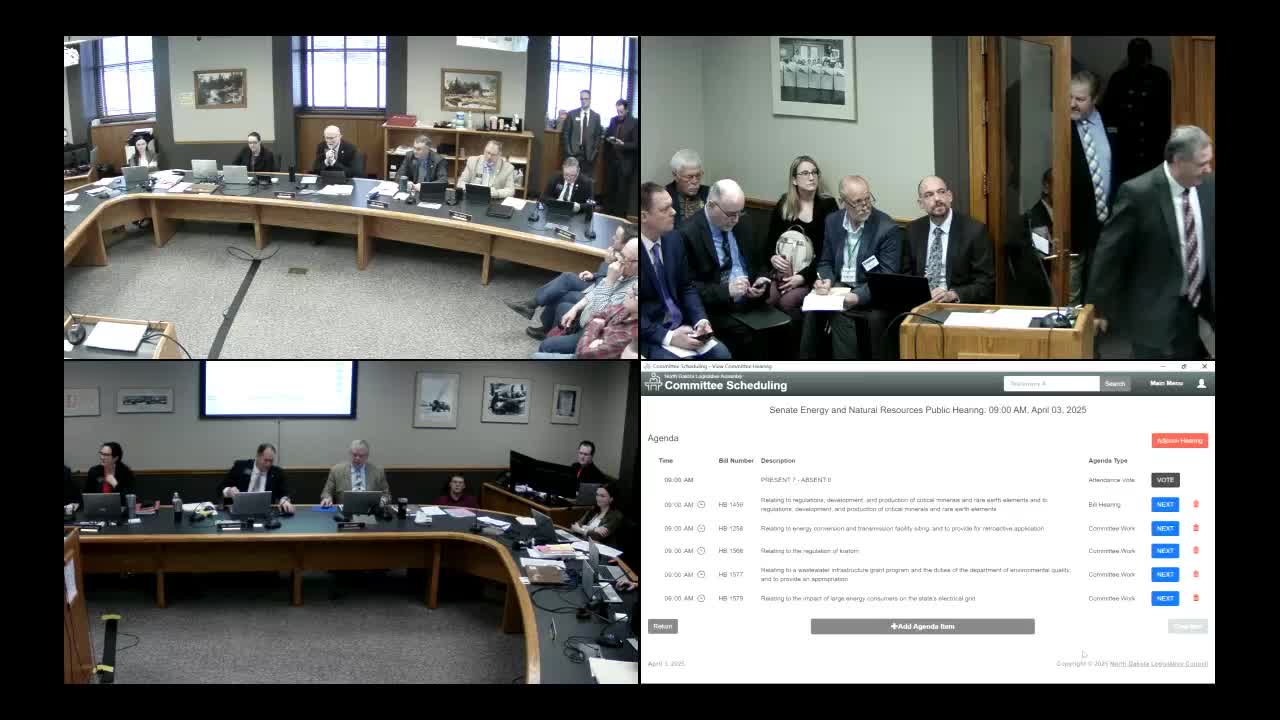
The Senate Energy and Natural Resources Committee heard an amendment to House Bill 1566 on kratom that would create a new chapter in the North Dakota Century Code to license and regulate kratom processors and retailers, require product registration and labeling, and prohibit sales to people under 21.
The amendment, presented by Doug Goring, North Dakota agriculture commissioner, would require kratom processors and retailers to disclose the factual basis for labeling a product as a kratom product, register products with the state, obtain annual retail licenses, and comply with limits on adulterants and synthetic alkaloids. Goring said, "Our intent was to come in here neutral. If you tell us to do this, we'll do it. If you tell us no, we won't do it." He told the committee the amendment includes criminal and administrative penalties and an estimated biennial cost to his department of about $580,000 to implement the program with two full‑time staff.
The proposal would ban kratom products mixed with non‑kratom substances that could affect potency or render the product injurious, prohibit any hydroxymitragynine fraction greater than 2 percent of alkaloid composition, and bar synthetic alkaloids. The amendment would make violations subject to administrative fines ($500 first offense; $1,000 subsequent) and possible class A misdemeanor charges for more serious breaches. It would also require manufacturers and processors to register products in a state database so regulators could verify label claims.
Scott Meske of the American Kratom Association testified in support of the form of the amendment, saying it "mirrors the original intent" of the bill's drafter and noting other states have adopted kratom consumer protection frameworks. Meske told the committee there are 22 states with kratom laws on the books and several more considering regulation.
Committee members questioned agency capacity, costs and loopholes. Senator Gerhardt asked whether the agriculture department is the right agency and whether the department already regulates similar products; Goring said the department has experience with industrial hemp and CBD and described how registration and licensing would give regulators tools to manage bad actors. Senators also asked whether online sales would be covered; Goring and Meske said online sales could be a loophole to address and that registration language might be used to require verification before distribution or sale.
Several members pressed the rationale for a minimum purchase age of 21. Goring said medical evidence was not fully developed and that states have chosen 21 to limit access while more is learned: "Too much of anything can be a bad thing ... we probably need to do till we know more is restrict or limit access ... if you're over the age of 21, you may purchase it and use it." The committee also discussed potential taxation and whether sales would be subject to sales tax unless the Legislature directs otherwise.
The amendment would give the commissioner authority to adopt administrative rules for testing, labeling and sale of kratom products. Goring said registration fees would be modest (he referenced multiple figures in the hearing record and identified a $25 registration fee in the draft), and he described a practice of regulatory "grace and mercy" for noncompliant manufacturers who correct problems after notice.
The committee did not take a final vote on the amendment during this session; the chair noted the department requested rapid action because fiscal notes and staffing impacts mean the committee must act quickly to meet deadlines for bills with fiscal notes.
Why it matters: the amendment would move North Dakota from a study posture to an active consumer‑protection regulatory program for kratom, creating licensing and testing obligations for manufacturers and retailers and adding criminal and administrative penalties. The proposal also raises questions about implementation costs and whether online sales can be controlled under the registration framework.
The committee kept the hearing open for kratom and signaled the department would work on clarifying registration/online‑sale language before the next committee action period.