Get Full Government Meeting Transcripts, Videos, & Alerts Forever!
Get email alerts on the Elections Campaign Finance topic
No spam. Unsubscribe anytime.
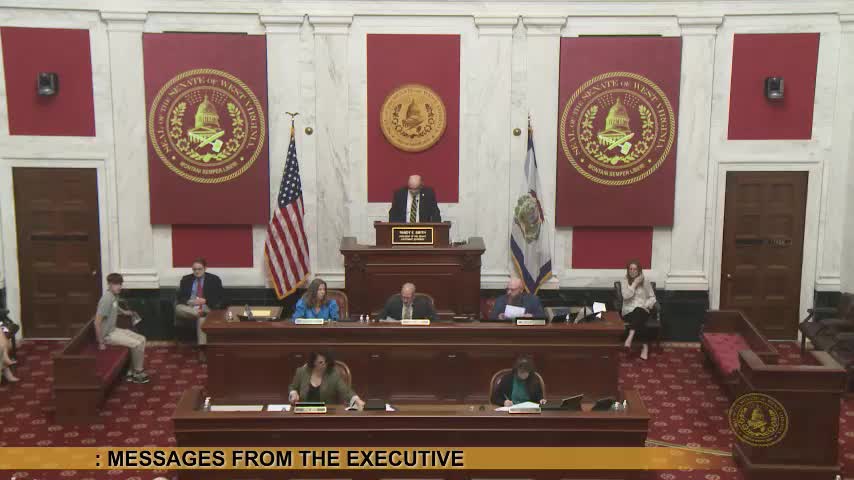
Senate reconsiders governor objections and passes Committee Substitute for Senate Bill 369
Summary
After the governor returned the measure with objections, the West Virginia Senate reconsidered and passed the committee substitute for Senate Bill 369 with an amendment clarifying election‑related committee language; the measure was made effective on passage by a recorded vote of 34–0.
The West Virginia Senate on April 2 reconsidered and passed the committee substitute for Senate Bill 369 after receiving a letter from the governor listing objections, and adopted an amendment that removes subsection 7 of the bill before final passage.
The action follows a letter from Gov. Patrick Morrisey that disapproved and returned the enrolled committee substitute for Senate Bill 369 under Section 14, Article 7 of the Constitution of the State of West Virginia. Senator from Lewis moved that the chamber reconsider and roll the bill; the motion carried, and the senate then adopted an amendment offered by Senator Martin that struck subsection 7 on pages 8 and 9. The Senate then voted 34 yays, 0 nays to pass the bill as amended and later voted 34–0 to make the bill effective from passage.
The amendment and final passage incorporated clarifying language the State Election Commission, through the Secretary of State, provided to “clarify and guide” provisions in Section 14 of the rules. As explained on the floor, the revised language was intended to provide clarity for candidates who form and operate separate political action committees under existing law — requiring separation of candidate committees and PACs — and to reinforce existing law regarding coordinated expenditures and the prohibited use of campaign or committee funds for personal use.
Senator Martin described the amendment as lining up the bill with the election commission’s revisions and urged adoption. After voice and machine votes on the amendment and final passage, the clerk reported 34 yays, 0 nays, 0 absent for each recorded question; the presiding officer declared the amendment adopted and the bill passed as amended "as a result of the objection of the governor." The Senate instructed the clerk to communicate the action to the House.
The Senate also voted to make the bill effective from passage; the clerk certified the two‑thirds threshold was met with 34 yays and the presiding officer declared the bill effective from passage.
The Senate record shows the sequence: receipt of the governor’s letter, the motion to reconsider under the cited constitutional provision, adoption of the Martin amendment that struck subsection 7, passage of the bill as amended, and a separate recorded vote making the act effective from passage. No roll‑call names other than the tally were read into the record for the final passage votes.
The bill text and the State Election Commission’s precise rule language as implemented will determine how the clarified provisions operate in practice; the floor explanation described the changes as technical and aimed at aligning the statutory text with the commission’s guidance.