Get Full Government Meeting Transcripts, Videos, & Alerts Forever!
Get email alerts on the Energy Utilities Centerpoint Sb231 topic
No spam. Unsubscribe anytime.
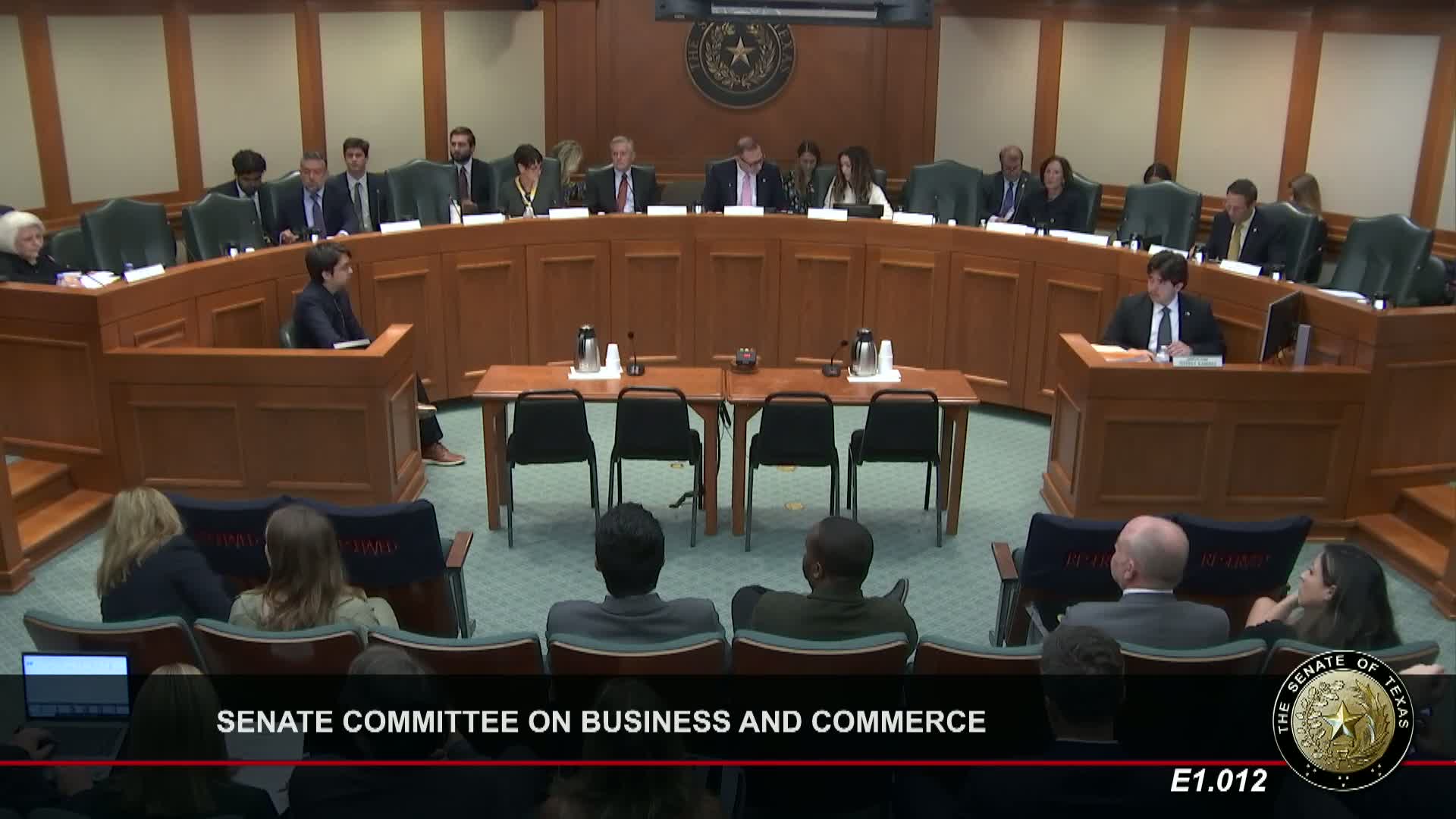
Senate Business & Commerce committee reviews CenterPoint plan to refund customers and donate large generators to ERCOT; SB231 amended to reflect agreement
Summary
The Senate Committee on Business & Commerce heard detailed testimony on Senate Bill 231 and an agreement under which CenterPoint Energy says it will refund customers charged for 15 large emergency generators, donate the units to ERCOT for roughly two years and absorb certain costs, while a committee substitute to SB231 was laid out and left pending for PUC review.
The Senate Committee on Business & Commerce heard detailed testimony on Senate Bill 231 and an agreement between CenterPoint Energy and state actors to refund customers for charges tied to 15 large emergency generators and to donate those units to ERCOT for temporary use.
The bill and a committee substitute were presented Tuesday to reflect a negotiated process whereby CenterPoint will (a) forego charging customers for most costs attributable to the 15 large units going forward, (b) implement an immediate, multi‑year base rate reduction and (c) donate the 15 units to ERCOT for deployment in the San Antonio area for about two years. The committee laid out the substitute and then left SB231 pending for further review and for forthcoming filings at the Public Utility Commission (PUC).
Why this matters: CenterPoint customers have already been billed for work tied to those generators. Committee members, Houston delegation senators and consumer groups pressed CenterPoint and the PUC for a remedy that would return funds to customers while keeping emergency tools available for grid reliability.
CenterPoint executive vice president Jason Ryan told the committee the company will not charge ERCOT or Houston‑area customers for the generators while ERCOT uses them and that the company will “absorb the approximately $180,000,000 of costs” attributable to the donation period. Ryan said the company has collected roughly $430,000,000 from customers so far for those generator costs and that CenterPoint has begun steps to refund amounts already charged. He apologized to legislators and customers for the company’s communications and decision‑making leading up to the controversy and summarized the company’s commitments: a near‑term base‑rate reduction to benefit all customer classes, a decision not to seek recovery of costs attributable to the covered period, and a planned PUC filing to remove those costs from rates going forward.
Ryan: “To re‑earn the trust of our customers, our communities, all of you and all of our other elected officials, we have proposed to donate these 15 large generators to ERCOT… CenterPoint Energy will not charge ERCOT or Houston area customers or anyone, for this 2 year period where these generators will be used.”
Senators from the Houston delegation pressed for guarantees that refunds would cover all customer classes. Ryan said the company’s package of rate reductions and forgone storm‑cost recoveries would make all customer classes whole, and provided committee members a spreadsheet purporting to show the allocation of benefits by customer class. He said, for example, the average residential customer would have paid about $100 for the large units and would receive roughly $120 in combined benefits once the company’s commitments and the PUC filing are implemented.
The Public Utility Commission’s on‑site representative, Connie Corona, told the committee the PUC staff will review CenterPoint’s forthcoming contested‑case filing and that the agency has the authority and process to consider whether the company’s commitments should be adopted or otherwise enforced in a rate proceeding. Corona said PUC staff would “review it thoroughly and provide a recommendation to the commission.”
Two consumer and reliability advocates testified at the committee hearing. Sandy Haberlam of the Texas Consumer Association said her group had a pending complaint at the PUC and that it would monitor the PUC filing. John Elder of the Texas Reliability Coalition urged the committee to avoid language that would unintentionally eliminate utility‑scale microgrids that some localities use for critical water and other infrastructure; he described microgrids as a distinct, stationary solution that can protect critical facilities.
Committee action and next steps: The chair laid out a committee substitute for SB231 that removes a disgorgement clause from the filed bill and incorporates the terms of the negotiated agreement described by CenterPoint. The committee heard from the company and the PUC and then left SB231 pending; CenterPoint said it will file a contested‑case application with the PUC in the coming days. The committee’s substitute also includes operational requirements about emergency‑generation facilities that mirror recent PUC rulemaking, including mobility and competitive‑bidding standards for temporary emergency units.
CenterPoint and the Houston delegation characterized the agreement as the first step in making customers whole; the PUC representative indicated the agency expects to evaluate the company’s filing through its usual contested‑case process.
The committee recorded public testimony and directed staff to monitor the PUC filing; no final committee vote on the bill was taken at the hearing.
(Reporting note: dollar figures, unit counts and time frames are drawn from committee testimony and the company’s presentation to the committee.)