Get AI Briefings, Transcripts & Alerts on Local & National Government Meetings — Forever.
Texas committee hears mixed testimony on bill to protect health workers who report misconduct
Loading...
Summary
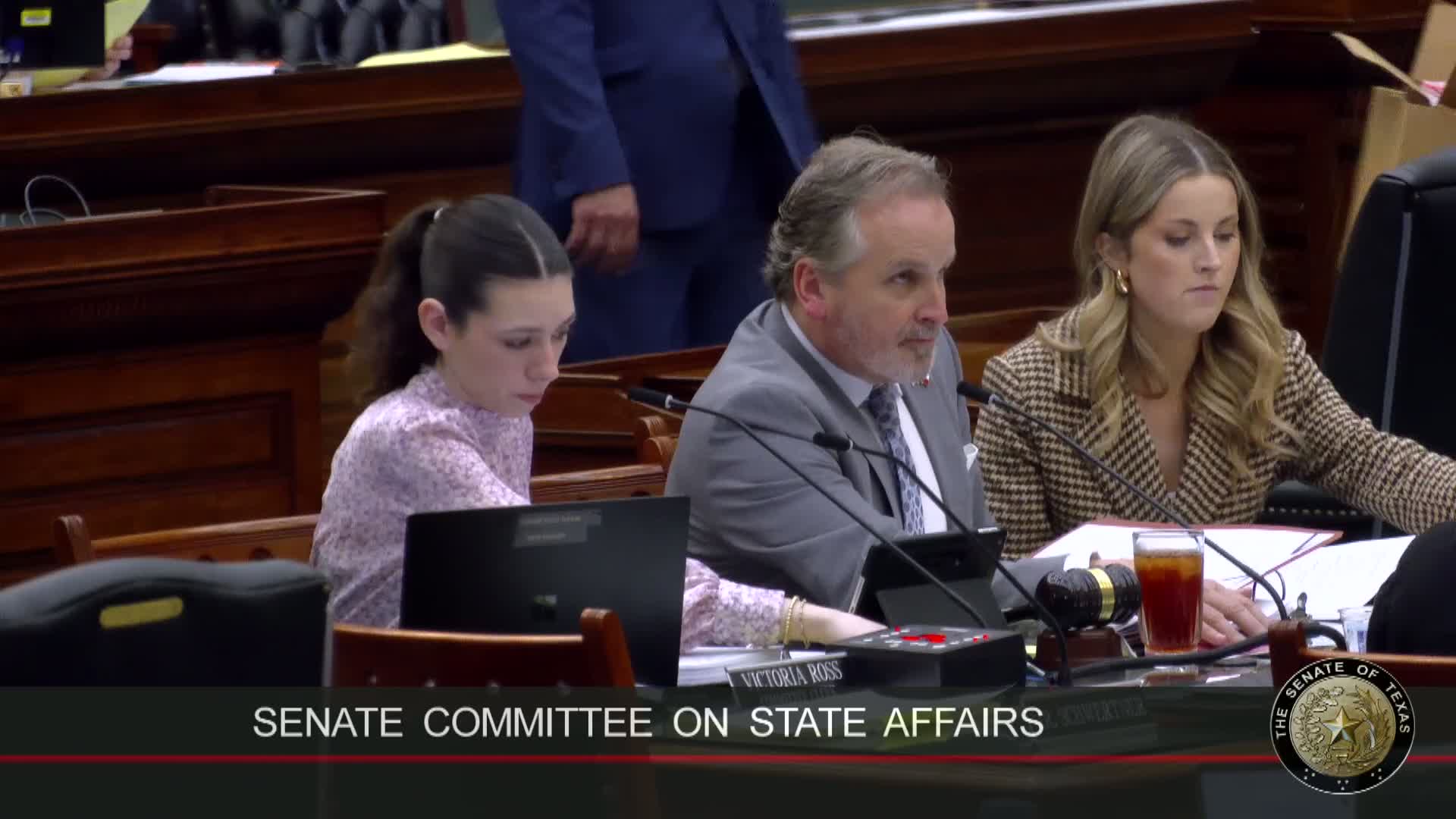
The Texas Senate Committee on State Affairs on a bill hearing that opened discussion on Senate Bill 2043, a measure authored by Senator Hughes to protect health care providers from retaliation when they report illegal or unethical medical practices.
The Texas Senate Committee on State Affairs on a bill hearing that opened discussion on Senate Bill 2043, a measure authored by Senator Hughes to protect health care providers from retaliation when they report illegal or unethical medical practices. Supporters, including attorneys and several health‑care witnesses, said the bill would safeguard whistleblowers; representatives of the Texas Hospital Association urged tightening the language to avoid unintended limits on private employers' ability to manage staff.
Senator Hughes, the bill's author, told the committee SB 2043 would give physicians and other health care professionals "the ability to report any... illegal or unethical behavior without fear of retaliation" by prohibiting adverse actions and creating a civil remedy for those who suffer retaliation. He said the measure is intended to protect patient safety and the implementation of legislative policy.
Greg Chaffin, an attorney and senior counsel with Alliance Defending Freedom, testified in favor and framed the bill as a free‑speech protection for clinicians. "Free speech rights are good for doctors because they need to be able to [give] their opinions, their expert opinions about medical procedures and report issues as they arise," Chaffin said, citing cases he said showed clinicians can be targeted after speaking out.
Vanessa Savage, a pediatric nurse who said she worked at Texas Children's Hospital, described her experience in 2022 and said she faced federal investigators after publicly criticizing gender‑affirming care. "Senate Bill 2043 provides crucial protections for health care providers, including nurses, against retaliation when they report violations or take actions in the best interest of patient safety and ethical health care," Savage said.
Advocates from Texas Values also spoke for the bill. Jonathan Kebbe, director of policy, said whistleblowers played a critical role in exposing alleged violations of state law, and Jonathan Saenz, president of Texas Values and an attorney, said the bill would reduce the chilling effect that prosecutions and investigations can create for would‑be whistleblowers.
The Texas Hospital Association, represented by Steve Wolop, opposed the bill as written and urged revisions. Wolop said the bill's speech and association protections for private employees and physicians could prevent hospitals from disciplining staff for conduct that harms a hospital's brand or operations. "A hospital employee could post pictures of themselves at a KKK rally... and there's nothing the employer could do," Wolop said, arguing the draft language was too broad. He also cited existing protections and noted that some reporting is already actionable under state law, referencing section 161.134 of the Health and Safety Code.
Committee members questioned witnesses about the scope of protection, the distinction between protected speech and regulated practice, and overlap with existing statute. Senator Perry and others pressed for clarity whether the bill would protect mere speech (such as criticism or academic views) while still allowing regulators to act against improper medical practice. Hospital representatives said they were open to working on narrowed language to protect good‑faith reports related to patient safety while preserving employer recourse for non‑patient‑care conduct that ties the employer to objectionable speech.
Public testimony included Denise Seibert, who supported the bill and said she wanted providers "that have the highest morals and standards," and Paul Hale, who tied the bill to concerns about gender‑affirming care. Hunter Bledsoe testified against the bill and asked the committee not to single out transgender people, calling for accurate framing of the problem rather than targeting a population.
After the public testimony period the committee closed testimony and left Senate Bill 2043 pending for further work; no committee vote was taken.
The bill, as presented, would: prohibit adverse actions against health care providers who report violations of law, regulations, or ethical guidelines; protect speech about treatment practices unless the provider's conduct directly caused physical harm to a patient (as described in testimony); and create a civil remedy for retaliated employees, according to the author. Committee members and stakeholders said they will continue discussions to refine the language and clarify interactions with existing law and employer rights.
The committee took no final action; the measure was left pending.