Get Full Government Meeting Transcripts, Videos, & Alerts Forever!
Get email alerts on the Student Absenteeism topic
No spam. Unsubscribe anytime.
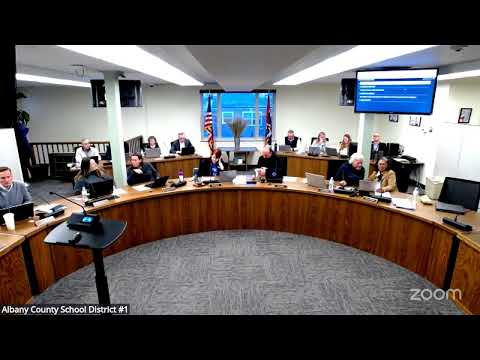
Albany County School District #1 reports attendance gains; district emphasizes outreach over punitive letters
Summary
At a board work session, district staff said overall attendance has improved since the COVID years and described a shift from form letters and automatic referrals toward family outreach, while clarifying state rules on 10‑day drops and reenrollment.
Albany County School District #1 officials told the board during a work session that districtwide attendance has improved compared with the years immediately after the COVID‑19 disruption, and that staff are prioritizing outreach and supports over automatic punitive letters to families.
The presentation, led by a district staff member identified in the transcript as Mr. Lewis, compared pre‑COVID attendance (the 2018‑19 school year) with the district's most recent three years and described how the district now emphasizes communication and problem‑solving with families before pursuing referrals or court petitions.
District staff said the districtwide attendance rate was 93 percent in 2018‑19 and rose to about 94.3 percent as of the most recent data cited. The presenter explained how the district compiles attendance data from average daily membership (ADM) and average daily attendance (ADA) and noted that in the 2021‑22 school year the district’s reported ADM on a typical day was 33,306 students.
Mr. Lewis said the district has changed practices that once relied heavily on automated form letters and automatic referral after set absence thresholds. "Instead of engaging those families and those children on an adversarial ground, it was, let's open up lines of communication," he said, describing more personalized outreach by nurses, counselors, principals and teachers.
The presentation explained classification of attendance codes (excused, unexcused, absent as a placeholder until a reason is confirmed) and said responses differ depending on the type of absence. Mr. Lewis told trustees that families with excessive excused absences are handled differently from families with repeated unexcused absences, and that staff and community partners work together to identify barriers — for example transportation or short‑term crises — and offer temporary scheduling or remote options where appropriate.
Trustees asked for clarification about existing policy and operational practice. Trustee Nate Martin said teachers had previously flagged a lack of clarity around protocols; Mr. Lewis responded that the district already has policies that "mirror state statute around compensatory attendance law" and that current work focuses on supporting principals and individual families rather than seeking new board policy at this time. "My opinion and my recommendation is at this point now, I don't think there's any need for board action to create or modify a policy," he said.
Trustee Kim Sorensen asked about the district practice of removing students from the roster after 10 consecutive days of absence. Mr. Lewis said that under Wyoming accounting rules, a student who misses 10 consecutive days (or 10 consecutive periods at the secondary level) is dropped from the roll for accounting purposes, but that students who are later reenrolled have their attendance recorded as reenrollment. "When they are reenrolled, they're back on our roll," Mr. Lewis said, adding that reenrollment is usually a matter of a few clicks in PowerSchool and the student's attendance is not treated as absent for the rest of the year once the record is corrected.
Trustee Emily Stanton asked about language and culture around attendance, suggesting a shift from admonishments to messages such as "we miss you." Mr. Lewis said classroom‑level and elementary practices increasingly reflect that approach, while some administrative communications must remain specific and statutory when court or neglect processes could be necessary.
Mr. Lewis identified a small number of families the district continues to watch closely — he said there are roughly 17 families on his watch list who face persistent attendance challenges — and credited community partners including Big Brothers Big Sisters, the Laramie Youth Crisis Center, Cathedral Home for Children and the Albany County Attorney's Office for supporting outreach, counseling and court‑ordered youth programs when needed.
Trustees and staff agreed that the district will continue to monitor attendance by quarter; Mr. Lewis said schools are currently tracking between roughly 0.5 and 2 percentage points higher than in comparable quarters in the prior three years. He cautioned the board that the final quarter of the school year historically reduces attendance levels and that the district is unlikely to finish the year exactly at 94.3 percent, but described the current trend as a positive three‑year recovery trajectory.
The work session included no formal board action on attendance. Staff outlined that central office administration will continue to support school‑level practices and family engagement, and that staff can provide additional data or follow‑up if trustees request it.
At the end of the segment the board moved to the next agenda item.