Get Full Government Meeting Transcripts, Videos, & Alerts Forever!
Get email alerts on the Land Use Housing topic
No spam. Unsubscribe anytime.
City attorney: Live Local Act limits local control; residents press commission on 8‑story Dunes project
Summary
Neighbors and city officials clashed over an 85‑foot, 298‑unit project during public comment on April 1, while the city attorney told commissioners the Live Local Act limits municipal control over qualifying multifamily developments.
Residents from multiple neighborhoods urged the commission on April 1 to oppose a planned 85‑foot, 298‑unit multifamily project—referred to by speakers as the Dunes project—and to seek ways to limit the law’s local effects. The city attorney explained how the state’s Live Local Act restricts municipal authority over qualifying developments.
During public comment, Save Las Mangos representatives and nearby homeowners told commissioners the proposed project’s density and height would be incompatible with one‑ and two‑story nearby neighborhoods. “We are here to protest in the strongest terms possible against this Live Local Act protected 8 story 85 foot high project containing 298 rental apartments,” one speaker said. Speakers asked the commission to use the CRA and other local tools to protect neighborhood character, to require greater setbacks and to push for lower height limits.
City Attorney Shawna Lam briefed the commission on the statute, commonly called the Live Local Act (Senate Bill 102). “When the state regulates something that means we no longer have the right to regulate that,” Lam said. She told commissioners the law preempts local control over land‑use, density, height and zoning for qualifying multifamily developments that meet state eligibility criteria (including set‑asides for workforce or affordable units and infrastructure sufficiency), and that the city’s authority is generally limited to building‑code life‑safety reviews and technical infrastructure concurrency checks. Lam cited a recent county‑level dispute involving Bal Harbour Village as an example of the legal tension municipalities face when attempting to block or rezone such projects.
Planning staff said that qualifying Live Local projects still must comply with technical reviews—drainage, utility capacity and traffic—and that such concurrency reviews are handled by city engineering, utilities and outside agencies such as the South Florida Water Management District and Lake Worth Drainage District where applicable. Planning Director Amanda Radegan said the land‑development regulations and engineering reviews remain applicable even if certain comprehensive‑plan controls are preempted by state law.
Several residents asked the commission to press the state delegation to change the statute and to pursue a comprehensive plan overhaul or stronger land‑development regulations to make future approvals less likely under Live Local’s criteria. Commissioner Adam Turkin asked staff to bring back proposed changes to the city’s land‑development code and a charter‑amendment option for voters to consider longer residency requirements for candidates; the commission asked staff to prepare comparative materials on petition thresholds, qualifying fees and residency proof used in nearby jurisdictions.
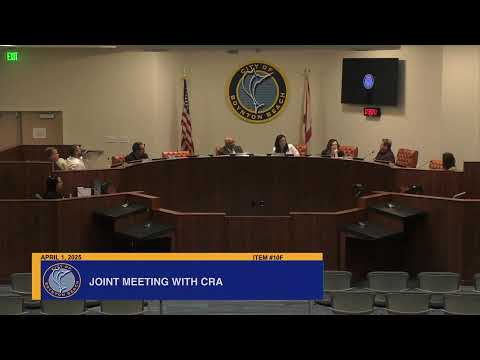
Commissioners agreed to schedule a joint meeting with the Community Redevelopment Agency (CRA) to discuss the statute’s implications for redevelopment funding and to coordinate a citywide response. Staff said they would arrange the joint meeting with the CRA and bring back options for change in the land‑development regulations.
Ending: The city attorney’s explanation left clear legal limits; residents and commissioners said they will pursue both local regulatory options and communications with state lawmakers to seek longer‑term solutions.