Get Full Government Meeting Transcripts, Videos, & Alerts Forever!
Get email alerts on the Hazing Prevention topic
No spam. Unsubscribe anytime.
Washington lawmakers hear campus hazing-prevention programs and raise concerns about transparency under Sam’s Law
Summary
University leaders described coordinated hazing-prevention programs at Washington State University and Western Washington University, while an anti-hazing advocate told the Post-secondary Education & Workforce Committee many institutions are not posting required transparency reports under Washington’s Sam’s Law.
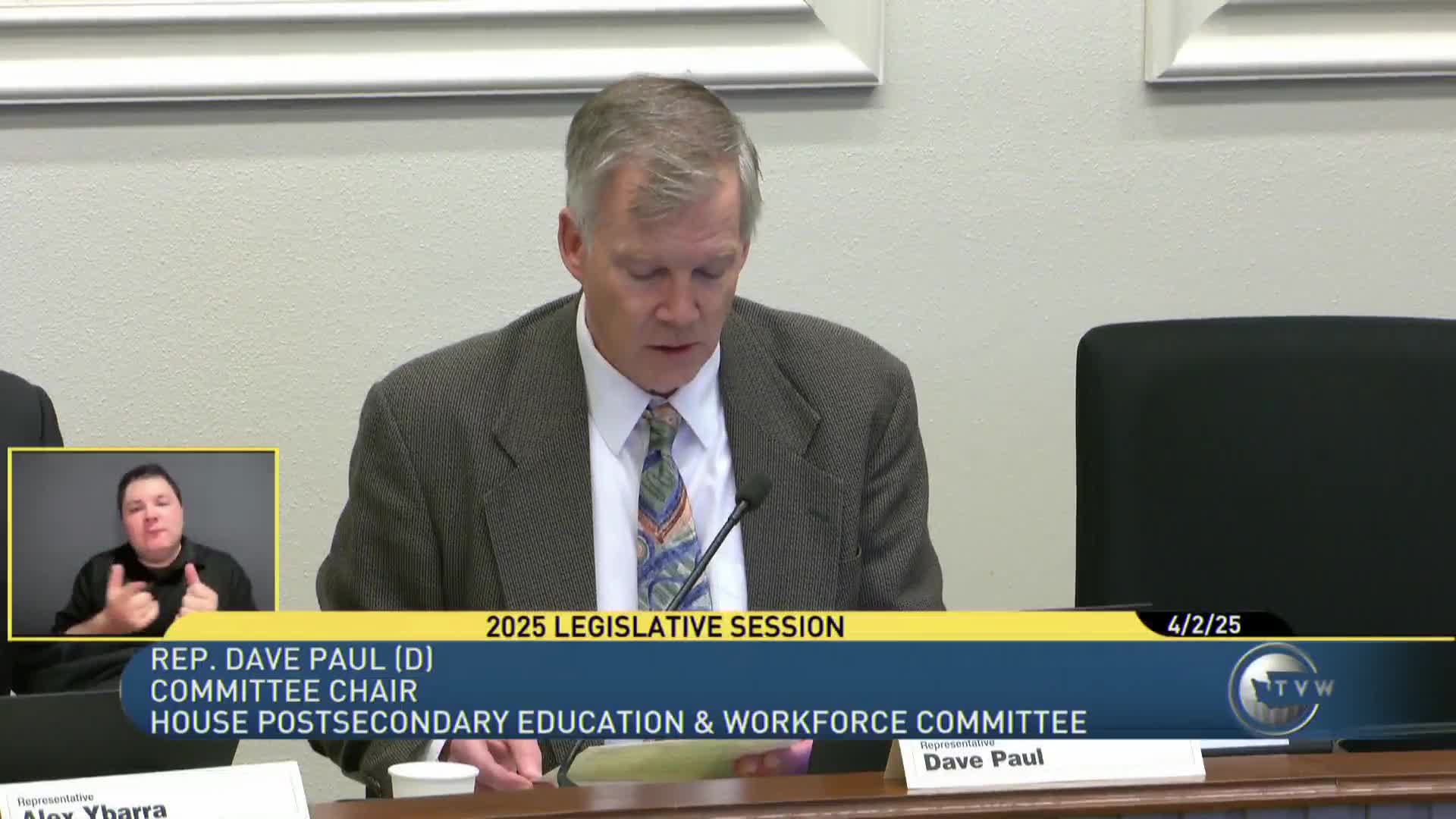
OLYMPIA, Wash. — Campus leaders and an anti-hazing advocate told the state Post-secondary Education & Workforce Committee on April 2 that colleges are using evidence-based prevention programs but many institutions remain out of compliance with transparency requirements in Washington’s hazing law.
Dr. Jenna Hyatt, associate vice chancellor for student affairs and dean of students at Washington State University, described a coalition-based, evidence-driven prevention framework on WSU’s five-campus system that uses StopHazing.org materials, campus climate surveys and internships that let students study hazing prevention from “the inside out.” “Our fierce number-one goal is that our campuses are completely inhospitable to hazing,” Hyatt said.
Dr. Melinda Husky, vice president for student affairs at Western Washington University, told the committee that Western focuses on a public-health ecological model of prevention that spans individual education, group accountability and organizational accountability. “We are balancing interventions at the individual, the interpersonal, the organizational, the community, and the public policy level,” Husky said, and noted Western had no reported hazing incidents since fall 2022.
Terri Standishkeuan of the Independent Colleges of Washington and Anne Adams, interim dean of students at Saint Martin’s University, described required online training modules for students and employees and said institutions post codes of conduct and prevention materials on their websites. Standishkeuan told the committee that, across nine ICW campuses, there had been two formal findings since 2022.
Jolaine Houts, founder of HazingInfo.org and a family advocate whose son Sam died in a 2019 fraternity hazing incident, urged stronger compliance with the law’s transparency provisions. Houts said a HazingInfo review of nine states found 940 reported campus hazing incidents since 2018 and that in Washington only 35% of colleges were publicly posting the incident reports required by Sam’s Law. “That means 20 out of our 31 higher education institutions in this state are not disclosing hazing incidents despite a legal requirement to do so,” Houts told the committee.
Committee members pressed presenters on training, reporting and K–12 connections. Rep. Mari Levitt asked WSU about training for faculty and staff who serve on campus prevention committees; Hyatt said advisory-committee members receive the same student-facing training modules as students and that ex officio campus partners present their organization’s training to the committee annually. Rep. Levitt also asked whether the Council of Presidents could provide incident totals for the six institutions it represents; Melissa Beard, director of legislative affairs for the Council of Presidents, said she did not have full data on every campus but said a one-page handout provided links to each institution’s transparency pages and that WSU had recently removed a fraternity chapter following a hazing investigation.
Several lawmakers pressed for clearer public access to transparency reports and for outreach to high schools. Houts said many hazing incidents never reach public reports because victims do not recognize or report them, because institutions do not investigate every report to a finding, or because campuses fail to post reports even when required by law. She urged the legislature to seek answers on why institutions are not publishing mandated data and to pursue “100% compliance with the hazing transparency requirements of Sam’s Law.”
The committee did not take formal action during the session. Members used the remainder of the meeting to identify interim priorities for the committee, including community college workforce training, student mental health, apprenticeship access and credit-transfer pathways.
The presentations and exchanges highlight a split between campuses that described active, multi-pronged prevention programs and advocates who say statutory transparency is not being uniformly implemented. Committee members asked staff to follow up on data and compliance so legislators can assess whether further policy or enforcement steps are needed.