Get Full Government Meeting Transcripts, Videos, & Alerts Forever!
Get email alerts on the Surface Mine Fees topic
No spam. Unsubscribe anytime.
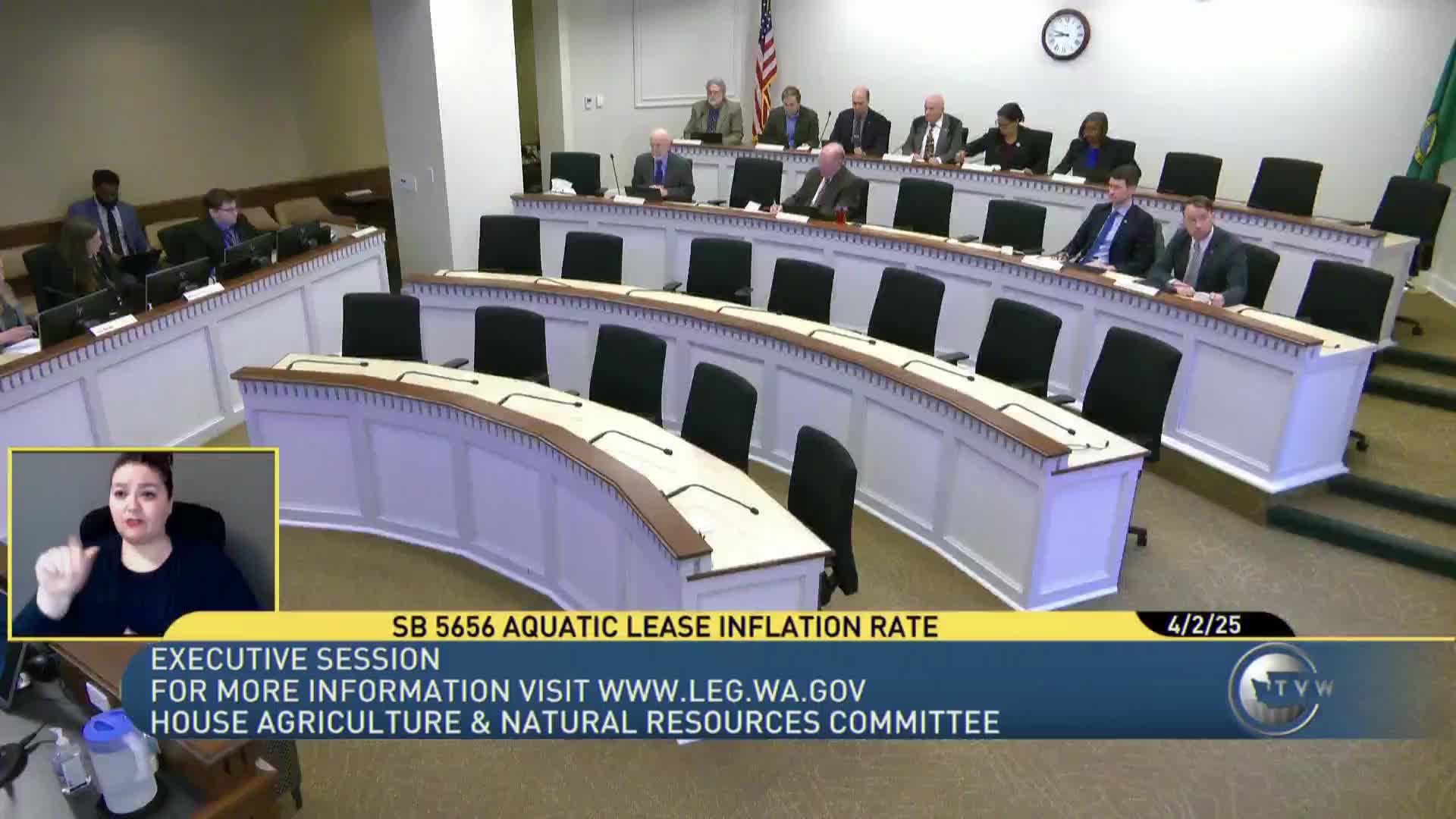
House Ag & Natural Resources committee advances surface-mine reclamation fee bill after contentious amendment debate
Summary
After extended debate and several withdrawn and defeated amendments, the House Agriculture and Natural Resources Committee voted 8-2 (1 excused) to report Senate Bill 53-19 out of committee with a striking amendment restoring a lower fee schedule for very small counties and mines.
The House Agriculture and Natural Resources Committee on April 2 voted to report Senate Bill 53-19 out of committee with a due-pass-as-amended recommendation after extended debate and multiple amendment attempts.
The bill, originally aimed at updating surface mine reclamation fees administered by the Department of Natural Resources (DNR), drew a sequence of proposed amendments intended to tier or reduce fee impacts on small mines. Representative Schmick offered a striking amendment that restored the existing fee schedule for certain very small counties; that amendment was adopted and the committee later voted to report the bill out as amended. The final roll call showed eight ayes, two nays and one excused member, and the standing committee report will reflect the bill as amended.
Committee staff Lily Smith briefed members before the caucus recess, describing the bill as a DNR-request measure to update how surface mine reclamation fees are charged. Several members raised concerns that the underlying bill’s fee increase would disproportionately burden small, family-owned operators. Representative Engel introduced multiple amendments to tier fees by mine size or by employer-size; those amendments were either withdrawn or rejected by the committee after debate.
Supporters of the adopted striker said it restored affordability for the smallest counties and operators. Representative Schmick described the change as returning fees “back to where it was” for the smallest producers, citing county commission concerns about tight local budgets. Representative Springer and others said the adjustment was a compromise to protect very small producers while still moving a DNR-requested update forward. Opponents said the department had not made a compelling case for a 75% increase in fees and that the work group that negotiated the earlier package did not fully represent small operators.
Representative Engel, who repeatedly pushed amendments to protect small businesses, voted against the final committee report and recorded his position as “nay, do not pass.” Representative Orcutt likewise voted no. The clerk recorded Representative McClintock as excused.
The committee recorded a sequence of amendment actions before final adoption: multiple SMIL/SMELL amendment motions were withdrawn; SMIL 58 and SMIL 59 (attempts to tier fees by volume or acreage) were defeated by voice vote; SMIL 57 (an attempt to exempt small employers under 50 employees) was defeated; the striking amendment H-2100.1 was adopted; and the committee then voted to report the bill out as amended.
The committee’s action at this stage is a committee recommendation to the full House; the record shows debate and a split membership on the merits of the fee changes and how they should be apportioned among very small, small and large mine operators.
Discussion points captured in committee debate included: whether a fee increase should be graduated by mine acreage or volume removed; whether small county budgets and very small mines require special treatment; whether the DNR had justified the scale of the proposed increase; and whether the stakeholder work group that had reviewed the fee changes adequately represented small operators.
The bill will appear on the House calendar with the committee’s due-pass-as-amended recommendation. No final legislative enactment occurred at the committee meeting; the committee vote forwards the measure and the adopted striking amendment for further consideration.
Ending: The committee’s report preserves a pathway for further negotiation on fee structure as the bill moves to the next step in the House. Members and staff indicated they intend to continue engagement with DNR and small operators as the bill proceeds.