Get Full Government Meeting Transcripts, Videos, & Alerts Forever!
Get email alerts on the Education Tribal Curriculum topic
No spam. Unsubscribe anytime.
Bill would require districts to incorporate 'Since Time Immemorial' curriculum and report compliance
Summary
Substitute SB 5570 would require school districts to incorporate the John McCoy 'Since Time Immemorial' tribal sovereignty curriculum into social studies by Sept. 1, 2026, expand tribal consultation obligations, and direct monitoring and reporting on district compliance through 2029.
Substitute Senate Bill 5570 would require school districts to incorporate the John McCoy “Since Time Immemorial” (STI) curriculum into social studies curricula by Sept. 1, 2026, strengthen government‑to‑government consultation requirements with federally recognized tribes, and establish a system of annual monitoring and reports from 2027–2029.
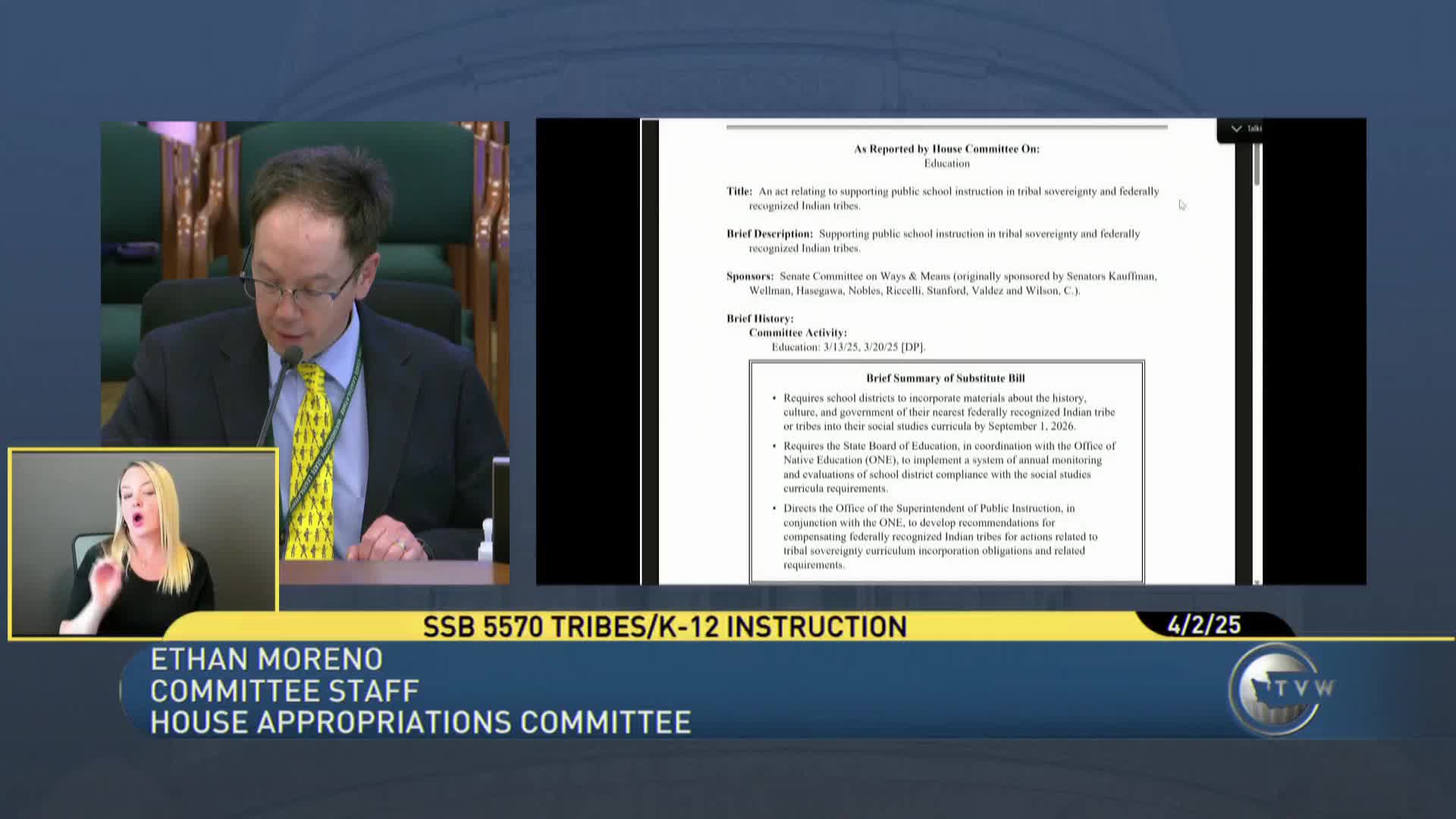
Ethan Moreno (House Education Committee staff) and Jordan Clark (appropriations committee staff) briefed the committee. The bill requires districts to consult and collaborate with federally recognized tribes within their boundaries and neighboring tribes — including tribes whose traditional lands include parts of Washington but who now reside outside the state — when districts review or adopt social studies curricula. The bill directs OSPI and the Office of Native Education to develop support and to work with districts on consultation challenges (for example, when numerous districts must consult with a single tribe or when tribes have large enrollments). The State Board of Education and Office of Native Education would implement annual monitoring and reporting on district compliance between 2027 and 2029, and OSPI must report recommendations for compensating tribes for consultation and for retroactive compensation by Sept. 1, 2026.
Susan Eibner, a resident and longtime educator, testified in support and said she learned Indigenous history only after retirement; she urged passage so students receive curriculum she did not. OSPI noted modest fiscal costs for monitoring: OSPI estimated 1.5 FTEs from FY27–FY30 and the State Board 0.15 FTE to implement monitoring and reporting, and the Senate budget funded the fiscal note.
The committee did not take a formal vote; staff emphasized the bill’s monitoring timelines and the requirement to propose compensation recommendations to tribes.