Get Full Government Meeting Transcripts, Videos, & Alerts Forever!
Get email alerts on the Taxation Capital Gains topic
No spam. Unsubscribe anytime.
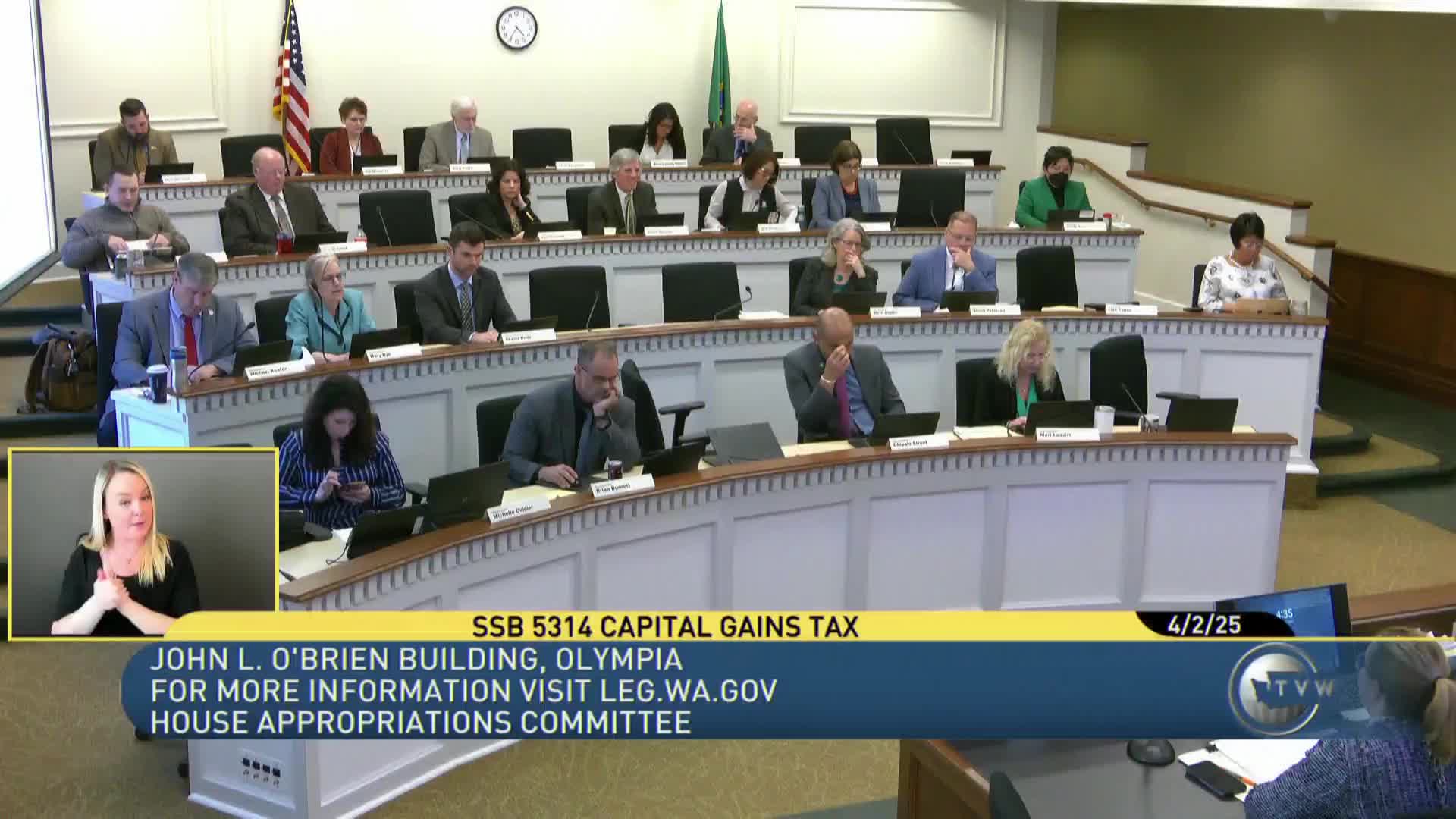
Appropriations hears technical, administrative changes to capital gains tax in SB 5314
Summary
Department of Revenue staff briefed the committee on technical corrections to the Washington capital gains tax in Substitute SB 5314; the bill clarifies filing forms, adjusts the B&O credit into a capital‑gains credit, and makes other administrative changes; revenue and IT impacts were described as indeterminate.
The Appropriations Committee received a staff briefing and public testimony on Substitute Senate Bill 5314, a companion to House Bill 1614, which makes administrative clarifications and technical corrections to Washington’s capital gains tax.
Tracy Taylor (finance committee staff) and Sydney Jeffries (committee staff) briefed the committee on the bill’s scope: clarifying which federal forms to include in Washington capital gains filings, adjusting the computation of adjusted capital gain to account for long‑term capital loss carryforwards and certain contract sales, and making technical changes to penalties and reporting requirements. One notable change in the bill repeals the current B&O tax credit effective Jan. 1, 2026, and instead creates a nonrefundable credit against an individual’s Washington capital gains tax in limited circumstances; the bill preserves taxpayers’ rights to claims for prior years. The bill also requires broker and barter exchanges to provide IRS Form 1099‑B when gains are allocated to Washington and makes other administrative filing changes.
On revenues and costs, staff said the revenue impact is nonzero but indeterminate: some changes (definition clarifications and loss carryforwards) could increase revenue, while moving the B&O credit source to the capital gains tax might reduce collections. The Department of Revenue estimated indeterminate revenue impacts but requested funding for system changes and staffing, with an estimated general‑fund expenditure of about $898,000 in the 2025‑27 biennium and $878,000 in 2027‑29 for labor and hardware updates and ongoing processing costs; the senate bill includes funding at the fiscal note request level.
Public testimony included Department of Revenue support for administrative improvements and stakeholder opposition from tax‑opposed groups, who criticized the capital gains tax on principle. Several private commentators raised concerns about long‑term revenue reliability and taxpayer mobility; DOR staff stressed the bill’s administrative aims and added a late‑payment penalty waiver provision requested by stakeholders.