Get Full Government Meeting Transcripts, Videos, & Alerts Forever!
Get email alerts on the Education Competency Based topic
No spam. Unsubscribe anytime.
Committee hears competing views on statewide competency‑based education bill
Summary
Supporters said competency‑based education in SB 5189 would let districts fund students who advance on mastery rather than seat time; opponents raised cost, implementation and evidence concerns. Staff estimated a determinative cost of about $602,000 in 2025‑27 for OSPI and related agencies; the Senate budget matched the fiscal note.
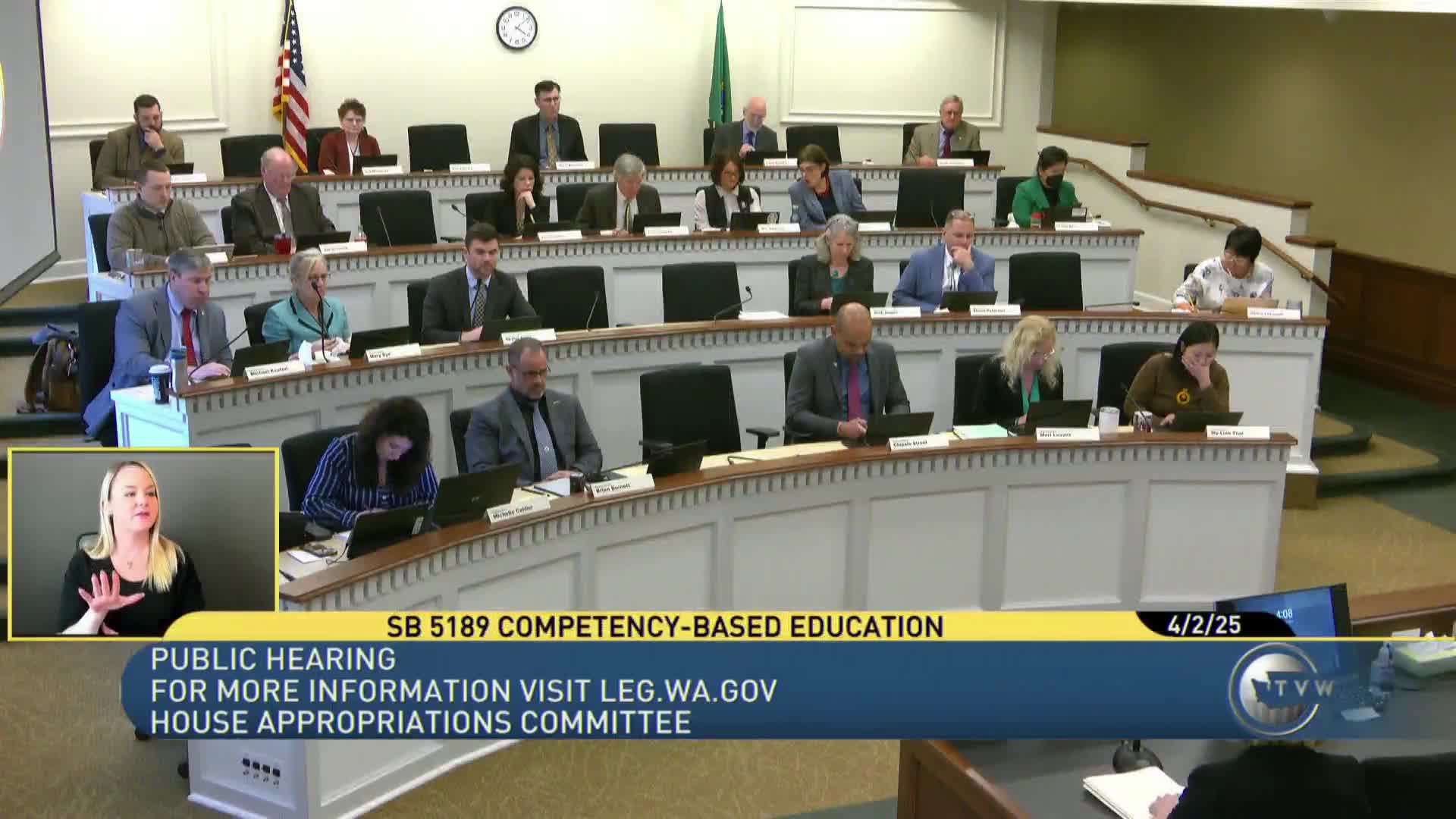
The Appropriations Committee received staff briefings and public testimony on Senate Bill 5189, which defines “competency‑based education” (also referred to in the bill as mastery‑based learning) and sets state processes to authorize full‑time enrollment funding for eligible competency‑based programs.
Ethan Moreno, nonpartisan staff to the House Education Committee, summarized the bill’s provisions and history. The bill defines competency‑based education with several elements (students progress after demonstrated mastery, explicit measurable competencies, transparency, and transferable learning outcomes). SB 5189 would require the Office of the Superintendent of Public Instruction (OSPI) to adopt rules by Sept. 1, 2025, allowing school districts to report full‑time equivalent (FTE) students enrolled in eligible competency‑based programs for general apportionment funding, and would direct the State Board of Education to recommend identification processes for schools and districts implementing the approach. The bill also directs OSPI to create competency statements aligned with state learning standards, update high school transcript formats, and asks the Washington Interscholastic Activities Association to review whether rules would create barriers for students in competency‑based programs.
Fiscal staff (Jordan Clark and others) and an education fiscal analyst briefed determinative costs: about $602,000 in the 2025‑27 biennium (including OSPI staff and contractor costs) and ongoing costs thereafter; the Senate budget contained funding to match the fiscal note. The briefing also noted uncertainty about future costs if many students convert from alternative learning experience (ALE) enrollment rates to basic education rates, which could increase state spending if a large number of students shift funding categories.
Public testimony included student supporters who described personal benefits: Nica Rondinelli, a student at Gibson Island High School (Issaquah), testified in favor, citing internship opportunities and career preparation. Srinaj Padi, a Lake Washington High School student, testified against the bill, raising concerns about high statewide implementation cost, teacher retraining, logistical disruption, and equity for underfunded districts. Dr. Vicky Murray of the Washington Policy Center testified in opposition, saying the evidence of effectiveness for competency models is “limited and mixed.”
Committee members did not take a committee vote in the hearing; staff and proponents emphasized rulemaking, costs, and the need to align transcript and activities policies with competency definitions.