Get Full Government Meeting Transcripts, Videos, & Alerts Forever!
Get email alerts on the Social Services Overpayments topic
No spam. Unsubscribe anytime.
Committee hears bill to waive recovery of some DSHS overpayments for older and disabled adults
Summary
The Appropriations Committee heard testimony on Senate Bill 5079, which would let DSHS waive collection of certain unintentional overpayments made to older and disabled adults; agency staff estimated a $204,000 annual general‑fund cost.
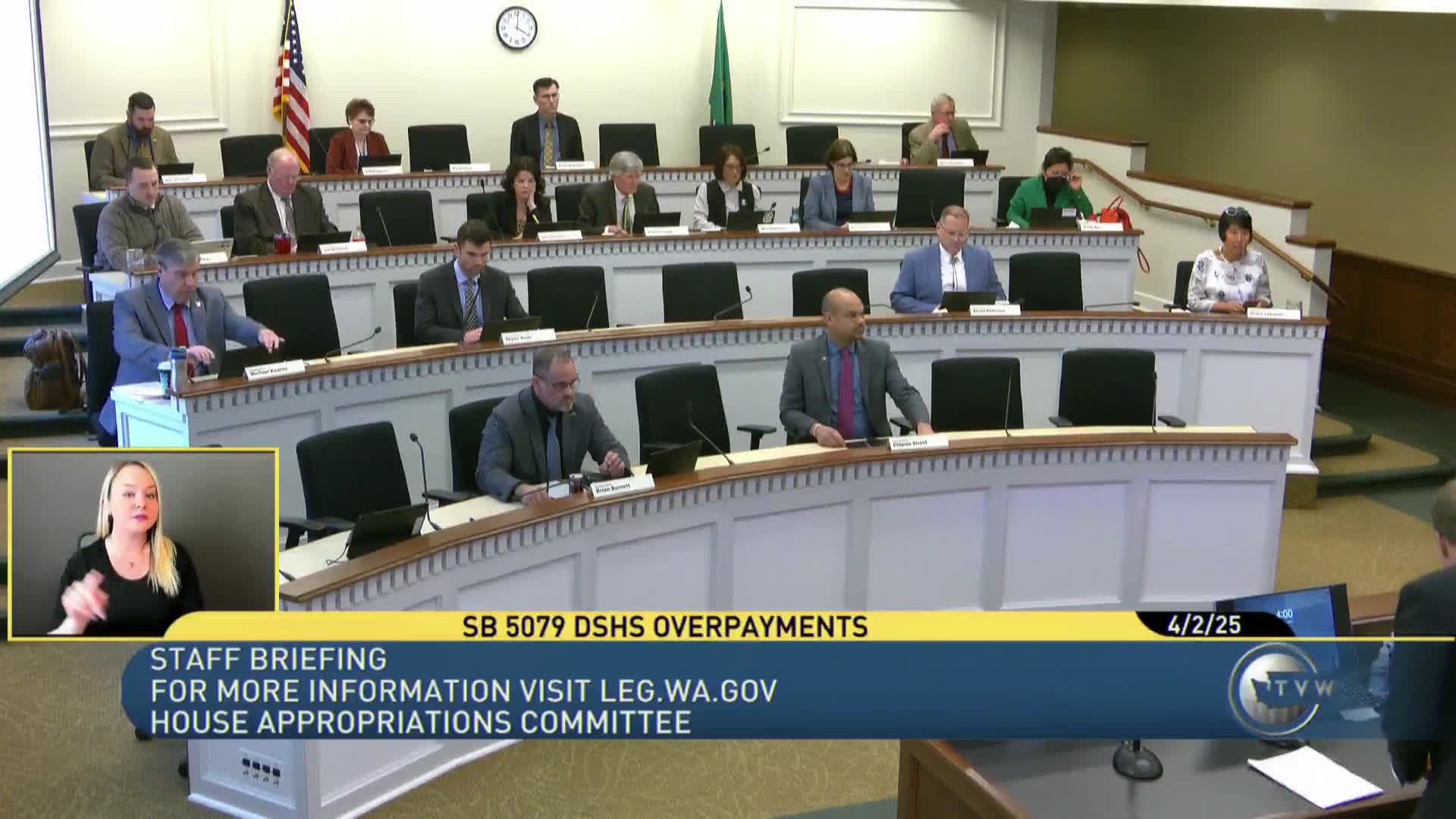
The Appropriations Committee heard testimony and briefings on Senate Bill 5079 on waiving collection of certain unintentional benefit overpayments by the Department of Social and Health Services (DSHS).
Omera Harrington, staff to the Early Learning and Human Services Committee, told the committee SB 5079 would authorize DSHS beginning July 1 to waive efforts to collect unintentional overpayments for the Aged, Blind, and Disabled (ABD) cash assistance program and for functionally disabled adults receiving long‑term support and developmental disability services. Harrington said the bill directs DSHS to adopt rules establishing the circumstances when collections would be waived and noted federal Medicaid rules require states to remit the federal share of overpayments to CMS.
Matt Mazerhart, committee fiscal staff, summarized the fiscal note and DSHS estimates: about $204,000 per year in general‑fund cost ($408,000 per biennium), largely from foregone ABD collections. According to the fiscal briefing, DSHS currently collects roughly $16,000 per month (about $191,000 per year) in ABD overpayments; the bill would eliminate most of that recoverable revenue but produce modest administrative savings (about $37,000 per year) from reduced collection activity. Mazerhart said the Senate budget includes the same amount in its proposal.
Carla Reyes, assistant secretary for the Economic Services Administration at DSHS, and Bryce Montgomery, director of the Community Services Division at DSHS, testified in support. Reyes said people served by ABD, long‑term services and supports, and DD waiver programs “have very limited means” and that recovering unintentional overpayments “challenges them and creates additional hardships.” Montgomery offered to answer technical questions about program administration; no committee questions were asked of the panel.
There was no formal committee vote recorded on SB 5079 during this hearing; the item moved to public testimony and then the committee closed the public hearing portion for that bill.
The bill retains DSHS discretion to accept offers of compromise, write off amounts no longer cost‑effective to pursue, and to establish rule criteria for waivers. Committee members and staff flagged the interaction between state waiver authority and federal Medicaid reporting requirements; Harrington reiterated that federal rules require states to remit the federal portion of any recovered Medicaid overpayment to CMS even when a state forgives or waives the state share, which is a constraint on how waivers can be applied.