Get Full Government Meeting Transcripts, Videos, & Alerts Forever!
Get email alerts on the Minor Subdivision topic
No spam. Unsubscribe anytime.
Plan Commission approves Edwards Acres three‑lot subdivision, requires drainage easement dedication
Summary
Clinton County Plan Commission granted primary approval for the Edwards Acres three‑lot minor subdivision (application 2025-00079) on the condition that the shared drainage easement be dedicated to the county Drainage Board before secondary approval; health department and drainage approvals are already on file.
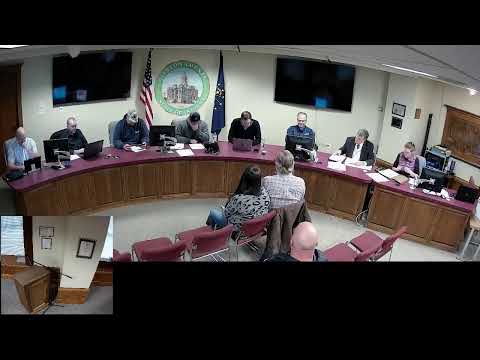
Clinton County Plan Commission granted primary approval Tuesday for Edwards Acres, a three‑lot minor subdivision petitioned by Paul and Celeste Edwards, subject to dedicating a shared drainage easement to the county Drainage Board before secondary approval.
Clinton County planning staff recommended primary approval of application 2025-00079 after the petitioners submitted revised, legally sufficient restrictive covenants and provided evidence of drainage‑plan and health‑department approvals. The commission voted unanimously in favor of the conditional primary plat.
The site consists of about 23.5 acres on the west side of 700 West between State Road 38 and 500 North in Section 16 of Madison Township, zoned agricultural and located roughly a half to 1 mile east of the Mulberry urban growth area boundary. The applicants seek to create three buildable lots: one of about 13.5 acres on the north end and two roughly 5‑acre lots. Planning staff said flood plain mapped along the northern edge of the tract primarily affects the 13.5‑acre lot, and soils and the flood plain prevented the petitioners from placing a fourth lot as originally considered.
Planning staff told the commission the drainage board approved the drainage plan on Jan. 20, 2025, and the Clinton County health department has approved septic systems for all three proposed lots. County Highway indicated no objection to driveway accesses, and the petition includes a reciprocal enforcement clause in the covenants. The planning presentation noted one remaining technical item during earlier reviews: the need to add rural development protection language to the covenants; staff reported that revised covenants had been submitted and reviewed.
Bob Gross of RW Gross and Associates, representing the petitioners, said the site’s contours and a legal drainage ditch cutting through the property will limit higher‑density development. “You may be able to get a few more lots there, but, you know, not saying it’s impossible,” Gross said, adding that sewer would be required for any substantially increased density because the soils are not suitable for more intensive septic use.
Petitioner Paul Edwards said he and his family intend to build on the 13.5‑acre lot as their “final dream home” and that, if prevented from doing so, they would keep the entire 23.5 acres intact rather than pursue denser subdivision. “We were going to build on the 13 and a half acres and make it our final dream home,” he said.
A motion to approve the primary plat with the condition that the shared drainage easement be dedicated to the Drainage Board before secondary approval carried on a roll call vote: Jordan Brewer, yes; Grant Mueller, yes; Dan Sheets, yes; Andy Bailey, yes; Jeff Chenoweth, yes; Chad Colby, yes. The commission instructed the petitioners to coordinate with county staff (including the county drainage contact) to complete the dedication and to amend certificates and the plat drawing as required; county staff will verify compliance before signing the secondary plat.
The commission and staff discussed whether the commission should require placement restrictions in the covenants (for example, siting houses to preserve potential future subdivision if sewer were extended from Mulberry). Staff noted those provisions could be added if the commission wishes to preserve the possibility of more intense development in the future, but no additional covenant siting requirement was imposed as a condition of primary approval.
What happens next: the petitioners must secure the drainage‑easement dedication to the Drainage Board before the county will accept a secondary plat; they must also amend certificates and drawings to reflect the dedication. Once those items are completed and verified by county staff, the commission’s designee will sign the secondary plat.