Get Full Government Meeting Transcripts, Videos, & Alerts Forever!
Get email alerts on the Community Solar topic
No spam. Unsubscribe anytime.
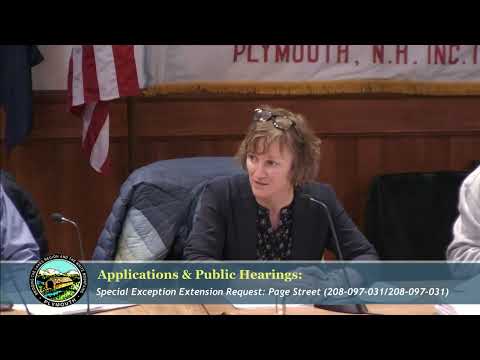
Plymouth board approves Pine Gate Cooperative community solar special exceptions, limits access road use
Summary
The zoning board approved two special exceptions for a community solar project proposed by Pine Gate Cooperative, accepted a $400,000 renewable-energy grant was received, and imposed a condition limiting use of an access driveway to maintenance for the life of the project at its current location.
The Plymouth Zoning Board approved two special exceptions for a proposed community solar array for the Pine Gate manufactured-housing cooperative and adopted a condition limiting use of a nearby access drive to maintenance of the solar project in its current location.
Carlson Swafford, attorney with the Energy Clinic at Vermont Law and Graduate School, told the board that the cooperative received a $400,000 award under New Hampshire’s Renewable Energy Fund and that the award supports a community solar project for low- and moderate-income residents in Plymouth. Swafford said the cooperative engaged Barrington Power, with Ted Van Zant present as the project engineer, to design and construct the array. Swafford said the award will fund “the Pine Gate Cooperative to build a 92.4” (transcript: unit not specified in meeting record).
Swafford requested two special exceptions from the Plymouth Zoning Ordinance: one to permit more than three accessory structures on a lot (the project’s three panel arrays will be counted as separate structures) and one to allow an eight-foot fence where code generally limits fence height to six feet without special permission. The project team explained that the taller fence is proposed for electrical safety and security. Van Zant, the engineer, told the board that electrical gear will sit behind the front array, that a new utility pole will be installed for interconnection, and that the inverters and disconnects will be mounted on or behind the arrays; he confirmed the system will not use battery storage.
Jeannie Oliver, vice president of ROC New Hampshire at the New Hampshire Community Loan Fund, spoke in support and described community solar as a mechanism to deliver rent credits to cooperative members: she explained the cooperative will sell electricity into the New Hampshire Electric Co-op and then annualize the revenue as lot-rent credits so the benefit does not count as income for participating households.
An abutter, David Goodwin, told the board he had no objection to the solar equipment itself but asked the board to limit use of an existing dirt access drive because of concerns about headlight glare and vehicle traffic near his property line. Board members agreed to make a formal condition: the access drive may be used only for construction and ongoing maintenance of the solar project, and any future proposal to expand or change that access would require a separate review. At the meeting the board clarified that the conditional restriction applies to the drive’s current location and that changes to the access route or expanded use would require additional approvals and notice.
Board members reviewed findings of fact, including that the project will keep existing vegetation for visual screening to the maximum extent practicable, that the property at roughly 1.31 acres has been merged with the manufactured-housing park acreage to create a contiguous parcel, and that the applicant had filed for site plan review with the Planning Board (scheduled for April 17, per the applicant). The board concluded the two special exceptions met the ordinance criteria and voted to approve them, subject to the access-road condition limiting use to project maintenance and access in the current location for the life of the use. The board also recorded that one existing shed on the site will be removed while one will remain in use.
The board’s approval includes the following practical details discussed on the record: the project will use a new utility pole and trench for interconnection to the New Hampshire Electric Co-op; the arrays are expected to be up to about 12 feet tall at their highest point; maintenance is minimal (applicant estimated roughly one maintenance visit and annual mowing); and the project team will advocate to place electrical gear inside the fenced area for security and to work with the fire chief on access.
Votes at a glance: The zoning board approved two special exceptions for the Pine Gate Cooperative community solar project and attached a condition restricting the access drive to maintenance and project use in its current location. The project team will continue through Planning Board site-plan review and permitting.