Get Full Government Meeting Transcripts, Videos, & Alerts Forever!
Get email alerts on the Ems Consolidation topic
No spam. Unsubscribe anytime.
Greene County officials discuss consolidating EMS into single county system to address staffing and finance gaps
Summary
Local leaders and EMS staff reviewed an outline for a consolidated countywide emergency medical services system, focusing on staffing, fleet inventories, funding options and timing; no formal decision or vote was recorded.
Greene County officials, town representatives and EMS personnel spent a two-hour meeting reviewing a plan to consolidate multiple local ambulance agencies into a single countywide system, focusing on workforce shortages, equipment inventories and possible funding through a new taxing jurisdiction.
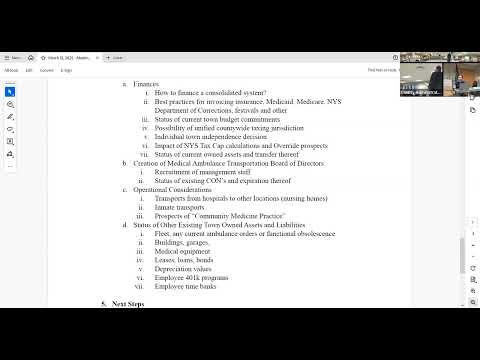
County staff presented the results of two staff/field sessions and a set of handouts that included fleet and facility inventories and summaries of outside studies. The presenter said the materials are an initial inventory and that departments had been “very engaged in discussion” during the smaller sessions. “All I’m doing is I’m going to develop an operational budget,” said Sean Daddio, who the group identified as the lead staff contact for producing cost estimates and a consolidation timetable. “Then we have to decide” how town contributions are applied if the county takes over operations, he said.
The discussion centered on three interlocking problems: workforce shortfalls that prevent running more rigs, inconsistent training and equipment across independent agencies, and the money needed to operate a larger consolidated system. Participants cited current annual municipal contributions of about $4.6 million from towns and roughly $2.5 million from the county as baseline revenue; they also noted “about $2,000,000 plus or minus in invoicing” currently collected by existing providers. Town and county leaders asked whether those town payments would shift to the county, be discounted, or be phased in.
Why it matters: EMS access is time-sensitive and relies on sustained staffing and equipment. Countywide consolidation would affect budgets, tax calculations and local control. The presenters said the governor’s proposed budget includes language to permit creation of a special taxing district for EMS but warned that draft language also sought an exclusion from the state tax-cap calculation — an item that some legislators are likely to oppose. The group noted uncertainty in the state budget process could affect timing.
Key operational points
- Staffing: The working target discussed by EMS leaders and county staff was a 12-rig daytime system and about 9 rigs at night, but attendees emphasized that putting that many rigs on the road depends on recruiting and retaining personnel. Presenters used a relief factor (coverage multiplier) to estimate needed hires; the transcript records a 1.6 relief factor to account for vacation, sick time, training and overtime. Using that factor, participants estimated a workforce on the order of several dozen full‑time equivalents (examples cited range from about 60 to 92 employees depending on assumptions about two‑person rigs and relief coverage).
- Recruitment and pay: Local EMS staff and several town representatives said agency-hopping — workers taking shifts across multiple independent providers — is common today and that a consolidated pay/benefit package might reduce that churn. The county’s current scholarship program was cited as $15,000 per year to support training; the group discussed whether to expand paid training and require service commitments. Mark Evans, an EMS staff member who spoke about recruitment, said paramedic training is “difficult” but that Greene County’s specialty rescue teams and training partnerships help attract applicants.
- Service model and clinical options: Attendees agreed the existing “fly-car” (paramedic response/first-response) model is not broken, but there was debate over whether to preserve fly cars, expand them, or merge fly-car ALS services with BLS transport units. Participants also discussed community paramedicine and triage-at-dispatch models that can avoid unnecessary ambulance transports by sending lower‑acuity responses or arranging follow-up, and the possibility of invoicing for certain non-transport treatments.
- Fleet, facilities and assets: County staff said they circulated a survey of fleet, equipment and facility inventories and asked agencies to provide depreciation and ownership information so the county can build a capital budget. Towns raised questions about how recently purchased rigs and station real estate would be treated if ownership transfers to a consolidated system (buyouts, credits, depreciation schedules or continued local ownership and rental arrangements were all discussed).
- Funding options and timing: Presenters described three broad ways to fund a consolidated system: (1) create a special district funded by an ad valorem tax across participating parcels (the packet referenced state legislation that would enable special taxing districts), (2) shift existing town levies to county appropriations, or (3) a phased transition over multiple years. Attendees discussed whether towns would see immediate budget relief if their existing payments were folded into a county budget, and whether the county would need to exceed the state tax cap in year one to establish higher pay and benefits. The group agreed to aim for budget decisions in time for the towns’ and county’s next budget cycles and discussed a phased implementation that could begin organizationally in the third or fourth quarter of the year with a potential operational “go-live” of Jan. 1 the following year.
What was not decided
No formal vote or motion was recorded at the meeting. Leaders asked staff to produce a detailed operational budget and staffing model, and to return with wage-and-benefit proposals and options for phasing. Attendees said towns need more concrete hour/pay/benefit numbers to present to their boards and asked staff to return with scenarios showing how town levies, county contributions and any new debt service would interact.
Concerns and constraints
Participants repeatedly stressed recruitment and retention as the system’s principal constraint. Several town representatives asked how consolidation would affect employee assignments and whether employees would be required to relocate or accept different home stations; presenters and town officials discussed bids, seniority and collective-bargaining implications. The county staff said seniority, titles and any union representation would be settled in collective bargaining and that PERB (the Public Employment Relations Board) processes could take months if multiple unions petition to represent the combined workforce.
Next steps
County staff committed to produce a draft operational budget, sample wage/benefit tiers, and a roster-based estimate of how many full‑time and part‑time personnel would be needed to sustain a target 12/9 rig model. Towns were asked to review how they would prefer to phase payments and whether they would accept immediate removal of town levies in exchange for a county assessment or a multi-year transition. A follow-up meeting was scheduled for roughly one month.
Ending
Participants described consolidation as politically and operationally complex but necessary to address chronic staffing shortfalls and uneven equipment and billing practices. The meeting closed with agreement to return with numbers and scenarios that boards and town councils could evaluate in their respective budget cycles.