Get Full Government Meeting Transcripts, Videos, & Alerts Forever!
Get email alerts on the Trade Tariffs topic
No spam. Unsubscribe anytime.
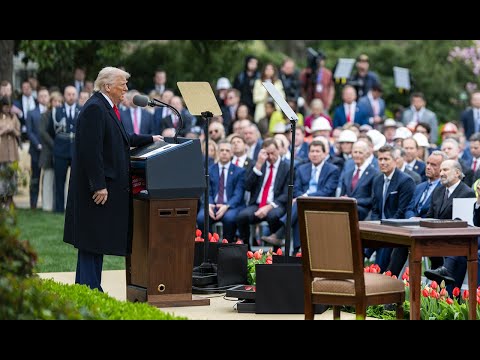
Trump signs reciprocal-tariff order, says 25% auto tariff takes effect at midnight
Summary
President Donald J. Trump signed a reciprocal-tariff executive order and a second document to close a de minimis imports loophole, announcing a 25% tariff on foreign-made autos and a minimum 10% baseline tariff while listing country-specific rates as he described them.
President Donald J. Trump signed an executive order instituting reciprocal tariffs and a second document aimed at closing a so-called "de minimis" loophole for imports from China, saying the move would take effect immediately for some measures and that a 25% tariff on foreign-made automobiles would begin at midnight.
Trump framed the action as a reversal of decades of U.S. trade policy. "In a few moments, I will sign a historic executive order instituting reciprocal tariffs on countries throughout the world," he said, and later declared, "effective at midnight, we will impose a 25% tariff on all foreign made automobiles." He said the administration would calculate combined rates of tariffs and nonmonetary trade barriers and impose a discounted reciprocal rate roughly half of those combined rates.
The president said the order also establishes a minimum baseline tariff of 10% and listed country-specific figures "as stated by the president": China 67% (reciprocal rate cited as 34%), European Union 39% (20%), Vietnam 90% (46%), Taiwan 64% (32%), Japan 46% (24%), India 52% (noted as "very, very tough"), and a range of other examples. Trump described the approach as "kind reciprocal" because the administration would not charge the full calculated rate but approximately half.
A White House staff member told the assembled audience that two documents were prepared for the president's signature: one to close the de minimis loophole with respect to imports from the People's Republic of China and the other the larger reciprocal-tariff executive order. "This is obviously a huge deal, and it's been an honor to be a part of your team getting this ready for you, sir," the staff member said.
At the event, a visitor who identified himself as Brian, saying he grew up north of Detroit and brought UAW members, praised the move as a turnaround for local manufacturing. "Donald Trump's policies are gonna bring product back into those underutilized plants," Brian said, adding that he expected benefits within months.
Trump also cited specific company investment commitments he said were reacting to the policy, naming Apple, TSMC, Nvidia, Johnson & Johnson, Eli Lilly, Meta, Merck and others and giving large dollar figures for those commitments as he spoke. The administration did not provide documents or independent verification of the investment figures during the remarks.
The president tied the tariff action to a broader policy agenda that he said will include tax cuts and incentives for domestic production; he described proposals such as an interest-rate deduction for loans tied to cars built only in the United States. Details about exemptions, implementation procedures, and administrative review processes were not specified during the remarks.
A White House staff member said the documents were ready for signature; the transcript records the staff briefing that "1 closes what's referred to as the de minimis loophole... The other is the big 1 is the reciprocal tariff executive order that the president just spoke about at length." The transcript does not record additional legal text or guidance on implementation timelines beyond the president's statements about "midnight" for the automobile tariff and "starting tomorrow" for broader reciprocal tariffs.
What happens next: the remarks and the staff briefing indicate the administration intends to implement the measures immediately for some items, but the transcript does not include the executive order text, implementing regulations, a published schedule of tariff lines, or details on exemptions or dispute-resolution procedures. The statements in the event represent the administration's account of planned policy; further documents or agency announcements will be needed to determine exact legal and economic effects.