Get Full Government Meeting Transcripts, Videos, & Alerts Forever!
Get email alerts on the Right Of Way Permitting topic
No spam. Unsubscribe anytime.
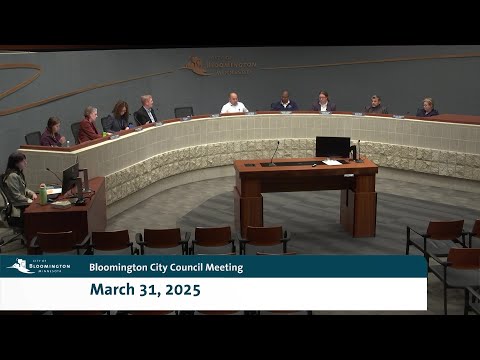
Bloomington council adopts changes to right-of-way permitting, sets winter moratorium and new fees
Summary
The City Council voted 6-0 March 31 to amend City Code Chapter 17 and Appendix A to change right-of-way permit fees, require substantial restoration before additional permits, set a winter moratorium and remove a separate registration requirement.
Bloomington City Council on March 31 adopted an ordinance that updates the city’s right-of-way permitting and management rules, changing how the city charges for underground and aerial permits, adding restoration enforcement tools, codifying a winter moratorium and removing a local registration requirement.
The amendment, which modifies City Code Chapter 17 and Appendix A, passed on a 6-0 vote. Council also authorized summary publication of the ordinance.
City engineering staff told the council the changes respond to a surge in utility work in 2024 — driven largely by fiber-to-home installations — and repeated resident complaints about slow or poor restoration after trenching. Brian Hanson, staff presenting the item, told the council the city permitted roughly 1.6 million feet of underground and aerial work in 2024 and ran into capacity and restoration problems. He said staff is proposing four main changes: a new per-foot fee structure, clearer restoration requirements, defined winter moratorium dates and removal of a standalone city registration from the code to align with current business practice.
Under the new fee structure, the right-of-way underground permit will have a $150 base up to 100 feet and then a 30¢ per-foot charge beyond 100 feet; aerial permits will have a $120 base up to 100 feet and then 15¢ per foot after that. The city will remove a separate $36 processing fee. Hanson said an example effect is that the largest currently allowed underground permit would see a higher charge (to roughly the mid‑$900 range for a full-length permit), while comparable aerial permits would be cheaper under the new schedule because their review and inspection demands are lower.
To address restoration complaints, the code will require “substantial restoration” (defined in the staff proposal as at least 75% complete) before additional permits will be issued for the same contractor in the same service area and will set a 50,000 linear-foot in-progress maximum per applicant unless authorized by the city engineer. Hanson said that cap was chosen to allow typical service areas to be covered with a single permit while giving the city engineer discretion to extend an applicant’s allowance when appropriate.
The amendment also codifies a winter moratorium on hard-surface excavation from Nov. 15 through April 15 (or when conditions are unreasonable), language the presenter said mirrors Dakota County practice. Hanson said soft-surface restoration work may continue when conditions allow and that contractors remain responsible for warranty repairs for two years after restoration.
Finally, staff proposed removing a code requirement that applicants register locally, noting the State of Minnesota’s Department of Labor and Industry maintains licensure, bond and insurance records and staff already verifies those online before issuing permits. Hanson emphasized the change “does not relieve applicants of the requirements of the registration” (licensure, bond, certificate of insurance), only removes duplicate language from city code to reflect current practice.
Council members asked about enforcement and how residents would identify contractors. Hanson said residents should first contact the contractor, but the city will accept citizens’ calls and escalate cases when needed; staff will also maintain a webpage listing providers and an engineering contact number. He said staff will track fees and staff time and review the fee schedule at the end of the year to confirm cost recovery and adjust if needed.
The council adopted the ordinance and later approved summary publication, both by 6-0 votes. The ordinance is intended to streamline permitting, strengthen restoration requirements and provide clearer expectations for residents and utility providers.
Ending: The ordinance takes effect following summary publication per city code; staff said they will return at year-end with a fee-recovery review and will enforce restoration and warranty provisions during the upcoming construction season.