Get Full Government Meeting Transcripts, Videos, & Alerts Forever!
Get email alerts on the Historic Preservation Ordinance topic
No spam. Unsubscribe anytime.
Augusta commissioners meet with preservation board, weigh changes to appeals, enforcement and training
Summary
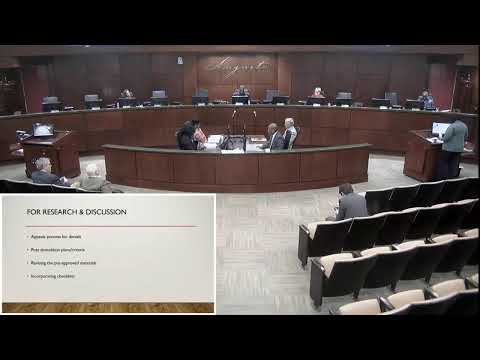
Augusta commissioners held a special work session on the city’s historic‑preservation ordinance, focusing on enforcement powers, the appeals process for denied certificates of appropriateness (COAs), board training and administrative improvements such as online COA submission.
Augusta commissioners held a special work session on the city’s historic‑preservation ordinance, focusing on enforcement powers, the appeals process for denied certificates of appropriateness (COAs), board training and administrative improvements such as online COA submission.
The meeting, called by Commissioner Catherine Smith Rice, assembled the Historic Preservation Commission (HPC), representatives of Historic Augusta and staff from the Planning and Development Department to discuss language in the ordinance that commission members and staff said is vague or creates procedural burdens for applicants.
Why it matters: The HPC regulates changes in three named historic districts — Somerville, Downtown Augusta and Old Town — and its decisions affect federal and state tax incentives and downtown redevelopment. Commissioners and preservation advocates said uncertain rules or a lengthy appeals path can discourage maintenance or rehabilitation and risk leaving cleared sites undeveloped.
David Barbee, chair of the Historic Preservation Commission, described how the COA process operates and the commission’s experience approving most requests. “I would say 90% of the COAs that have been brought before us, we have approved,” Barbee said, explaining that approved COAs are valid for six months and applicants may appeal denials through an established process that includes mediation/arbitration and then the commission.
Eric Montgomery, executive director of Historic Augusta, described the role of his nonprofit and summarized preservation incentives: two state investment tax credits and one federal incentive available to certified rehabilitations, and a property‑tax assessment freeze that typically runs about 10 years when applicable. Montgomery recommended clearer guidance for applicants and said Historic Augusta volunteers regularly prepare advisory reports for HPC and planning staff.
Planning and Development Director Carla Delaney briefed commissioners on administrative and enforcement issues. Delaney said the department lost a long‑experienced code‑enforcement staffer in 2023, which has complicated enforcement and contributed to a permit backlog. She reported a recent surge in permit applications — about a 150% increase in commercial permit requests and a 200% increase in residential permit requests — and proposed several administrative steps, including online COA submissions, clearer checklists, updated preapproved materials lists and periodic updates to the district guidelines.
Multiple commissioners, including Commissioner Scott and Commissioner Slendak, and Mayor (unnamed) raised objections to the current appeals path, which requires applicants to pursue arbitration before the governing commission. “I see that as a problem,” the mayor said, citing the cost to property owners of hiring attorneys for arbitration. Several commissioners asked staff and legal counsel to draft alternate language that would make the governing commission the first review step after an HPC denial, rather than arbitration, and return that language for the commission’s consideration.
On enforcement, Barbee and others said the ordinance currently lacks effective enforcement “teeth.” Delaney and Attorney Plunkett noted there is existing county code language that allows fines (Plunkett said the code provides for penalties up to $500 per incident or per day), but HPC members pressed for clearer, more enforceable processes and for authority that would let code enforcement act when a property is unsafe or falls into blight.
Commissioners and staff also discussed the ordinance requirement for a post‑demolition plan when applicants propose demolition of contributing buildings. Staff warned that removing the post‑demolition requirement risks producing empty lots or surface parking if redevelopment fails to proceed; Barbee and others cited past examples where demolition was approved and the promised replacement project did not materialize.
Training and board development were recurring themes. Delaney said the Planning and Development Department has proposed funding to update guidelines and to support training; she described options to send HPC members to existing sessions in other Georgia cities or to host a training locally (she estimated a per‑person registration when hosted in another city at roughly $275 and said bringing a trainer to Augusta would cost “thousands,” depending on scale). Commissioners asked staff to identify budget and scheduling options so volunteers would not have to front travel or registration costs.
The body agreed on next steps that staff and counsel would draft and present back to the commission: (1) proposed ordinance edits and clarifications (including clearer language about citations and enforcement scope), (2) alternate appeals-path language for HPC denials (options that would move first review to the governing commission and then mediation/arbitration), (3) a plan for board training that minimizes out‑of‑pocket costs for volunteers, and (4) operational improvements such as online COA submission, updated checklists and an updated preapproved materials list. No formal votes were taken at the work session.
The meeting closed with commissioners asking staff to bring proposed language and options to the next committee cycle so the governing body could consider adopting changes.