Get Full Government Meeting Transcripts, Videos, & Alerts Forever!
Get email alerts on the Rezoning Access Variance topic
No spam. Unsubscribe anytime.
Planning commission denies 72‑unit Goshen Circle townhome rezoning and related subdivision variance after strong neighborhood opposition
Summary
The commission rejected JSMG Development's request to rezone 11.3 acres for 72 townhomes and denied a subdivision variance allowing a single access point; staff and traffic engineering opposed approval and residents cited safety and single‑access concerns.
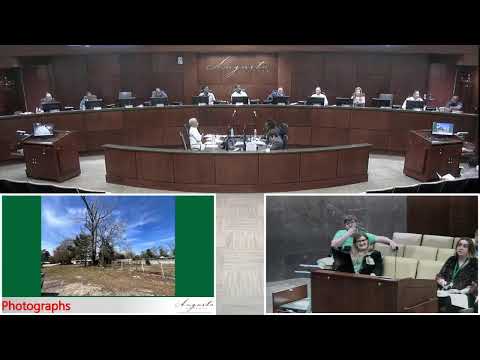
Augusta Planning Commission on April 2 denied a rezoning request (Z‑25‑17) and a related subdivision variance that would have allowed a 72‑unit townhome development with a single entrance on Goshen Circle. The denial followed staff findings that the project exceeds allowable cumulative access limits and a traffic engineering recommendation against the variance.
Brian Kepner, zoning administrator, presented the application and noted the tract is about 11.31 acres; the concept plan proposed 72 attached townhome lots, a density of 6.3 dwelling units per acre, 32% open space and extension of Goshen Circle by roughly 1,400 feet to loop through the site. Kepner said public sanitary sewer would need to be extended roughly 125 feet and that the cumulative lot count for Goshen Retreat (95 existing lots) plus the proposed 72 units would total 187, triggering the subdivision regulation that requires two entrances for contiguous developments of 100–200 lots (section 30‑200 of the land subdivision regulations). He said the site has only one practical access point because two sides are bounded by the golf course and the other adjoins land whose only existing access also runs to Goshen Lake Drive South.
Developers and residents debated safety and traffic at length. Mark Green and Justin Bolling of JSMG Development said the project’s density is consistent with the 2023 comprehensive plan and that the developer would extend Goshen Circle and pay the cost of roadway construction. Philip Green, representing JSMG on some answers, said the open‑space percentage does not include detention areas and confirmed the developer would cover roadway extensions.
Neighbors mounted strong opposition. Linda Williams, president of the Goshen Retreat Residents Association, said the community has a single entrance and circulated a petition she said contained hundreds of signatures; she and others argued a single access point would create safety and emergency‑response problems, that sidewalks and curbs are lacking, and that existing storm drains and roads are deteriorating. Fred Ogden, a longtime resident, compared the current petition to a 2022 application; he and others said their neighborhood could absorb modest growth in single‑family homes but not a dense 72‑unit project. Several speakers expressed concern that prior promises about “townhome” developments elsewhere in the area had been followed by rental apartments in practice.
Traffic engineering weighed against the variance. During the meeting staff reported that, after the hearing started, the assistant director of traffic engineering notified planning staff that the subdivision variance was not recommended. Planning staff therefore recommended denial of both the variance and the rezoning; staff added that if the commission considered an approval it should cap the number of units in any approval to avoid leaving an open-ended entitlement.
Commissioner discussion urged negotiation between developer and neighbors, but the motion to deny the subdivision variance (25‑02) and rezoning (Z‑25‑17) carried on a voice vote. Commissioners noted the practical constraints of a single access and the neighborhood’s safety concerns; staff emphasized that any future application should address access, emergency response, and road upgrades.
Why it matters: The decision keeps in place the current zoning and preserves the neighborhood’s single‑access configuration for now; it also demonstrates the commission’s reliance on subdivision regulations that base entrance requirements on cumulative development rather than phase by phase approvals.
Next steps: The developer may revise the concept, seek additional property or access, or return with a proposal that addresses traffic/variance concerns and emergency access.